











For enterprise teams, the real challenge is not launching a digital adoption platform. It is governing it as adoption expands across applications, teams, and release cycles. As more workflows, business units, and authors come into scope, content becomes harder to keep accurate, consistent, and aligned.
That is where many DAP programs start to lose control. Without a governed operating model, ownership becomes unclear, duplicate assets build up, and releases make content harder to maintain at scale. This guide explains how to build a DAP Center of Enablement, govern content across the lifecycle, and evaluate what to look for in a platform built for enterprise-scale control.
Why enterprise DAP programs stall after early success
After the initial rollout, the challenge shifts from adoption to control. Demand rises, but standards, ownership, and lifecycle discipline often lag behind, making the program harder to govern, maintain, and scale.
The hidden cost of siloed DAP growth
When DAP content is managed separately by teams or functions, duplicate guidance starts to appear, standards begin to drift, and success metrics stop rolling up cleanly. That fragmentation creates inconsistent user experiences across applications, business units, and regions, which limits visibility and weakens enterprise impact.
Why more authors do not solve the problem
Adding more creators can increase publishing output, but without shared governance it usually increases sprawl. Content production goes up, yet trust in the system drops because naming, structure, approvals, and reuse become harder to control at scale. What enterprise teams actually need is not more content volume, but content that stays governed, reusable, and reliable.
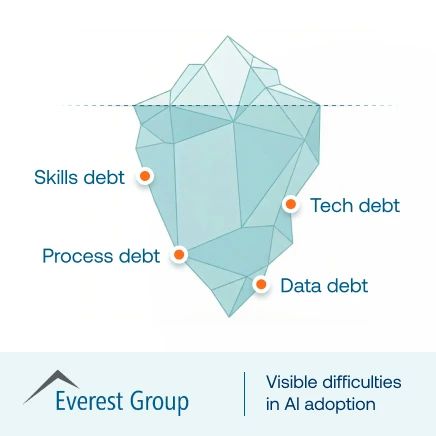
The governance debt that builds after go-live
Most governance problems appear after rollout. Assets become outdated, workflows break after UI or process changes, approvals become unclear, localization falls behind, and no clear refresh cadence exists to keep guidance aligned to the current application state. Over time, that debt affects workflow execution, increases support burden, and makes it harder for leaders to trust that the DAP program is scaling in a controlled way.
The need for a DAP center of enablement
As a DAP program expands across teams, applications, and regions, informal governance stops working. It needs a control layer that governs how digital adoption is requested, created, reviewed, released, measured, and scaled. That is the role of a DAP Center of Enablement.
A center of enablement is not a content factory
A CoE should not exist to fulfill every content request that enters the queue. Its role is to set standards, govern prioritization, and create the operating discipline that keeps the program scalable. A high-performing DAP CoE governs quality and scale, not just content output.
What the CoE governs in a multi-app environment
A strong CoE governs the operating layer behind digital adoption. This includes intake, standards, templates, approvals, release management, localization, refreshes, and measurement.
In enterprise environments, these governance controls must work consistently across ERP, CRM, HCM, ITSM, portals, and other shared systems used by different teams and regions. The CoE creates that consistency so adoption does not fragment by application, function, or geography.
What operating model works best
There is no single model that fits every enterprise, but most large programs benefit from a hybrid structure. Central governance should define standards, controls, and measurement, while execution remains distributed across workflow owners or application teams. This balance keeps the program governed without making the CoE slow, over-centralized, or resource-heavy.
Ownership structure of a DAP center of enablement
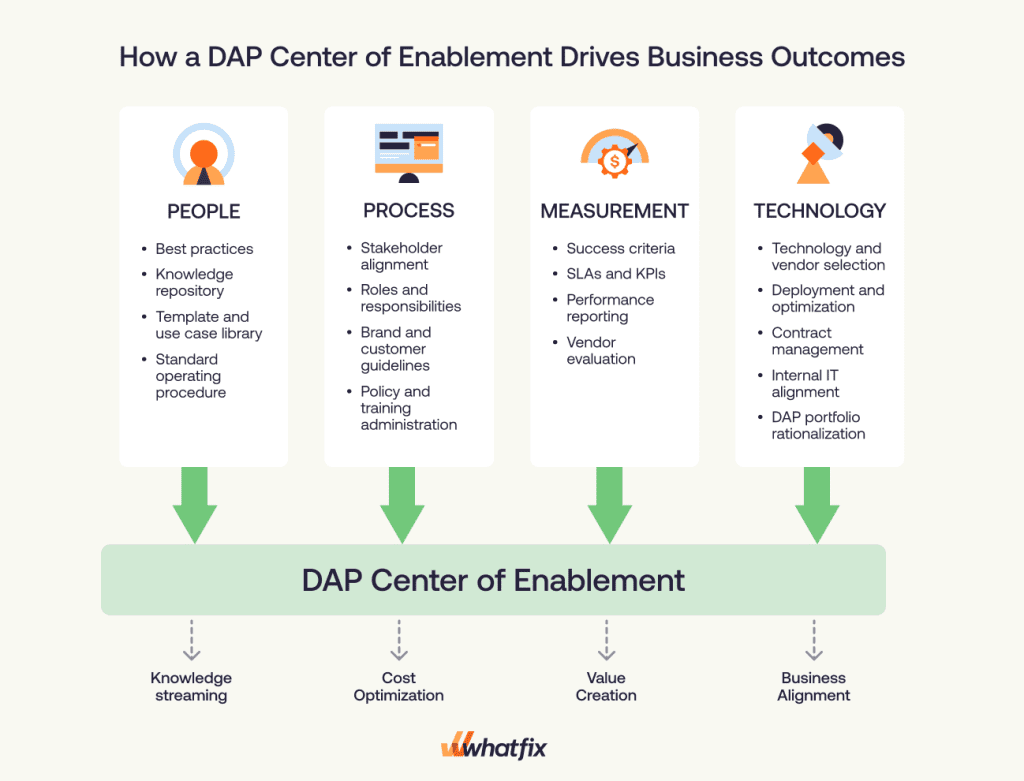
A DAP Center of Enablement only works when it runs like a management system, not an informal support layer. A CoE must clearly define what is centralized, what stays with workflow or application teams, and who owns each decision. The model should stay lean, but disciplined.
Standards and reusable systems
The CoE must own the shared systems that make content scalable across teams, applications, and regions. Without a common foundation, each team creates its own logic for how guidance is built, named, and maintained, which quickly creates duplication and drift.
That shared foundation should include:
- authoring standards
- naming conventions
- standard operating procedures
- template libraries
- approved design patterns
- use-case libraries organized by workflow type
These systems reduce duplication, improve consistency, and make it easier for distributed teams to build within a common model instead of starting from scratch every time.
Roles, responsibilities, and approvals
The operating model must clearly define who does what across the content lifecycle because this is where most DAP programs break down after go-live.
At a minimum, the CoE should define:
- who can request content
- who prioritizes requests
- who builds content
- who reviews content
- who approves publication
- who owns post-launch maintenance
The goal is not to add layers of process. It is to create clear decision rights so the program can scale without confusion.
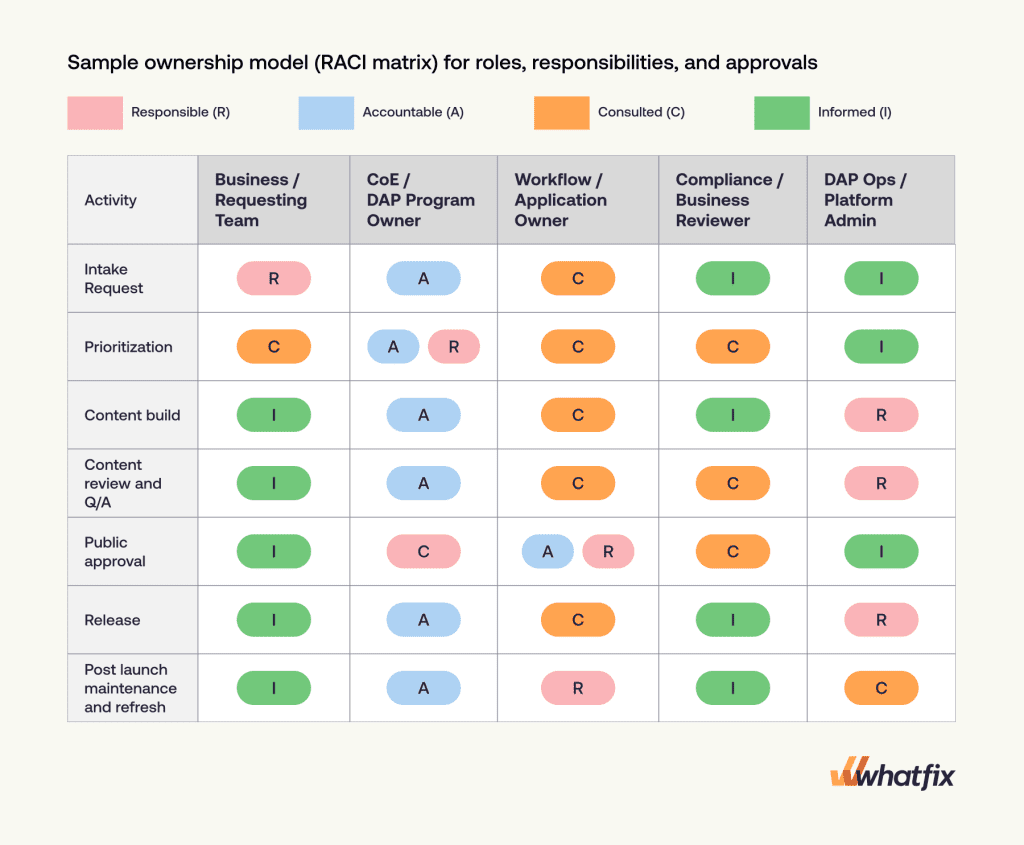
Governance and escalation paths
A mature CoE also needs clear publishing guardrails. Teams must know what can move through a standard path, what requires workflow-owner input, what requires compliance review, and what should be escalated as an exception.
Governance should create control without creating bureaucracy. The objective is to give teams enough structure to make consistent decisions while keeping enterprise guardrails intact.
Measurement and reporting
The CoE must connect project-level performance to enterprise scorecards. Reporting should go beyond content activity and show whether governed content is improving workflow execution, reducing friction, and supporting broader transformation goals.
Monthly reporting should stay focused on a few signals:
- governance health
- adoption outcomes
- priority risks
- issues that need executive visibility
Vendor and platform oversight
The CoE should also own platform and vendor oversight so the DAP program does not fragment across tools, teams, or unmanaged experiments. DAP vendor involvement must not end after implementation, especially in enterprise environments where governance, lifecycle control, and scale need ongoing support.
The vendor must remain part of the operating model through best practices, enablement support, performance tracking, and guidance as the program matures. This helps the CoE scale with more structure and less reinvention.
Whatfix is built to support that model. Beyond DAP implementation, it provides dedicated enablement support, author training, and a customer delivery approach designed for governed scale, not just platform rollout. That makes it a stronger fit for teams building a CoE and formalizing the operating model around digital adoption.
How to operationalize content governance
Content governance must run like an operating system, not a documentation exercise. The goal is to make sure the right content gets built, released, maintained, and measured across applications, teams, and release cycles.
Set the content lifecycle management operating model first
Start by defining the control model before defining the content. Clarify what the CoE owns, what workflow or application teams own, who has decision rights, and which approvals stay centralized.
For most enterprises a hybrid model works best, where:
- the CoE owns standards, governance, prioritization, and measurement
- workflow or application teams own business context and validation
- DAP ops handles execution within defined controls
Build content intake and prioritization
Do not treat every request as equally urgent. Intake must protect the roadmap and focus the CoE on content that supports critical workflows, releases, or business outcomes.
A valid request should include:
- target application and workflow
- business problem being solved
- audience and user scale
- release or compliance dependency
- expected outcome metric
Prioritize requests by workflow criticality, business impact, release impact, compliance risk, user scale, and support burden. If a request does not map to a priority workflow or measurable friction point, it should not automatically enter the queue.
Define content taxonomy, naming, and structure
This is where many DAP teams create content debt. If assets are not structured consistently, the library becomes hard to search, reuse, govern, and refresh.
The DAP program manager should standardize:
- naming conventions by content type
- metadata for app, workflow, role, region, and owner
- version labels and status labels
- template hierarchy for reusable patterns
- rules for global versus local content
Every asset should be easy to identify by application, workflow, audience, lifecycle state, and current version. If the system cannot support that, it will not scale cleanly.
Build lifecycle controls
Treat DAP content like release-managed production assets, not ad hoc publishing. Each asset must move through a defined lifecycle with clear owners, rules, and exit criteria.
A strong lifecycle includes:
- draft
- QA
- approval
- staging
- rollout
- rollback
- archive
- refresh
Every asset should answer five questions:
- who owns it
- what workflow it supports
- what version it reflects
- when it was last validated
- when it must be reviewed again
That is what separates a governed library from an expanding pile of content.
Govern for release management and change
Most DAP governance failures show up during releases. UI updates, process changes, and policy shifts expose whether content ownership and refresh discipline are actually operationalized.
The CoE must align to the release calendar and define:
- which releases require content review
- which assets need regression testing
- update SLAs after workflow or UI changes
- who validates content after release
- when urgent hotfixes bypass the normal queue
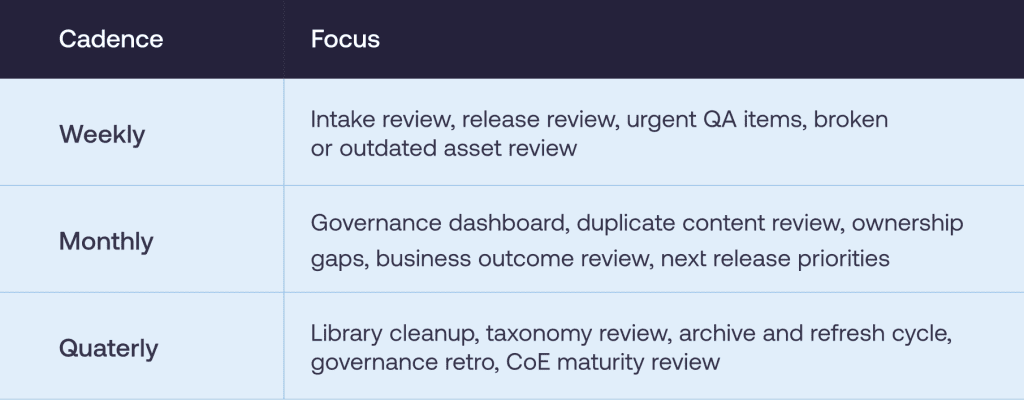
Design a content operating cadence
Programs drift when cadence is weak. Governance holds through recurring review loops that keep ownership visible, surface risk early, and pushes teams to maintain the library as applications and workflows change.
This cadence keeps the queue healthy, keeps ownership visible, and prevents long-term governance debt from building quietly. Suggested cadence:
Create a scalable localization and regional model
Localization must be part of governance from the start, not a patch after rollout. Without a defined model, regional content quickly fragments into disconnected copies that are hard to maintain and easy to miss during releases.
Define:
- who initiates translation requests
- which assets are global versus regional
- who owns localized versions
- what approvals differ by geography
- how source updates cascade into translated assets
The lifecycle metrics that show whether DAP governance is working
A DAP CoE should measure two things. First, whether content governance is keeping the library controlled and current. Second, whether that governed content is improving workflow execution. The cleanest model is one primary operating metric supported by a small set of governance and business outcome metrics. This keeps reporting focused on value, not activity volume.
Primary operating metric: Content freshness rate for priority workflows
The strongest primary metric is content freshness rate for priority workflows. This is the percentage of guidance assets tied to priority workflows that are current, approved, and validated against the latest application state within the defined review window.
This metric is useful because it measures what the CoE is expected to control. It shows whether critical guidance remains trustworthy as releases, UI changes, and process updates happen.
Supporting governance metrics
These are the signals that tell the program owner whether the operating model is healthy:
- approval turnaround time
- QA pass rate
- duplicate asset reduction
- outdated asset rate
- release update SLA compliance
- localization lag by region
These metrics show whether the governance model is actually keeping content controlled, current, and scalable.
Supporting business outcome metrics
These are the signals executive sponsors care about most:
- process adherence rate for critical workflows
- workflow completion rate
- tickets per active user
- time-to-proficiency
- error or rework rate
This is the proof layer. Leadership does not need evidence that more content was published. They need evidence that governed content improved execution, reduced friction, and moved outcomes that matter to the business.
From a governance standpoint, do not treat volume as success. Metrics like number of assets created or author activity can be useful operationally, but they should not be the headline. Governance should be judged by whether it keeps priority content current and helps the business run better.
Why Whatfix is the right DAP partner for governed, enterprise-scale adoption
For enterprise teams, the DAP decision is really an operating model decision. If governance, lifecycle control, and scale matter, the platform has to do more than help teams publish guidance. It has to help program owners maintain control across releases, applications, teams, and regions while still proving measurable workflow outcomes. This is where Whatfix aligns to the needs of enterprise digital adoption leaders, application owners, and transformation teams.
Enterprise-grade CLM for governed content operations
Whatfix is built for teams that cannot afford governance to break after go-live. Its content lifecycle management capabilities are designed for enterprise control, including approvals, QA, version control, rollback, staging, localization, and controlled changes. This matters when the program owner is dealing with release-related ticket spikes, compliance pressure, inconsistent process execution, and the need to keep guidance current across business units and regions.
For a digital adoption program owner, this means less time chasing broken assets and inconsistent authoring practices, and more time running a scalable program with clear governance and release discipline. Whatfix helps turn content operations into a managed system instead of a growing source of governance debt.
Built for complex application environments
Whatfix is purpose-built for enterprise environments where adoption spans multiple systems, teams, and workflow contexts. It supports web, mobile, and desktop, and Citrix/VDI environments, including cross-application workflows, which makes it better suited to organizations trying to govern adoption across ERP, CRM, HCM, ITSM, and other mission-critical systems.
This matters because governance rarely fails inside one application alone. It usually breaks where workflows cross systems, where teams use different standards, or where the platform cannot support the environments users actually work in. Whatfix reduces that fragmentation by giving teams one governed model that can scale across the enterprise application estate.
Support beyond the platform
Whatfix’s value is not limited to product capability. It also brings dedicated enablement support, author training, and a customer delivery posture designed for enterprise rollout and ongoing program maturity. This is especially important for teams trying to build a CoE, formalize governance, and raise authoring discipline across multiple applications and business units.
For a digital adoption program owner, this support matters because the challenge is rarely just deploying the tool. The harder challenge is building the operating model around it. Whatfix helps teams do that with more structure, more reuse, and less reinvention as the program scales.
One platform for readiness, execution, and optimization
Enterprise governance does not stop at publishing guidance. Teams need to prepare users before go-live, support them in the flow of work, and then measure where workflows break down so the program can improve over time. Whatfix supports that full motion through one connected platform across readiness, in-app execution, and optimization.
- Whatfix DAP helps teams govern in-app execution with guided experiences, Self Help, surveys, and AI-powered assistance, while supporting approvals, QA, controlled changes, localization, and release discipline.
- Whatfix Mirror helps teams improve go-live readiness with simulation training and risk-free practice before users touch production systems.
- Whatfix Product Analytics helps teams measure workflow performance, identify friction, and prove value through metrics like time-to-proficiency, workflow completion, ticket reduction, and executive scorecards.
- WhatfixAI is embedded across authoring, guidance, insights, and roleplay experiences, helping teams scale content creation, improve support, and accelerate analysis across the lifecycle.
For enterprise buyers evaluating DAPs through the lens of governance, Whatfix is more than a platform for publishing guidance. It is built for organizations that need to govern content at scale, maintain control across complex environments, and connect adoption efforts to measurable business outcomes. With enterprise-grade lifecycle management, broad application support, dedicated enablement support, and a unified platform across readiness, execution, and optimization, Whatfix is better aligned to the realities of enterprise digital adoption.
Request a demo with us to see how Whatfix helps enterprise teams build governed DAP programs with stronger lifecycle control, lower content debt, and a clearer path to scale.