












For enterprise teams, selecting a digital adoption platform is only the first step in a longer journey to digital excellence. The real challenge is turning that investment into a structured rollout across enterprise applications, workflows, user groups, and change programs without losing momentum after purchase.
That is where many DAP evaluations become more serious. A DAP rollout requires technical readiness, clear ownership, realistic milestones, governance for content and change, and a way to measure whether adoption is actually improving. When those pieces are not aligned early, implementation slows, priorities drift, and long-term ROI becomes harder to prove.
For CIOs, digital transformation leaders, digital adoption owners, change leaders, application owners, and L&D teams, the real evaluation goes beyond product capability. It includes the vendor’s implementation model, the services and support they provide during and post rollout, the structure they bring to governance and content operations, and their ability to help the program create measurable value after go-live.
This article focuses on that implementation question. The first 90 days usually reveal whether a DAP program is set up to scale, whether roles and responsibilities are clear, and whether the vendor can support value realization beyond launch.
Why some DAP implementations scale and others fail
The difference between a scalable rollout and a messy one is the underlying DAP operating model, and usually comes down to five factors:
- implementation starts with business outcomes, not content volume
- scope is narrow enough to prove value early
- content governance is defined before scale begins
- measurement is instrumented before launch
- vendor support continues after go-live
Messy implementations tend to expand too fast, underdefine ownership, delay measurement, and treat launch as the finish line. Scalable implementations build the operating discipline needed to grow app by app, workflow by workflow, that can eventually become a digital adoption operational model that spans across multi-app enterprise stacks.
What a scalable DAP implementation plan must include
For enterprise buyers, implementation quality is one of the clearest predictors of whether a DAP will create measurable value or become another underused platform. A scalable implementation plan should show how the vendor will help the business prioritize high-impact workflows, prepare the right environments, establish a sustainable operating model, and prove value after launch.
Clear business outcomes tied to priority workflows
A strong DAP implementation plan should begin with business goals, not simple platform activity. Before rollout starts, teams should be aligned on:
- the business problem the DAP is meant to solve.
- the workflows, applications, and user groups that matter most.
- what success looks like for each workflow owner.
- one primary outcome metric and a small set of supporting adoption metrics.
Enterprise buyers should expect a DAP vendor that acts like a partner, aligning its rollout with business priorities and measurable outcomes, rather than treating implementation as just product setup.
Technical readiness across the application environment
Enterprise DAP implementation depends on how well the platform fits the reality of your application environments. Buyers should evaluate whether the vendor can support:
- the application types and environments in scope (web, desktop, mobile, and VDI.)
- data integrations and security permissions
- deployment requirements, security expectations, SSO, and access controls.
- environment-specific constraints that could affect rollout timelines or user experience.
Whatfix customers receive high-touch support during implementation provide clear guidance for complex environments, with a proven deployment approach across enterprise applications.
An operating model for content, governance, and scale
Long-term DAP value depends on how the program will be managed after launch. A scalable plan should define:
- who owns content creation, approvals, updates, and governance.
- standards for authoring, release management, and lifecycle control.
- how the program will expand across workflows, business units, and applications over time.
Enterprise DAP partners like Whatfix support their customers from day one with reusable templates and use cases that can be quickly created and launched. Whatfix also provides support for building your DAP center of excellence (CoE) to ensure your user adoption program can span across multiple applications, keep up with changing workflows and underlying application UI, and drive business outcomes.
Measurement that proves value after launch
A DAP rollout is difficult to defend if success cannot be measured clearly. The implementation plan should include:
- baseline metrics captured before launch that tie directly to key business outcomes or KPIs.
- a scorecard that connects adoption activity to workflow and business outcomes.
- a review cadence for tracking progress, friction points, and next-step opportunities.
A strong DAP partner helps enterprise adoption teams instrument success early, define KPIs up front, and maintain visibility after go-live.
A 90-day DAP implementation plan for enterprise launch
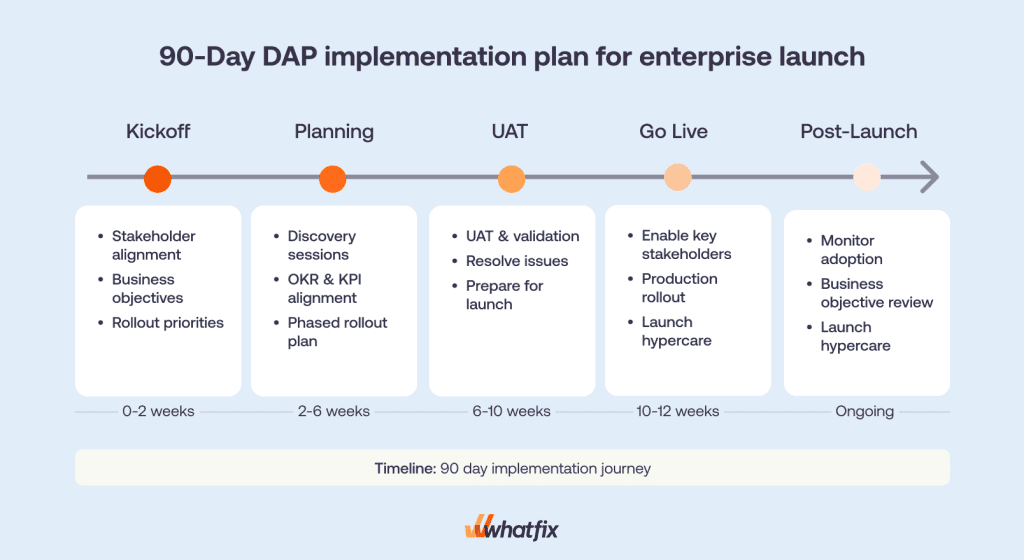
A successful DAP rollout should move through six clear phases in the first 90 days: kickoff, planning, build, validation, launch, and post-launch optimization. The objective is enough structure, alignment, and measurement discipline to launch with confidence and scale with control.
Phase 1: Kickoff and alignment
This phase sets the foundation for the upcoming DAP rollout. Before build work starts, customer and vendor teams should align on who is involved, what the rollout is meant to achieve, and how implementation will be managed.
Key decisions in this phase include:
- stakeholder introductions across customer and vendor teams
- implementation roles and responsibilities
- onboarding milestones and expectations
- business objectives, success criteria, and rollout priorities
- ownership across technical, business, and enablement stakeholders
For teams new to digital adoption platforms, this phase establishes their DAP operating model. For teams replacing an existing vendor, it should also define migration scope, continuity requirements, and which assets should be rebuilt, improved, retired, or migrated.
With Whatfix’s Fast Track program, organizations coming from legacy DAP vendors can streamline their migration with services that offload the work, protect business continuity, and avoid dual billing costs.
Phase 2: Planning workshops
Once alignment is in place, the next step is to turn adoption goals into an executable rollout plan. This is where discovery becomes direction.
Planning should cover:
- discovery sessions on workflows, friction points, and application priorities
- OKR and KPI alignment
- ideation and prototyping for initial use cases
- project planning and phased rollout sequencing
- mapping customer roles to implementation stages and governance needs
A strong planning phase leaves no ambiguity about where the DAP will start, which workflows matter first, and what the first release is expected to prove. For customers new to DAP, this should start with the basics (first 90 days), the intended outcomes, and the larger vision for scaling the program across the entire enterprise application ecosystem.
Phase 3: Co-creation and build
This is where implementation begins to take shape inside the platform. The scope should stay intentionally narrow at first, centered on the first set of high-value workflows and the user behaviors tied to them.
At this stage, teams should focus on:
- finalizing scope and build plan
- configuring environments and deployment foundations
- enabling analytics where relevant
- co-creating in-app content for priority workflows
- reviewing content for quality, consistency, and maintainability
This phase should not become a race to publish everything at once. The strongest programs launch from a narrow, high-value foundation and then scale from proof.
Phase 4: UAT and deployment readiness
Before launch, the rollout needs to be tested in real conditions. This phase confirms that the content works, the deployment behaves as expected, and the program is ready for production release.
This phase typically includes:
- UAT preparation and stakeholder alignment
- user acceptance testing
- issue resolution and UAT closure
- deployment initiation and launch planning
- pilot rollout or dry run with a limited audience
For DAP migration scenarios, this phase carries extra weight because the new experience should be validated before legacy guidance is turned off.
With Whatfix Fast Track, customers receive high-touch services that offload this work to our digital adoption and content authoring experts to audit your existing content, rebuild key experiences, validating through testing, reviewing with stakeholders, and launching to end-users.
Phase 5: Enablement, launch, and go-live
Go-live should be treated as a coordinated release, not a handoff. By this point, customer and vendor teams should be clear on launch responsibilities, and the people responsible for governing the program after launch should be ready for production ownership.
Launch readiness should include:
- launch planning across customer and vendor teams
- enablement for customer-side admins, authors, and program owners
- workflow owner or SME validation
- LMS and training alignment where relevant
- final checks across content, targeting, and environments
- production rollout
Phase 6: Post-launch adoption, optimization, and value realization
A strong DAP implementation plan continues well beyond deployment. The best programs treat go-live as the beginning of adoption, optimization, and value realization.
Post-launch priorities should include:
- hypercare after launch
- monitoring adoption and growth
- reviewing business objectives against actual usage and workflow outcomes
- creating a feedback loop for content and workflow optimization
- enabling a center of excellence or governance model for scale
- ongoing value management and executive reviews
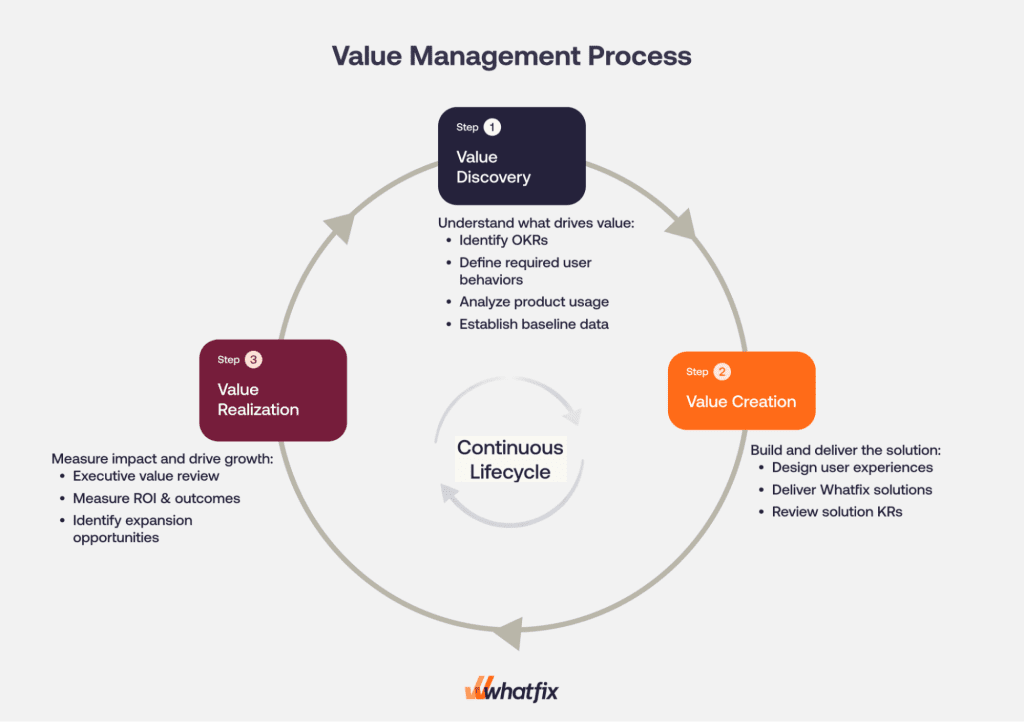
At this stage, the program should shift from launch support to value management. That means reconnecting adoption activity to the original business case so teams can measure progress against outcomes, not just usage.
A mature post-launch motion starts by identifying the OKRs the program is meant to influence and the user behaviors required to support those outcomes. From there, teams can establish baseline data, track movement with analytics, review whether delivered experiences are influencing the right behaviors, and assess progress through business and executive reviews. That is what turns a DAP rollout from a deployment project into a measurable adoption program.
Below you can see the value discovery and creation process all new Whatfix customers enter when they rollout their new DAP investment:
How implementation differs for a net-new deployment vs. replacing an existing DAP vendor
Enterprise buyers should evaluate these two paths differently because the implementation risks are different.
Net-new DAP deployment
For organizations deploying a DAP for the first time, the main challenge is building the digital adoption operating model from scratch. Teams need to define ownership, governance, content standards, success metrics, rollout priorities, and the first set of workflows to support.
The vendor’s role should include:
- helping define the first use cases and implementation scope
- supporting technical readiness and environment setup
- guiding content strategy and governance
- helping the team baseline KPIs and build an initial scorecard
Replacing an existing DAP vendor
For replacement scenarios, the challenge is continuity and transition quality. Buyers need a vendor that can help them avoid content disruption, migration confusion, and a long gap between tools.
The vendor’s role should include:
- helping assess which content should migrate, improve, or retire
- reducing disruption during transition
- supporting change management for program owners and admins
- preserving measurement continuity where possible
- accelerating time-to-value on the new platform
A vendor that handles net-new implementation well may still struggle in replacement scenarios. Buyers should ask directly how the team supports both motions.
As previously mentioned, Whatfix’s Fast Track program removes the pain points associated with migrating from legacy DAP vendors, including offloading the work to our team of content authoring and adoption experts, use a parallel-run migration approach that keeps critical guidance available throughout your transition, and helping you transition financially without carrying overlapping vendor costs to avoid dual billing.
What enterprise buyers should expect from a DAP vendor during implementation
Enterprise buyers should evaluate more than the platform itself. They should assess whether the vendor brings a clear implementation model, supports technical and operational readiness, helps the program scale beyond the first launch, and stays engaged after go-live.
- Structured implementation guidance that creates a foundation for success: Buyers should expect a repeatable rollout model with clear phases, milestones, ownership, and success criteria.
- Support across technical, operational, and adoption layers: Support should extend beyond setup. Enterprise buyers should expect help with rollout planning, content guidance, validation, adoption measurement, and post-launch optimization.
- A path to scale beyond the initial launch: The vendor should help customers build a program that can expand across workflows, teams, and applications without losing governance or quality.
- Post-go-live partnership: Go-live should mark the start of measurement, optimization, and long-term program growth. The vendor should stay involved in helping the team improve outcomes.
How Whatfix supports a successful DAP implementation journey
Whatfix helps enterprises move from rollout planning to long-term adoption with an implementation approach designed to reduce risk, lower internal lift, and bring more structure to the rollout.
Before implementation, Whatfix’s Fast Track migration program helps companies switching from legacy vendors accelerate their implementation. This includes financial incentives to avoid dual billing, rebuilding and auditing existing content from legacy systems, and protecting business continuity to ensure guidance doesn’t break during the migration.
Implementation support starts with aligning implementation to business goals, process complexity, stakeholder availability, and application realities. It continues through build, validation, launch coordination, and go-live readiness. For enterprise teams operating across web, desktop, or VDI environments, implementation support should match the complexity of the environment, not force the customer to work around the platform.
After launch, Whatfix helps customers establish a more sustainable operating model through customer success support, enablement, governed lifecycle management, and ongoing optimization. That makes it easier to scale adoption with stronger governance and lower maintenance overhead over time.
The most important point for enterprise buyers is this: the DAP vendor should help reduce implementation risk before launch and help prove value after launch. That is the standard a serious implementation partner should meet.
CTA: Request a demo to see how Whatfix can support your DAP rollout with more structure, lower risk, and a clearer path to long-term adoption.