












Procurement is no longer just about cutting costs—it’s about resilience, agility, and driving strategic value.
But many procurement teams are still held back by outdated systems, fragemneted data, and inefficient processes that make it difficult to keep up with growing demands.
Supply chain disruptions, evolving sustainability regulations, and the rapid shift to digital buying experiences are putting immense pressure on procurement leaders to modernize.
Organizations are responding by accelerating digital transformation efforts. According to PwC, purchasing departments are on an ambitious path to digitization, aiming for 70% of their processes to be fully digitized by 2027.
However, achieving this goal isn’t just about implementing new technology—it requires rethinking procurement’s role within the business, integrating smarter data-driven decision-making, and optimizing supplier relationships.
In this article, we’ll break down what procurement transformation really means-—not just in theory, but in practice. We’ll also explain how leading organizations are rethinking procurement to drive efficiency, mitigate risk, and create measurable business impact.
What Is Procurement Transformation?
Procurement transformation is the process of overhauling procurement strategies, technologies, and workflows to improve efficiency, cost savings, and compliance. It goes beyond simply upgrading tools—it involves redefining how purchasing decisions align with business goals, ensuring procurement drives value rather than just managing costs.
Types of Procurement Software
Procurement software can be a package suite of applications designed to manage the entire source-to-pay process or can be broken into single applications designed for certain procurement process areas.
When selecting a procurement solution, it’s essential to understand your current procurement infrastructure and contextual needs. Otherwise, they risk purchasing duplicate solutions or incompatible applications
With that said, here are the most common and popular types of procurement software:
- Source-to-pay (S2P) software: Covers the entire source-to-pay process, from sourcing vendors to managing payments, providing an end-to-end solution.
- Accounts payable and spend analysis software: Streamlines invoice processing and tracks organizational spending. It automates bill monitoring, schedules payments, and ensures on-time financial management.
- Contract lifecycle management software: Facilitates every stage of contract management, from creation and negotiation to execution and compliance tracking.
- Purchasing software: Automates purchasing activities, including requisitions, approvals, and order tracking, ensuring efficiency in procurement workflows.
- RFP software: Simplifies the RFx process by helping professionals create requests, receive responses, and manage vendor bids. It leverages templates, automation, and AI to enhance efficiency.
- Spend management software: Provides tools to track, analyze, and optimize procurement-related expenses, improving cost control and budget oversight.
- Strategic sourcing software: Supports procurement teams in managing sourcing projects, collaborating with stakeholders, and executing category management strategies effectively.
- Vendor management software: Centralizes vendor onboarding, communication, performance tracking, and relationship management for streamlined operations.
- Warehousing software: Helps manage inventory by categorizing, organizing, and tracking goods in storage, ensuring smooth supply chain operations.
Signs You Need Procurement Transformation
Legacy technology and outdated processes create ripple effects throughout your organization. If these situations sound familiar, you’re due for a procurement overhaul. Organizations still struggle with fundamental procurement inefficiencies despite increasing technology investments. It’s a clear indication that transformation requires more than just new tools. Here’s what to look out for.
1. Redundant, manual processes that slow approvals
When a department needs to buy something, their request might sit in approval queues for days. Even simple orders require multiple signatures and paper forms, causing unnecessary delays.
Meanwhile, your procurement team spends more time chasing down missing information and managing paperwork. This administrative burden impacts your company’s ability to move quickly when opportunities arise.
Red flags to watch for:
- Average requisition-to-PO cycle times exceeding 5 days
- More than three approval layers for standard purchases
- Procurement staff spending more on administrative tasks than strategic initiatives
2. Poor supplier performance management
You can’t improve what you don’t measure. Without structured supplier evaluation, you don’t have clear metrics for vendor management. That means when late deliveries or quality issues happen, you have limited visibility into root causes. A standardized approach to tracking performance helps you identify which vendors consistently deliver value and which ones are dropping the ball.
Companies with solid supplier performance management consistently achieve lower total costs and higher quality outcomes. You should know how suppliers perform in terms of metrics like quality, reliability, and innovation. You can use these insights to have conversations about necessary changes and improvements.
Red flags to watch for:
- Frequent late deliveries with no corrective action
- High defect rates or inconsistent product/service quality
- No standardized supplier scorecards or performance tracking
3. Frustrating customer and partner experiences
Your procurement interactions may create stress. For example, vendors may struggle with tasks like submitting information, checking payment status, or communicating with your team about orders. This can make the procurement process inefficient and a hassle for all parties.
This frustration leads to communication breakdowns and supply chain disruptions that impact your own customers. A negative supplier experience is more than an inconvenience—it’s a competitive disadvantage that limits your business potential.
Consider this: When was the last time you asked your suppliers about their experience working with your company? High vendor turnover or repeated complaints about your processes suggest relationship problems that ultimately affect your bottom line.
Red flags to watch for:
- Frequent supplier complaints about slow response times
- High vendor turnover due to poor working relationships
- Lack of a supplier portal or self-service capabilities
4. Limited cost and spend visibility
When executives ask questions about spending or consolidation opportunities, your team scrambles. They have to sort through multiple spreadsheets and systems to cobble together answers.
If you don’t have visibility on spend, you can’t identify when different departments are buying the same items at different prices. This issue may cause you to miss out on obvious savings opportunities.
You need a way to visualize spending patterns across categories, business units, and time periods. That’s what makes it possible to identify consolidation opportunities and track compliance.
Red flags to watch for:
- Multiple departments purchasing the same items at different prices
- Heavy reliance on spreadsheets to analyze spend data
- No centralized dashboard for procurement analytics
5. Complex spend categories
Your specialized purchases may not follow a standard process. Technical equipment, professional services, and custom manufacturing all require knowledge, and specifications may be different for each department.
Complex categories don’t necessarily mean complicated processes, but you do need to find a path that works for your organization. The right approach simplifies management and gives you the flexibility these purchases require.
Watch for signs that business users are working around your processes to get what they need. These workarounds are valuable signals that your current approach doesn’t fit actual needs, which can lead to more specialized purchases.
Red flags to watch for:
- Procurement processes that don’t accommodate specialized purchases
- Business users bypassing procurement to get what they need
- Lack of category-specific sourcing strategies
6. Compliance risks
When auditors review your processes, they flag weaknesses in documentation or approval flows. Considering compliance in your procurement workflow allows you to be proactive instead of reactive.
Compliance management is a big topic on the radar for chief procurement officers (CPOs), taking up 10 to 20% of the time for most high-performers. In fact, over half of CPOs say compliance and risk management are core areas of focus for digitization.
Procurement compliance failures can turn into business disruptions. Research also shows that disruptions have a milder negative performance effect when they emanate from suppliers with a history of being “good performers” compared to “poor performers.”
Red flags to watch for:
- Frequent audit findings related to procurement practices
- Inconsistent or missing approval documentation
- No automated compliance tracking within procurement workflows
7. Stalled responsible sourcing initiatives
It’s tough to effectively trace materials through multi-tier supply chains to ensure responsible practices at each stage. This disconnect between corporate commitments and procurement capabilities puts important customer and investor relationships at risk. Procurement shouldn’t only focus on price and quality. It supports transparent, responsible sourcing that aligns with your organization’s values.
Environmental and social responsibility are not just nice to have—they’re a must. Customers increasingly demand transparency, and investors scrutinize supply chain practices. You need to verify the origin of materials and services.
Red flags to watch for:
- No visibility into supplier sustainability or ethical sourcing practices
- Difficulty tracking material origins across supply chain tiers
- Lack of procurement policies for ESG (Environmental, Social, and Governance) compliance
Benefits of Procurement Transformation
What impact does procurement transformation have on business? This is why it’s worth the investment.
1. Automation of routine tasks
Your procurement team may spend hours on repetitive tasks like data entry and document filing. This work adds little strategic value but consumes resources. You can redirect this talent toward activities that matter.
For instance, automating purchase requisitions would speed up processing time. One of the most common use cases for AI in procurement is automated supplier selection and negotiation processes.
When purchase requisitions go through digital channels, processing time decreases. Approval notifications reach the right people automatically. Documents route themselves based on predefined rules. And your team can focus on relationship building, strategic sourcing, and innovation.
Leading organizations also use machine learning to scan supplier databases and identify partners based on performance history, risk profiles, and business requirements. Some have implemented AI-powered systems to analyze contract terms.
2. Deeper spend visibility and cost containment
You can’t control what you don’t know about. Procurement platforms reveal patterns like overlapping contracts. With category-specific dashboards, you can track price trends over time. This visibility is valuable during inflation or supply chain disruptions when prices fluctuate. You get the insights needed to negotiate based on the current market.
Good data informs your actions. With inflation putting pressure on margins, visibility matters more than ever. When material costs spike or new tariffs hit your supply chain, teams with analytics can model scenarios and adapt quickly. They tackle the highest-value opportunities first because they can actually see where the money is.
3. Supply chain resilience
Procurement often prioritizes unit cost above all else. Forward-thinking procurement changes this approach. You map supply networks and identify failure points before they cause disruptions. This way, you position your organization to navigate shortages or geopolitical complications that would stop operations.
4. Stronger supplier relationships
Your procurement team may be stuck in a pattern of transactional purchasing. Procurement often treats vendors as interchangeable parts. They have interactions about price and term negotiations, not strategic partnerships.
You can replace these interactions with collaborative supplier relationships that create mutual value. Digital supplier portals streamline onboarding and routine transactions to reduce the administrative burden for everyone, freeing up time for meaningful discussions about innovation.
5. Improved compliance and responsible sourcing
Paper-based approvals and disconnected systems make it challenging to enforce policies or demonstrate compliance. Procurement software solves this by adding documentation requirements and policy checks into the purchasing process.
The same tools that streamline compliance also elevate your ESG initiatives. Supplier scorecards that measure labor practices and resource usage help you identify procurement risks before they become public relations crises.
Start by benchmarking your current suppliers against sustainability metrics. Then, track improvement against specific targets. Leading organizations use supplier scorecards that measure labor practices, resource usage, and more. These scorecards help spotlight risks before they become PR nightmares and identify partners who share your values.
6. Optimized tax structures
Most companies just accept taxes as unavoidable costs. With better visibility into global trade rules, you can source materials from countries with favorable trade agreements to reduce your burden. You can also set up operations in locations with tax incentives for conducting business or setting up shop. This helps you manage changing trade policies and save money.
7. Greater agility and scalability
Old procurement systems can’t keep up when your business needs to change. Cloud-based procurement tools fix this problem with workflows that your team can adjust easily. When regulations change, you can update your processes in days, not months.
Common Procurement Transformation Challenges
What stands in the way of successful transformation? Look out for these obstacles and mistakes.
1. Resistance from internal stakeholders
People resist change, especially when it disrupts their familiar routines. For example, a procurement specialist who has processed purchase orders the same way for 15 years might see new technology as a threat.
Users also need to know what’s in it for them to justify the costs and the value. Successful transformations anticipate this resistance and address it head-on before or during training. They calculate and communicate the tangible benefits. For example, this could be better visibility for managers or more concrete ROI for finance.
With Whatfix Mirror, employees experience an easier transition through interactive, hands-on training in the application without putting data at risk. This approach accelerates onboarding and builds confidence, making change feel natural, not disruptive.
2. Legacy infrastructure and data silos
Most organizations struggle with outdated systems that don’t talk to each other. For example, an engineering team might track supplier quality metrics in spreadsheets that are disconnected from the purchasing system. This creates duplicate work and prevents smart decision-making.
Legacy systems block progress, but many organizations fail to move away from them. Successful transformation requires a thoughtful migration strategy. This means mapping the tech stack and targeting the highest-value integration points first. Then, using APIs to connect systems during the transition. This phased approach delivers quick wins and supports modernization.
3. Need for upskilling and new talent
Procurement teams need new skills to succeed with digital tools. Category managers may need to learn data analysis to use spend insights effectively. Training is more important than ever to help teams do their best work. Nearly 2 out of 3 survey respondents (64%) report that training has been useful for building confidence when navigating changes
With Whatfix DAP, you can create, launch, segment, and test in-app experiences like product tours, interactive walkthroughs, task lists, tooltips, pop-ups, self-help centers, and field validations to assist users and guide them through every aspect of an application and its contextual tasks and workflows.
Plus, With Whatfix Mirror, you can create interactive replicas of web applications for virtual hands-on user training without the risks of live software usage. This provides end-users with a sandbox environment for hands-on software training or user testing.
4. Complex procurement technology needs
Every industry has different requirements, and every team may need to consider different factors:
- Healthcare, construction, and manufacturing manage specialized purchases
- Large organizations must onboard thousands of vendors
- Industry-specific regulations affect procurement cycles
- ESG initiatives require monitoring sustainability metrics across the supply chain
- Tax regulations vary by location and change frequently
It can be challenging to juggle all of this and figure out which applications you need, including:
- Digital workforce enablement tools: Technologies that boost employee productivity and collaboration.
- Portals/networks: Platforms connecting buyers and suppliers to streamline information exchange and transaction processing.
- Cloud-based core procurement application suite: Centralized procurement systems hosted in the cloud for requisition-to-pay processes.
- Business process management/workflow tools: Solutions that automate and optimize procurement workflows and approval processes.
- Robotic process automation: Technology that uses software robots to handle repetitive procurement tasks.
- Legacy procurement core application suites: On-premises procurement systems that handle core purchasing functions.
- Procurement point solutions: Specialized applications focusing on specific procurement needs.
- Data visualization tools: Applications that transform procurement data into interactive visual formats for better insights.
- Advanced analytics: Solutions using sophisticated analysis techniques to identify spending patterns and opportunities.
- Master data management tools: Systems that power procurement data consistency and accuracy.
- Virtual assistants/chatbots: AI-powered conversational interfaces that support procurement users and suppliers.
- AI/cognitive computing: Technologies that mimic human intelligence to improve procurement decision-making.
- Secure digital ledger tools: Distributed ledger technologies provide transparent and tamper-proof record-keeping for procurement transactions.
5. Tracking procurement technology ROI
Procurement technology investments should lead to measurable results. Companies must establish benchmarks for metrics like cycle time, spend under management, and compliance rates. Then, they can compare performance after implementation.
Whatfix Product Analytics delivers a consolidated view of software adoption across your organization. By monitoring usage data and user engagement across tools, you can quickly pinpoint where users need help and measure the real impact of your transformation initiatives.
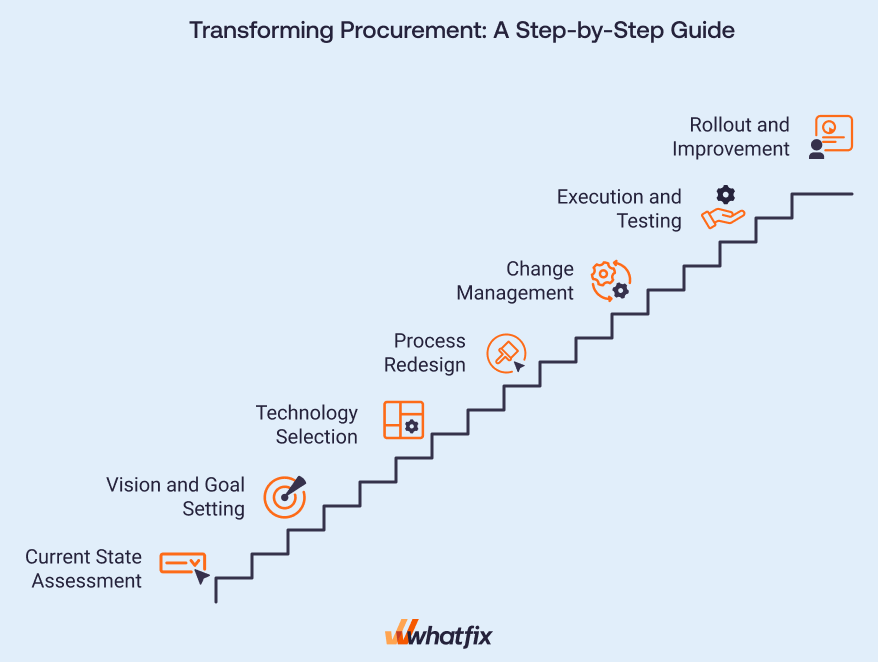
7 Stages of Procurement Transformation
Ready to transform your procurement function? Follow these steps for success.
1. Current state assessment
Start by understanding where you are today. Do a spend analysis with suppliers and departments to identify savings opportunities. Document current workflows and interview stakeholders to uncover pain points like delayed approvals or poor supplier communication.
2. Vision and goal setting
Don’t make changes without a clear goal. Set specific, measurable objectives like “Reduce purchase order processing time by 50%. Connect procurement goals to company priorities like supply chain resilience or sustainability.
Research shows that in corporate social responsibility, managing environmental issues, particularly reducing scope 3 emissions, is the top priority for procurement departments for the next three years.
3. Technology selection and implementation
Choose technology that addresses your specific business requirements. Evaluate platforms and their integration capabilities with your existing systems. Even the best technology is worthless if no one uses it, so prioritize user experience, too.
4. Process redesign and policy update
Look for opportunities to eliminate redundant steps and approvals. Create clear decision authority matrices. Who can approve what dollar amounts and for which categories? Update policies in simple language with clear examples that everyone can understand.
5. Change management and stakeholder engagement
Find executive sponsors who will champion the transformation. Create a stakeholder map identifying key influencers and potential resistors. Develop targeted communication for different groups addressing their specific concerns. Remember that training isn’t one-size-fits-all. Approvers need different skills than power users.
6. Execution and pilot testing
Don’t roll out everything at once. Start with focused pilots in controlled environments. Select a specific spend category or business unit with supportive leadership. Then, gather real user feedback and measure metrics like cycle time reduction and user adoption rates.
7. Rollout and continuous improvement
Think about your implementation in phases. Start tracking specific KPIs, including time-to-purchase and cost savings. You should schedule regular reviews to adjust strategies as business needs change.
Procurement Transformation Best Practices
Want to set your organization up for success? Use these best practices to get more from your transformation efforts.
1. Adopt an e-procurement mindset early
Don’t wait for problems to force you into change. Start planning your digital transformation while your current systems still work reasonably well. This gives you time to properly evaluate options and implement changes thoughtfully.
When choosing new platforms, focus on our biggest pain points first, like slow approvals or invoice processing delays. Getting quick wins in areas like these will help you get more team members and stakeholders on board.
2. Secure C-suite and cross-functional support
Find executive champions who promote the vision and reinforce its importance through consistent messaging and resource allocation. CFOs make powerful allies when you frame procurement improvements in terms of working capital impact and risk mitigation.
Also build cross-functional alignment with regular meetings that connect procurement initiatives to priorities in operations, finance, compliance, and IT. This collaborative approach prevents the siloed thinking that derails transformation efforts.
3. Establish clear KPIs and track performance
Start by documenting your current state metrics to establish a meaningful baseline. Then, set ambitious but achievable improvement targets that link to business outcomes executives care about. For instance, you may want to reduce purchase cycle time by 40%.
Build dashboards that highlight the information you need to track. This accessible approach demonstrates tangible progress throughout the transformation, making you more likely to get and keep buy-in.
4. Focus on user experience
Design your procurement experience with your least technical users in mind. Create role-specific interfaces that show relevant information and actions for each user type to reduce cognitive overload and training requirements. Observe actual user behavior to see where they struggle or create their own workarounds. These insights reveal improvement opportunities that generic training misses.
5. Enable ongoing training and change management
One-time training events don’t create lasting behavior change. You need to create a continuous learning environment with role-based resources addressing different user needs. Develop short, task-specific tutorials that people can access when needed.
A digital adoption platform (DAP) like Whatfix ensures procurement professionals get real-time, in-app guidance as they navigate new purchasing systems. With interactive walkthroughs, tooltips, and self-help widgets, Whatfix enables employees to complete procurement tasks without relying on lengthy training sessions or external support.
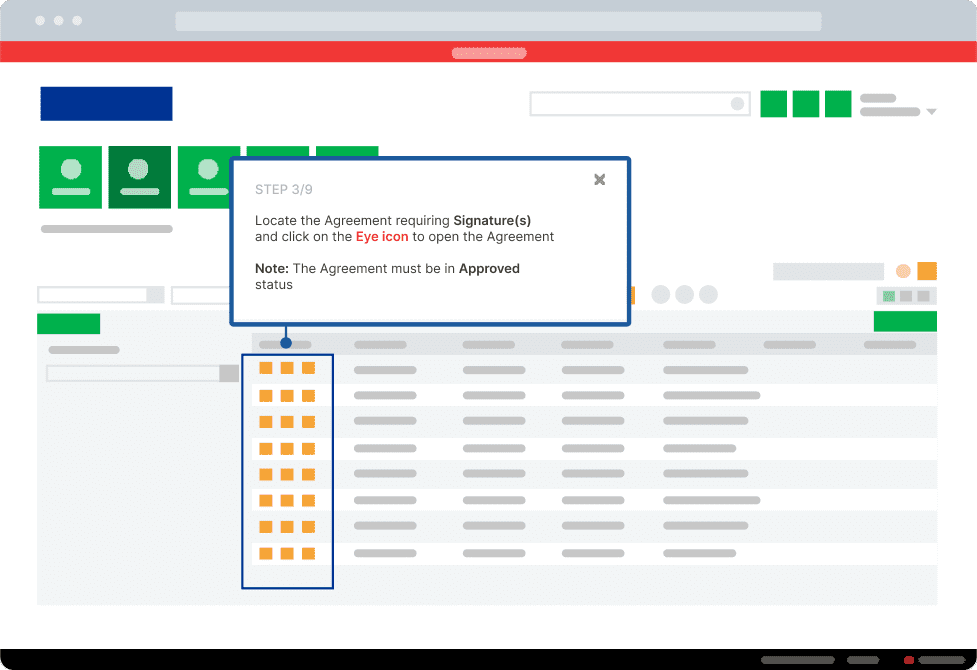
Automated onboarding flows help new users get up to speed quickly, while embedded knowledge bases provide instant answers, reducing the learning curve and improving system adoption.
Beyond training, Whatfix also supports ongoing change management by allowing procurement teams to push targeted in-app announcements about new policies, compliance updates, or process changes—ensuring employees stay informed without disruptive emails or meetings.
To further drive adoption, identify power users in each department who can serve as internal champions. These advocates reinforce best practices and provide peer coaching, while Whatfix’s analytics help track engagement and identify areas where employees need additional support. Establishing feedback channels also helps capture user insights, ensuring procurement transformation efforts continuously evolve to meet business needs.
6. Iterate on processes and policies
Many transformation initiatives stall after implementation because organizations treat them as one-time projects, not ongoing commitments. Twelve months later after implementing a new platform, users may create workarounds for processes that no longer fit.
Successful procurement organizations focus on regular reassessments for tasks like supplier performance audits. They conduct a quarterly spend analysis to identify shifting patterns and emerging categories. They review approval hierarchies when organizational structures change.
Without regular refinement, the very systems meant to transform procurement become constraints that hold it back. Your procurement strategy must evolve to include processes, policies, and upskilling needs.
7. Leverage analytics and AI
Turn procurement data into actionable intelligence that drives smarter decisions. For example, predictive analytics can analyze your historical purchasing patterns to forecast future demand, helping you negotiate better terms with suppliers.
Similarly, machine learning algorithms can continuously scan your spending data to flag unusual patterns, like sudden price increases or duplicate payments. These advanced tools help your team make more strategic decisions.
However, this is only true if you use the right tools in your strategy. Research shows that 96% of procurement leaders currently use AI in the procurement process, but only 30% are happy with their AI solutions.
Whatfix Product Analytics supports this data-driven approach by providing insight into how your team uses procurement systems. By tracking user journeys through your applications, you can identify where people struggle or abandon processes. This makes it possible to target improvements with the biggest impact on efficiency and adoption.
Procurement Transformation Clicks Better with Whatfix
Strategic procurement transformation helps businesses eliminate wasteful spending and gain a competitive advantage. Organizations need structured processes to choose the right approach and empower their teams to embrace new ways of working.
From there, it’s possible to align people, processes, and technology to maximize the value of procurement investments. Whatfix supports this with:
- Whatfix Mirror: Accelerates adoption of procurement systems by enabling hands-on, interactive training. This reduces implementation time and ensures employees quickly master new processes.
- Productive Analytics: Provides real-time visibility into system usage patterns, helping procurement teams identify adoption challenges and make data-driven decisions based on actual user behavior.
- Whatfix DAP: Supports users in applications through step-by-step guidance, reducing training costs and increasing adoption rates for new procurement processes and technologies.
Using Whatfix’s complete digital adoption platform, organizations can drive measurable improvements in procurement transformation, boost technology ROI, and convert process changes into actual business value.
Discover how aligning people, processes, and technology with Whatfix can turn your procurement transformation journey into a competitive advantage. Get a demo today.