An effective learning and development program starts with thoughtful planning. Knowing how employees learn and what motivates them helps engage learners throughout the training process.
When conducted effectively, employees become better equipped to perform their jobs effectively, are more likely to stay at the company longer, and empower organizations to achieve business outcomes.
To showcase the importance of a strong new employee training and continuous learning and development strategy, here are 49 of the most impressive employee training statistics across onboarding, development, and continuous learning phases of employee learning.
General Employee Training Statistics
- 93% of employees said that well-planned employee training programs positively affect their level of engagement. (Axonify)
- 60% of workers embarked upon their own skills training last year, highlighting an unmet appetite in the workforce for greater knowledge. (EduMe)
- Gen Z is more inclined to watch training material, consuming 50% more learning material in comparison to toher generations in 2020. (EduMe)
- 57% of employees also now expect to learn in a ‘just-in-time’ way. (EduMe)
- People are 95% more likely to retain information when conveyed via video than via text alone. (EduMe)
- Pulse Surveys are the most effective way to understand employee reception as they enjoy a response rate that’s 45-55% higher than traditional surveys. (EduMe)
- 90% acknowledge high-quality data is integral to improving learning delivery in their organization. (EduMe)
- 33% of employees say they received less than an hour of training when expected to use a new software and that 78% of employees lack the expertise in these tools to maximize its usage. (Whatfix)
- 84% of employees say there are core software features, every tasks, and processes they don’t know how to correct do or use. (Whatfix)
- The average training expenditure for enterprise companies is around $16.1M a year. (TrainingMag)
- On average, companies spend $1,111 per employee on training in 2020. (Cost of Training Employees)
- On average, companies spend $4,100 when onboarding new hires. (Cost of Employee Onboarding)
Statistics on L&D’s Impact on Employee Retention
- 68% of employees say training and development is the company’s most important policy. (Clear Company)
- 94% of employees say they would stay at a company longer if it invested in their learning and development. (LinkedIn Learning Report, 2020)
- 70% of employees would be somewhat likely to leave their current job to work for an organization known for investing in employee development and learning. (Lorman)
- 34% of employees who left their previous job were motivated to do so by more career development opportunities. (Lorman)
- 90% of organizations say providing learning opportunities is their number one retention strategy. (LinkedIn)
- 80% of employees say learning adds purpose to their work and 70% say it improved their sense of connection to their organization. (LinkedIn)
Growth of L&D Function
- 58% of L&D professionals say they have a seat at the executive table, up from only 15% in 2021. That’s nearly 4x growth in 3 years.
- 90% of executives plan to increase their budget to focus on upskilling in 2024. (LinkedIn)
- 66% of L&D professionals said that learning and development is becoming a more strategic part of their organization (Emerald Works, 2020).
Upskill & Reskill Statistics
- 74% of workers are willing to learn new skills or re-train in order to remain employable. (Lorman)
- 68% of employees prefer to learn at work. (FinanceOnline)
- 54% of employees would spend more time learning if they had specific course recommendations to help them reach their career goals. (LinkedIn Learning Report, 2020)
- 58% of employees want to learn at their own pace. (FinanceOnline)
- 70% of skills are picked up by employees through their jobs, 20% through peers and colleagues, and 10% through formal training sessions (70-20-10 rule of learning).
- Employees have less than 1% of their time to dedicate to learning activities. (Deloitte)
- The top L&D focus area is aligning learning programs to business goals in 2024. (LinkedIn)
- 80% of people want to receive AI skill training in 2024. (LinkedIn)
- 87% of L&D professionals say they can prove business value by training employees on new skills to move into different internal roles. (LinkedIn)
LMS Statistics
A proper LMS system is designed to help you develop, deliver, and track employee training. If you don’t have an LMS or need convincing to update your current one, look at the stats below:
- There are 575 corporate LMS vendors listed on G2.
- 83% of organizations currently use an LMS. (ShareKnowledge)
- According to G2, an LMS takes around 3 months to implement and 12-18 months to realize ROI.
- 72% of organizations gain a competitive advantage after adopting an LMS. (FinanceOnline)
- 40% of Fortune 500 companies use LMS extensively to remain competitive. (FinanceOnline)
- 93% of businesses plan to develop live online learning for their programs. (FinanceOnline)
- 42% of businesses are looking to update their learning management system (Brandon Hall, 2020)
- 30% of global LMS buyers are tech companies. (Research Markets/Docebo)
- 35% of primary users of LMS are managers. (Research Markets/Docebo)
- 49% of employees prefer to learn at their own point of need. (Research Markets/Docebo)
- 92% of organizations use an LMS and most of those have been in place for more than two years. (Docebo, 2020)
- 88% of businesses say poor UX is the No. 1 reason for switching their learning technology solutions. (Docebo, 2020)
Compliance Training Statistics
Compliance training can save your company millions of dollars from breaches. To be proactive against these attacks, train your employees to comply with interactive, engaging, self-paced training courses. Now, let’s get to the statistics:
- 27% of businesses report weekly breaches or attacks. (DCMS)
- The DCMS also found that the most common threat vector by far was phishing, which accounted for 83 percent of those attacks. (DCMS)
- The average annual cost from companies that experience non-compliance issues is about $14.82 million. Lorman
- 40% of companies rate their compliance programs as basic or reactive. (Lorman)
- 23% of organizations have no formal compliance training plan. (Lorman)
- 15% of respondents say they clicked through mandatory compliance training without listening or reading. (Corporate compliance insights)
- 34% say they only skim-read compliance content and tuned out of training audio. (Corporate compliance insights)
- 49% of respondents skip-read or didn’t listen to their mandatory compliance training in detail. (Corporate compliance insights)
- Companies with the least rigorous privacy practices are nearly twice as likely to suffer a data breach than companies with excellent data stewardship. (The Osano)
- $1.34 million is the average businesses spend on specialized compliance or security technology. (Ponemon)
- 69% of businesses are utilizing technology to support their compliance programs. (The Osano)
- 2.54 million is the average businesses save when incorporating a corporate data security training program. (Ponemon)
Leadership Training Statistics
- Study results show that participants undergoing leadership training improved their learning capacity by 25% and their performance by 20%. (Research Gate)
- Organizations that embrace a more inclusive approach to leadership training are 4.2X more likely to outperform those that restrict development to management. (Global Leadership Forecast 2018)
- 83% of businesses say it’s important to develop leaders at all levels. (Go Remotely)
- Less than 5% of companies have implemented leadership development across all levels. (Apollo Technical)
- 48% of leaders want to be educated by external coaches. (Apollo Technical)
- 48% of leaders want to be educated through developmental assignments. (Apollo Technical)
- 42% of leaders want to be assessed to diagnose leadership strength. (Apollo Technical)
- 39% of leaders want formal-in person training (DDI’s Global Leadership Forecast)
- 55% of CEOs believe that developing the next generation of leaders is the top challenge. (Apollo Technical)
Training Clicks Better With Whatfix
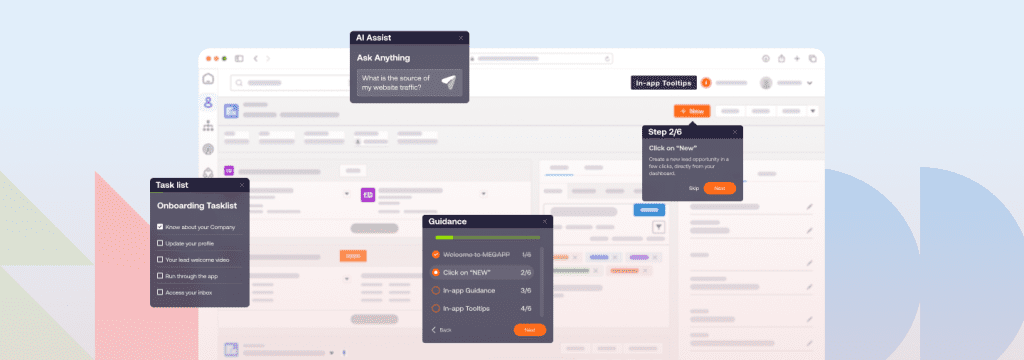
Invest in digital adoption platforms like Whatfix to maximize the ROI of your employee training programs. Using DAPs as training software empowers employees to upskill themselves on the latest tools, applications, or processes without disrupting their workflow or productivity.