












Change initiatives often stall not because of strategy or technology but because of human response. The Kübler-Ross Change Curve, originally conceived as a grief model, has been widely adapted in change management to map emotion over time, from denial to acceptance. In organizational settings, it helps change leaders anticipate resistance, tailor communications, and design interventions that meet individuals where they are.
In 2026, accelerated disruption, AI adoption, and continuous transformation are raising the stakes for managing change well. According to a report, the rate of change impacting businesses has increased by 183% over the past four years, and 52% of C-suite leaders admit they are not fully prepared for this accelerating pace.
These signals confirm that change leaders must go beyond process, they must understand the emotional journey of change if they hope to secure adoption, minimize backsliding, and protect productivity. In this article, we define the Change Curve, explain its stages, highlight its benefits and limitations, and show how Whatfix helps organizations apply it to accelerate adoption and reduce resistance.
What is the Kübler-Ross Change Curve?
The Kübler-Ross Change Curve is a psychological model that describes how people typically respond to major change. It was originally introduced by psychiatrist Elisabeth Kübler-Ross in 1969 as part of her work on the five stages of grief – denial, anger, bargaining, depression, and acceptance. Over time, change management practitioners adapted the framework to organizational contexts to explain how employees experience and process workplace change.
In a business setting, the Change Curve is used to:
- Anticipate emotional reactions employees may have when faced with new technologies, processes, or strategies.
- Design targeted interventions such as communications, training, and coaching to address resistance.
- Guide leaders and managers in providing the right support at each stage, helping people move more quickly from resistance toward acceptance and commitment.
It’s important to note that the Change Curve is not a strict linear path. Employees may skip stages, move back and forth between them, or experience several at once. Still, as a high-level model, it offers valuable insight into the human side of transformation, which is often the determining factor in whether a change initiative succeeds or stalls.
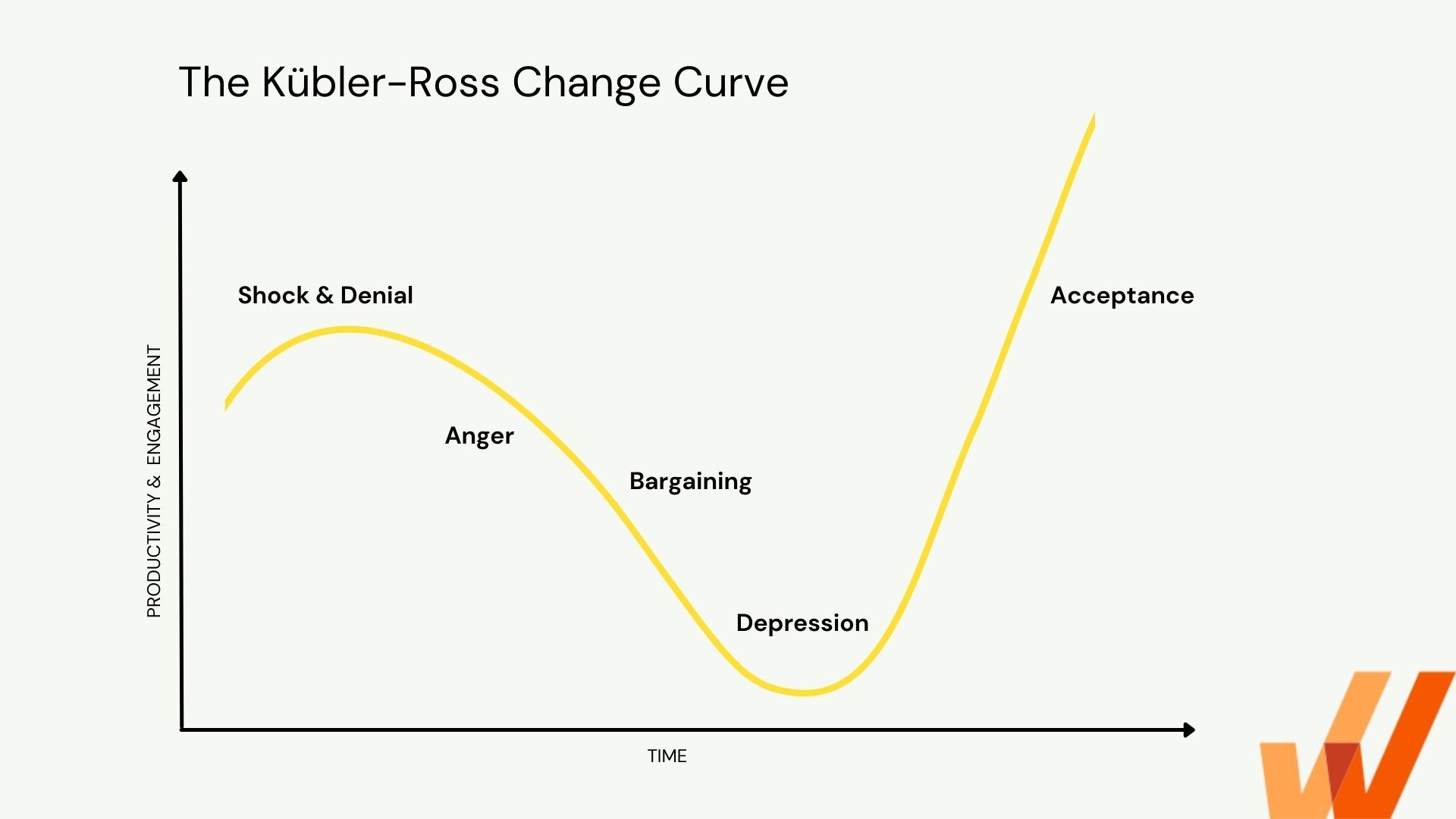
5 Stages of the Kübler Ross’ Change Curve Model
Here are the five stages of natural emotional responses highlighted in the Kübler Ross’ Change Curve Model:
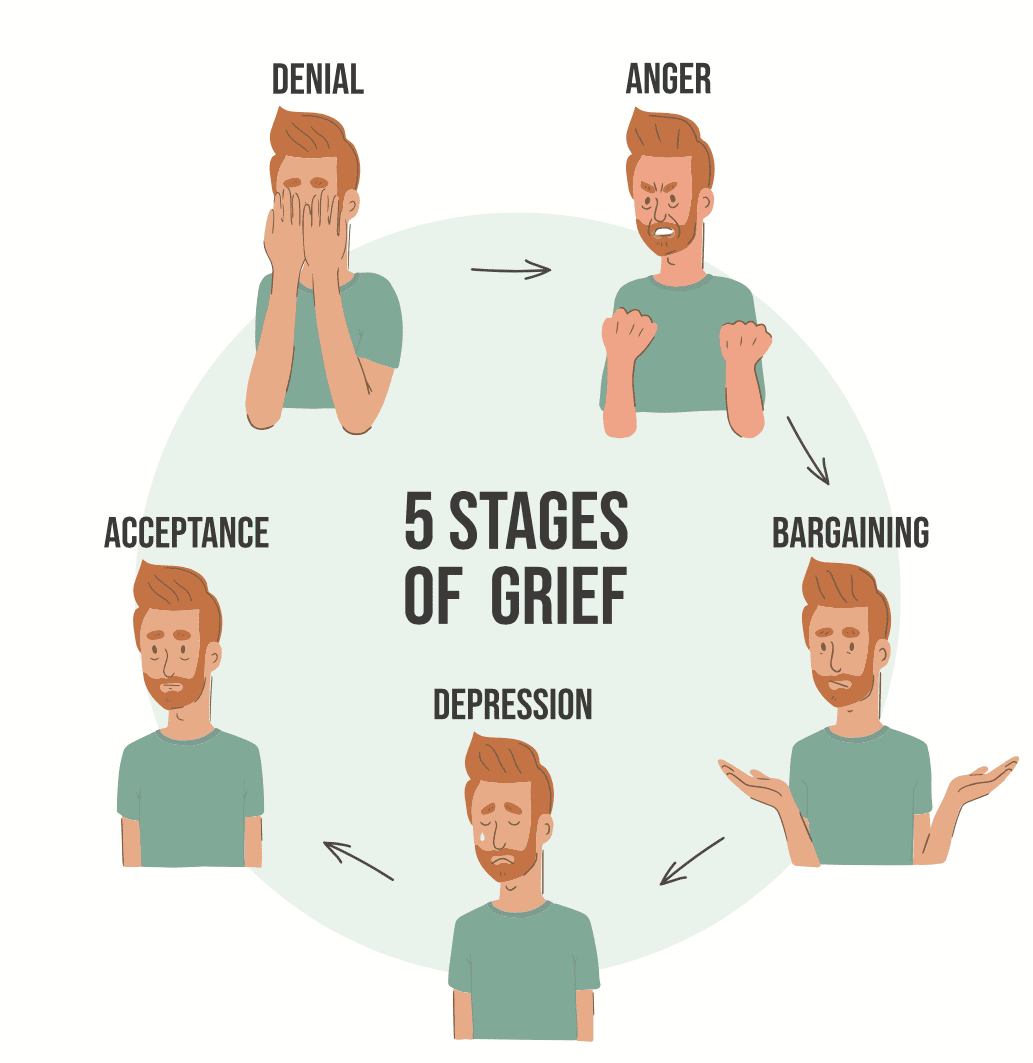
1. Denial
The first stage is shock, followed by denial. In this stage of the change curve, an individual develops defense mechanisms to deflect the actual occurrence of the change.
This leads to a steep decline in productivity as employees cling to past processes or individual expectations, leading to a disconnect from reality. This is typically due to a lack of information on the change, being comfortable with the status quo, feeling threatened, and fearing failure or doing something wrong.
This stage is typically short-lived. However, the shock and denial period can be extended if employees are inexperienced with change or have convinced themselves the change will not happen.
Constant, clear, and transparent communication is key to overcoming the challenges of the denial stage.
2. Anger
When the reality of change sinks in, it’s manifested in the form of fear or anger. Any change initiative has the potential to spiral out of control in this stage, resulting in significant change failures.
Reactions in this stage may be accurate, as employees may be exposed to risks associated with the implementation or new workloads they must take on. Many times, employees will fear unwarranted or irrational consequences of the change
3. Bargaining
Once an individual crosses the anger stage of the change curve, they attempt to salvage the situation by exploring the path of least objection. They may try to negotiate and find a compromise.
This stage may increase productivity as employees feel they can negotiate the reality of change, but it’s short-lived. This is due to employees fixating on small, day-to-day tasks and not looking at the overall bigger picture and importance of the change.
4. Depression
In the depression stage, a person loses hope entirely. There are signs of extreme sadness, apathy, isolation, regret, and demotivation. Productivity becomes the lowest at this stage.
It’s critical to support employees at this stage in two key ways:
- Reassuring employees that this is normal and others in the organization have the same emotions and feelings.
- Build an individualized plan showing employees you will support them as they navigate this difficult time.
5. Acceptance
In the final stage of the change curve, individuals come to terms with the change. Their inhibitions are lowered, they accept the change, and they start to explore new favorable opportunities that result from it. Once employees accept the change, you must cement it into your organizational culture to avoid reverting to old habits.
Employees who have resisted the change begin to show excitement for new opportunities and relief that they’re on the other side of the emotional change journey. They feel that progress has been made and new levels of trust have been built with their peers and organizational leadership.
Choosing the Right Framework for Your Change Initiative
While the Kübler-Ross Change Curve offers a useful lens for understanding emotional reactions, it isn’t the only model available to change leaders. Depending on your objectives, you may need a framework that provides more structure for adoption activities or one that focuses on the deeper psychological transitions people experience. The table below compares Kübler-Ross with two other widely used frameworks – ADKAR and Bridges’ Transition Model, to help you decide which fits best for your initiative.
| Framework | What it focuses on | Best for | Choose if |
|---|---|---|---|
| Kübler-Ross Change Curve | Anticipating emotional responses and shaping support | Managing resistance, morale dips, and sentiment during disruptive changes | You need a fast way to understand how people may feel and to tailor communications, coaching, and just-in-time support by stage |
| ADKAR | Structured adoption steps and reinforcement | Planning and executing behavior change at scale with clear milestones | You want a stepwise plan to build awareness, desire, knowledge, ability, and reinforcement with measurable checkpoints |
| Bridges’ Transition Model | Transition psychology across endings, neutral zone, beginnings | Guiding people through identity and role shifts like reorgs or leadership changes | You must help teams let go of the old, navigate ambiguity, and commit to the new with targeted interventions for each phase |
Common Pitfalls and Misconceptions Of the Kübler-Ross Change Curve
The Kübler-Ross Change Curve is widely recognized, but it is also frequently misused in organizational change. Understanding its limitations ensures you apply it responsibly and avoid undermining trust with employees.
- Treating the curve as a strict sequence: Many assume employees must move through denial, anger, bargaining, depression, and acceptance in order. In reality, people may skip stages, revisit them, or experience multiple emotions simultaneously. Presenting the model as a fixed path oversimplifies the human experience.
- Assuming it is evidence-based science: The original model was rooted in Elisabeth Kübler-Ross’s work on grief, not organizational behavior. It has value as a heuristic, but there is limited empirical evidence that the stages occur universally in workplace change. Use it as a guide, not a diagnostic tool.
- Ignoring organizational context: The curve highlights individual reactions, but it doesn’t address structural levers such as leadership alignment, governance, or training systems that drive adoption. Pair it with frameworks like ADKAR or Kotter for a complete change strategy.
- Overlooking ongoing reinforcement: Reaching “acceptance” does not guarantee sustained adoption. Without reinforcement, employees may revert to old behaviors.
Applying the Change Curve to Organizational Change
Here are the most effective action items for implementing the change curve model to support your organization’s change projects:
1. Clear change communication
When team members are in the shock or denial stage, they need reassurance. This can only come from transparent and clear change communication. Change communication must highlight the need for change, vision, strategy, and impact on the stakeholders.
Organizations can overcome communication-related change issues by:
- Creating cross-functional change teams with representation from teams most impacted by the upcoming change.
- Collect change feedback on the upcoming project.
- Have a clear organizational change announcement strategy, from initially announcing the upcoming change project to keeping employees updated as you progress.
2. Avoid roadblocks
When an individual is in a state of anger, self-destructive tendencies may surface. During this stage, change agents must watch for the potential roadblocks that may slow down your change journey. You must manage this change by being an active listener and observer. Create a safe space for employees to voice their opinions.
You can overcome common roadblocks and internal resistance to change by:
- Continuing to hold roundtable meetings with those most impacted to voice their concerns.
- Make an action plan based on your change feedback to help show your employees who are resisting the change that you’re here to support them.
- Roll out the change in beta launches with a phased implementation approach.
3. Offer contextual employee training
When employee productivity dips due to team members trying out and exploring new software, processes, or other changes, it’s essential to offer personalized employee training programs to help your workforce onboard a new tool or learn a new process—helping to bridge any skill gaps and build confidence.
To visualize its impact, let’s look at the graph below. The yellow curve signifies the overall change curve, while the orange curve depicts how organizations can enable employees with contextual onboarding and on-demand support to minimize the negative impacts and accelerate the change implementation process.
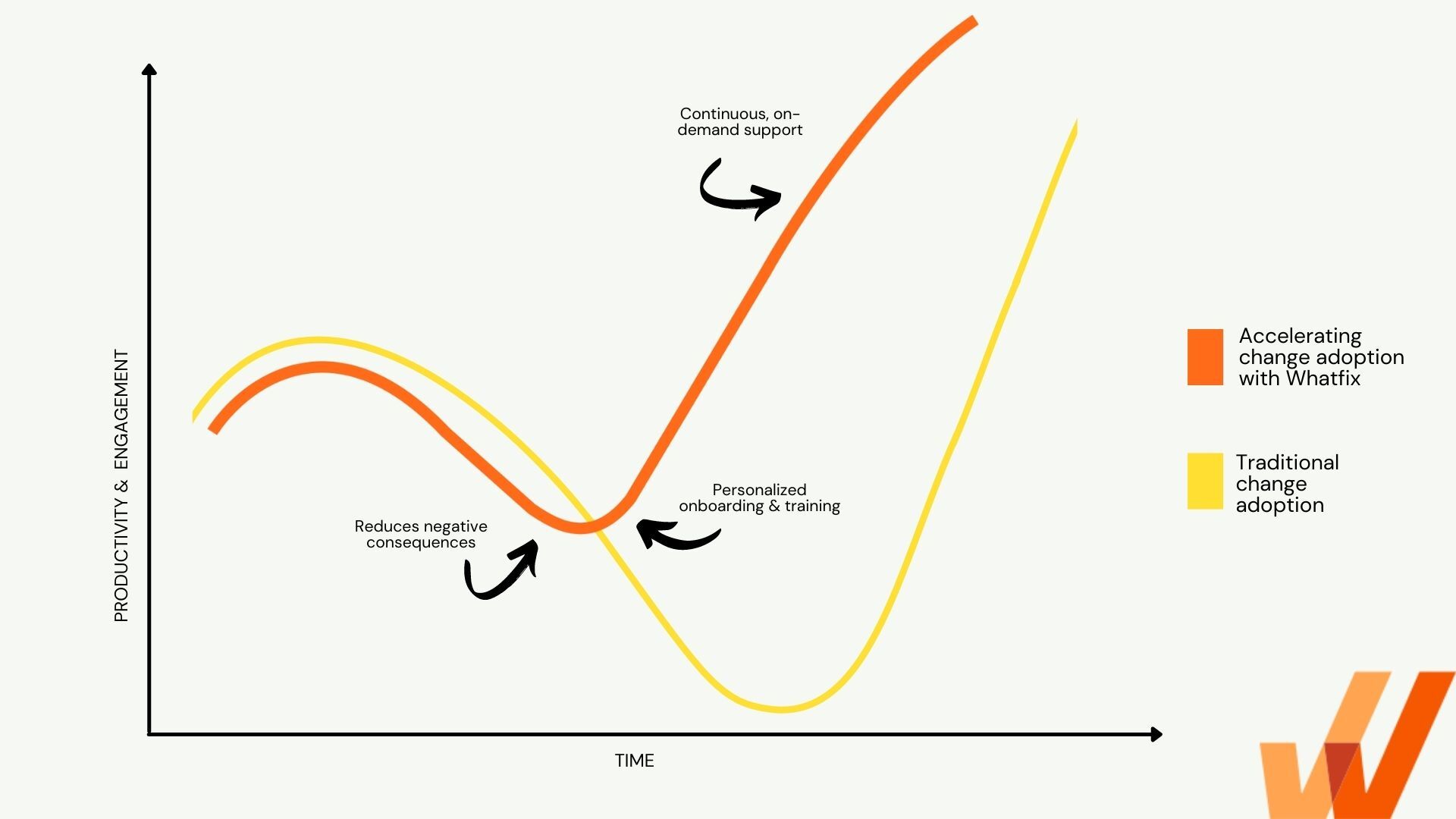
Organizations can support their employees and reduce time-to-productivity for new processes and applications by:
- Providing hands-on training with sandbox IT environments.
- Creating step-by-step documentation on new processes and procedures.
- Enabling employees with in-app guidance that overlays their digital workflows and tasks with experiences like product tours, walkthroughs, task lists, and tooltips.
- Providing on-demand performance support. An end-user support strategy enables employees to overcome friction and troubleshooting issues.
4. Recognize & celebrate critical milestones
A change invokes several emotions and may cause discomfort. However, when employees begin behavioral modification and being to accept the change, organizations must recognize the initial drivers of change and reward them. Once you achieve a critical milestone, be sure to celebrate these wins.
Change leaders can recognize milestones by:
- Sharing how early adopters are overachieving in their goals by using new applications or processes in Slack channels or team meetings.
- Having lunch-and-learns or recorded webinars on how employees are utilizing new systems.
- Creating self-service dashboards with business KPIs tied to the change project.
How Whatfix Helps Flatten the Change Curve
Even with strong communication and training plans, employees often struggle during the middle stages of the Change Curve causing frustration, and uncertainty. This is where a Digital Adoption Platform (DAP) like Whatfix accelerates the journey from resistance to acceptance.
1. In-app guidance to reduce confusion
Whatfix overlays applications with step-by-step interactive walkthroughs, task lists, and tooltips so employees can learn by doing. This minimizes errors and helps employees adopt new workflows without leaving the flow of work.
2. Mirror simulations for safe practice
With Whatfix Mirror, employees can experiment in a no-risk sandbox environment before changes go live. This builds confidence during the exploration stage and speeds up time-to-proficiency for complex processes.
3. On-demand performance support
Through embedded help menus, contextual FAQs, and searchable guides, employees get just-in-time answers when resistance or uncertainty peaks, preventing productivity dips.
4. Analytics to monitor adoption
Whatfix analytics identify friction points across the adoption curve. Change leaders can see which teams are lagging, where drop-offs occur, and deploy targeted nudges or training to move employees toward acceptance.
By embedding support directly into digital workflows, Whatfix helps organizations shorten the dip in productivity, reduce resistance to change, and reinforce long-term adoption, flattening the Change Curve and driving measurable ROI from change initiatives.
Frequently Asked Questions
1. Is the Change Curve scientifically proven?
No. The model is widely used as a heuristic but does not have strong empirical validation as a fixed sequence. It should be applied as a guide for understanding resistance and planning interventions, not as a diagnostic tool.
2. How does the Change Curve compare to ADKAR or Bridges’ Transition Model?
The Change Curve maps emotional reactions to change. ADKAR provides structured steps for building adoption (Awareness, Desire, Knowledge, Ability, Reinforcement), while Bridges’ Transition Model explains the psychological shift across endings, neutral zones, and new beginnings. Many organizations use them together for both emotional insight and execution planning.
3. When should I use the Change Curve?
It is most helpful during disruptive change, new technology rollouts, reorganizations, or major strategy shifts, where emotional resistance and morale dips are expected. Use it to shape communication, coaching, and training plans that meet employees where they are.
4. How does Whatfix support organizations applying the Change Curve?
Whatfix helps shorten the dip in productivity during change by embedding in-app guidance, providing Mirror simulations for safe practice, delivering contextual performance support, and offering analytics to track adoption. This accelerates employees’ progression toward acceptance and long-term adoption.
Change Clicks Better With Whatfix
Managing change isn’t just about frameworks, it’s about giving employees the clarity, guidance, and confidence they need to adopt new ways of working. The Kübler-Ross Change Curve highlights the emotional journey, and Whatfix helps flatten that curve with in-app guidance, contextual support, and adoption analytics. The result is faster productivity recovery, reduced resistance, and measurable ROI from every change initiative.
Ready to see how Whatfix can accelerate adoption and make change stick? Request a personalized demo with us today!