











The importance of employee training and continued skill development can’t be understated. It has an impact on direct and indirect business outcomes, including productivity, revenue, turnover, and more.
According to Deloitte, organizations with a strong learning culture are 92% more likely to develop new product innovations or novel process improvements and are 52% more productive overall. However, 59% of employees claim they received no workplace training and that the skills required to do their jobs effectively were self-taught.
This highlights a curious trend of employees relying on self-taught skills despite organizations acknowledging the importance of workplace training for professional growth, upskilling, and team improvement. Companies view employee training as an expense rather than an investment. Many organizations must also maintain current output and productivity levels before focusing on learning and development opportunities.
Employee training programs and development opportunities are essential features of successful organizations. They enable them to upskill team members and drive productivity levels. These programs are not a means to fill knowledge gaps; they’re strategic investments in people, fostering a culture of continuous improvement and adaptability.
From onboarding new hires to upskilling workers for emerging responsibilities, employee training programs are designed to align individual growth with organizational goals, futureproof organizations, and enable them to remain competitive, innovate, and achieve business outcomes.
What are the different types of employee training programs?
What Is an Employee Training Program?
Employee training programs are systematic L&D initiatives designed by organizations to:
- Train employees on how to do their job effective to maximize productivity.
- Develop new skills to create skillful employees that can solve technical problems, while helping build new career paths for these employees.
- Improve institutional knowledge.
- Enhance their interpersonal and leadership skills to cultivate future leaders from within and re-invest in their people.
- Meet regulatory and compliance standards.
Employee training programs are essential for supporting employees with the necessary skills, tools, and competencies to perform their roles effectively, adapt to new technologies and methodologies, and contribute positively to an organization’s growth and success.
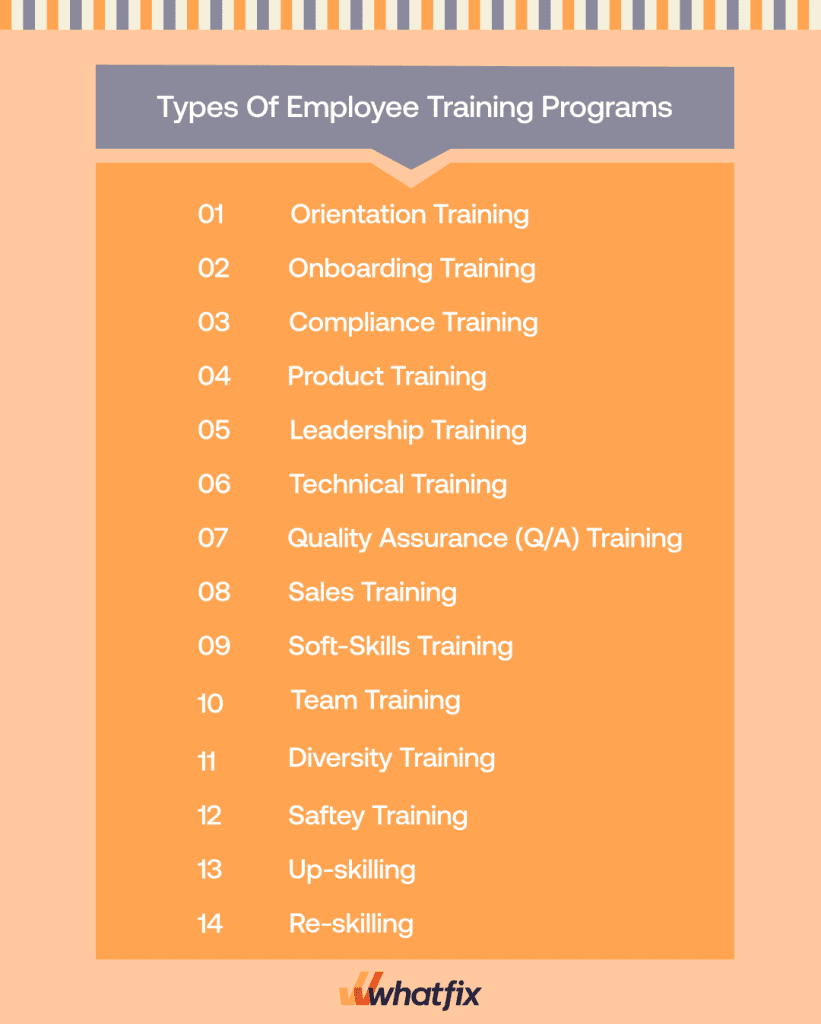
14 Types of Employee Training Programs
Companies conduct different employee training programs depending on their organization’s size, requirements, skills gaps, industry, needs, and business activities. Here is a list of the most common types of training programs in a modern workplace.
1. Orientation Training
Effective employee orientation training provides basic organizational information that new hires need to prepare for their role in a company. The orientation program benefits employees and employers by educating new hires, setting them up for success in their new roles, addressing any questions they might have, and helping them contribute to the organization immediately.
Here are the key components of an employee orientation training program:
- Standard new hire orientation that provides company knowledge, policies, safety procedures, etc.
- Meeting one-on-one with various team leaders and individual contributors to learn about their work, build relationships, and integrate into company culture.
- Self-paced online learning programs for job-specific technical training and how to use enterprise software and applications.
- Hands-on training for field and factory workers who handle machines and equipment.
- In-person group training sessions for role-playing activities and other traditional training methods, great for customer service training, team-building, and client management.
- Formal orientation training courses are provided by third-party companies to build soft or hard skills.
2. Onboarding Training
Onboarding training is the process of supporting new hires with the resources and knowledge they need to become productive in the role quickly, like understanding their responsibilities, becoming familiar with company culture, how to use company resources, learning about company products, and more.
While employee orientation is a 1-2 days process, the employee onboarding process is a series of events that take place over a longer time period. The length of employee onboarding depends on the organization and the role and can take anywhere from a week to a month to a full year. Onboarding is responsible for truly integrating an employee within an organization.
By the end of onboarding, an employee must have a clear sense of their responsibilities and goals in the organization. They must also know how to obtain the resources they need to do their jobs and understand how their role contributes to their team’s and company’s objectives.
Here are the core components of employee onboarding programs:
- Functional training to provide an overview of the organization’s products and services, clients and customers, and organizational structure.
- In-person training sessions are led by team managers and individual experts on your team.
- Job shadowing your colleagues.
- Training modules and sales training exercises on core company concepts, programs, products, and methods using a corporate LMS.
- Facilitated discussions between the new hire and managers to clarify expectations, priorities, and deliverables.
- Overview of company goals, organizational chart, and employee KPIs based on the job descriptions.
- A 30-60-90 day plan personalized to each employee according to their role, goals, and projects.
- Assigning an onboarding buddy for new hires to help them assimilate into social dynamics and company culture.
3. Compliance Training
Compliance training is a workplace training type mandated by legislation, regulation, or policy. It educates employees on the laws and regulations applicable to their job’s function, company’s industry, or worker rights protection laws.
An effective compliance training program helps prevent poor conduct, ensures proper governance, safeguards companies from risks, and protects employees. It minimizes risks to the company and provides a better and safer workplace environment for employees.
Here are examples of compliance-related training courses for government-mandated and industry-specific policies:
- Anti-harassment: Anti-harassment compliance training programs administer guidance and measures for responding to incidents like bullying, harassment, and sexual harassment.
- Diversity training: Diversity training, also known as diversity, equity, and inclusion (DEI) training, emphasizes the strengths of diversity and addresses how to work with people of different ethnicities, genders, sexual orientations, ages, mental or physical abilities, etc.
- Cybersecurity training: These programs teach staff how to manage sensitive and confidential information efficiently and train them on the strategies, tools, and systems needed to protect personal data.
- Business ethics: The ethics & compliance training programs include risk assessment training, methods to encourage whistleblowing, employee accountability structures, and a system for addressing grey areas/conflicts of interest.
- OSHA training: OSHA compliance training educates employees on the potential hazards in the workplace, protocols to avoid incidents, how to respond if an incident happens, and teaches workers about their rights.
4. Product training
Product knowledge training educates your employees on your organization’s products or services. This allows employees to do their jobs effectively, such as developing, selling, or marketing a company’s offerings.
Depending on different employee roles, product training focuses on various aspects and has other learning goals. Value-adding product training enables a marketing team to reach the right market and a sales team to answer the critical questions customers are looking for.
Here are a few standard product knowledge training objectives tailored to different roles:
- Product training for sales reps: Train the sales team on the product to sell better, improve their customer communication, overcome prospects’ objections, and close deals faster.
- Product knowledge training for customer service: Train the support team on the technical aspects of the product – how it works, what parts it consists of, and how to fix it.
- Product training for a marketing team: Training on distinctive features, use cases, personas, and benefits of a product to create an effective positioning and promotion strategy.
- Product knowledge training for customers: Train your customers on how to use the product and achieve great results.
5. Leadership training
Leadership training develops lower-level employees into future leaders and helps existing leaders maintain their thought leadership and expertise. Leadership development training provide several essential benefits to organizational growth, such as:
- Increases employee morale and retention.
- Promotes better decision-making.
- Build better teams.
- Improve leadership styles.
- Develops talent from within.
Here are a few essential steps to build your leadership training program:
- Define the company’s leadership needs. Where are your leadership gaps?
- Identify potential leaders by evaluating employees’ current and potential contribution levels to the organization.
- Create a succession plan and handover documentation on all critical skills, knowledge, and advice that current leaders can pass on to future leaders.
- Align your leadership development program with organizational goals to ensure the business has the right people in leadership roles that drive outcomes.
- Choosing training methods that work for your people. The training process can be handled differently depending on the size and type of the organization, like coaching, mentoring, leader-to-leader development, group-based leadership development, job rotation, job shadowing, etc.
- Measure results: Before implementing the training program, determine how the program’s success will be measured. You can measure training effectiveness with simple metrics like course completion rates, use assessments like quizzes, and collect post-training feedback.
6. Technical training
Technical training refers to the ‘hard’ skills required to accomplish a job’s responsibilities and succeed. For example, developers need expertise in certain programming languages.
Modern organizations don’t exist without a software stack. An HCM is critical to HR and people ops success. Sales and marketing teams rely on CRM systems for tracking leads and customer relationships. ERP systems automate dozens of operational tasks, including finance, procurement, supply chain management, and more.
However, while these enterprise applications provide the technology to achieve business outcomes, employees must know how to correctly use these applications and their custom-built workflows to achieve those results.
While organizations expect employees to have a baseline knowledge of using these mission-critical systems, every organization has its processes and governance to follow. This requires dedicated technical training sessions and on-demand performance support that enable employees to maximize the potential of these applications.
Here are a few ways to facilitate technical training to enable employees:
- Demonstrate a clear link between technical training and their day-to-day responsibilities and career progression to keep employees motivated and engaged throughout the course.
- Showcase examples of how technical training has positively impacted an employee’s real work.
- Use subject matter experts to enable effective instructor-led training sessions, pre-recorded videos, and screen recordings, and provide detailed process documentation.
- Create standard operating procedures (SOPs) for your company’s processes and workflows.
- Enable your employees to learn in the flow of work via in-app guidance like interactive walkthroughs, tooltips, and pop-ups.
- Technical training must be available on demand. Provide in-app performance support within your live applications, where employees can use it when and where they need it.
With a digital adoption platform (DAP) like Whatfix, organizations can use a no-code editor to create in-app guided experiences and on-demand performance support that overlay your software applications.

With Whatfix DAP, reduce application time-to-proficiency for new hires, support employees with guided tutorials on complex workflows or infrequently done tasks, and drive process governance by creating timely in-app alerts and tips that provide additional context and support at key friction areas.
7. Quality assurance training
Quality assurance training helps employees better understand quality assurance activities and improve processes that ensure the final product or service meets set quality standards, which leads to customer satisfaction and loyalty.
Q/A training benefits organizations by:
- Establishing trust and building integrity with customers.
- Reducing waste, improving profit margins, and accelerating growth.
- Building a company culture that prioritizes quality products.
- Building meaningful customer relationships and loyalty by taking a “customer-first” and “what’s best for the customer” mentality.
- Creating an educated and engaged workforce.
8. Sales Training
Sales training improves your sales team’s skills by teaching them new selling techniques, how to use sales tools like CRMs and CPQs, novel approaches to selling, how to overcome objectives, and more.
Effective sales training programs focus on helping sales teams define the benefits of products and services, address the unmet needs of the client, and how to progress deals and conversations through the pipeline to close ultimately.
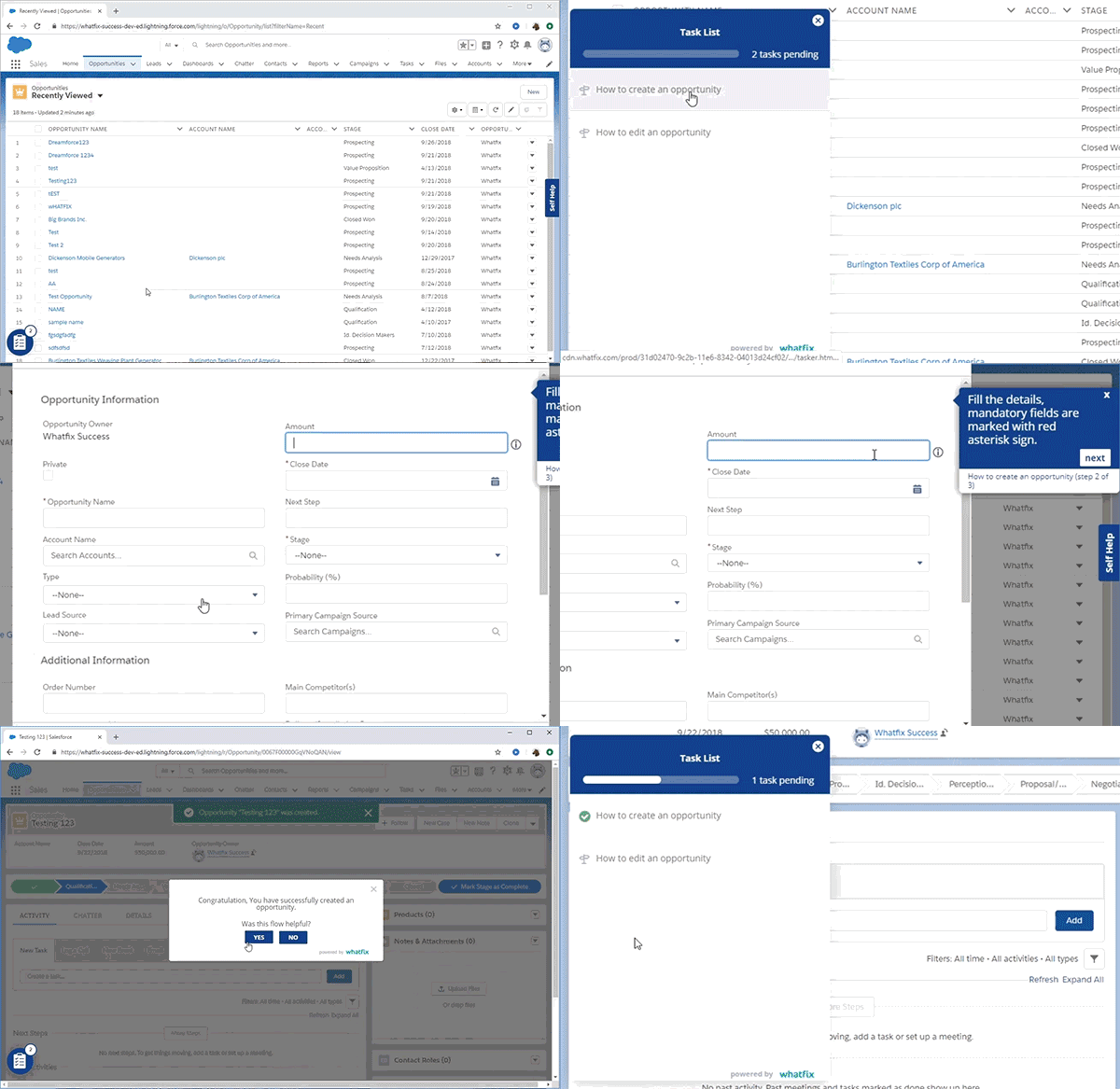
Below you can see how customer-facing teams can use Whatfix for sales teams to create guided tutorials, in-app workflows, and embedded self-help widgets that link to your SOPs – all right in your CRM.
Here’s what you need to look for in a sales training program:
- Identify opportunities for improvement using resources like customer service surveys, recorded calls, online reviews, and data intelligence tools.
- Identify your sales team’s weakest areas like people skills, lead generation, closing deals, etc.
- Seek out a sales training program designed specifically to improve the identified weak areas of your team.
- Provide sales training on how core selling principles like prospecting, nurturing, brand building, conversations, pitches, objections, and more.
- Consider different types of sales training programs according to the organization’s requirements, like inside sales, field sales, customer service training, sales management and leadership coaching.
- Design learning paths contextual to different sales roles, like for AEs, BDRs, CRM admins, CSMs, and more.
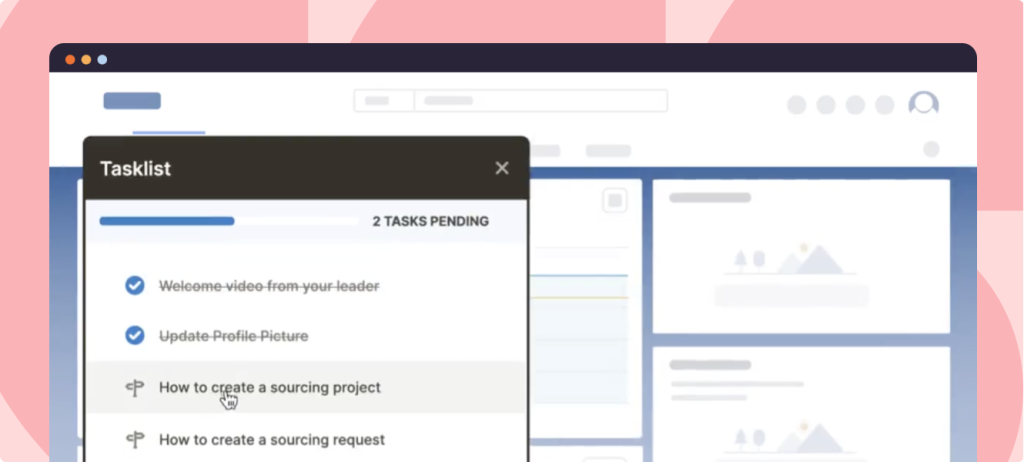
A core use case of Whatfix is drive sales business outcomes by enabling sellers to maximize their CRM usage. Via in-app guided experiences, sellers can learn how to use advanced CRM features and find the data they need to close deals. Task Lists provide sellers a detailed overview of important processes and playbooks to keep in mind. Self Help allows leaders to provide sellers an in-app CRM help center complete with in-app tutorials on how to complete various sales processes, links to playbooks and documentation, and more.
9. Soft-Skills Training
Soft skills training programs focus on personal attributes, such as communication, conflict resolution, and problem-solving, that are necessary for an individual’s success and career development. Across an organization, in every business unit and employee role, soft skills are crucial for gaining new clients, improving current customer relationships and service metrics, and building a stronger team dynamic.
Here are the steps to design a soft skills training program for your organization:
- Decide what soft skills are necessary for your employees.
- Assess employee soft skills via self-assessments.
- Identify the resources required depending on the type of training.
- Set goals to assess the effectiveness of the training program.
- Share the benefits of the training program with your employees to engage them.
- Provide ongoing feedback to learners.
10. Team Training
Team training encourages beneficial team dynamics, ensures every team member has the same professional growth opportunities and improves employee morale, collective efficacy, and member satisfaction.
Here’s how you can effectively implement team training in a workplace:
- Use your team’s input to determine training needs.
- Establish a training schedule that suits every team member.
- Implement team-building sessions across different departments working towards the same organizational objectives.
- Explain how every individual contributes to the overall team training objective to get their buy-in and give them a sense of purpose.
- Focus on good team-building skills to unite employees around a common goal and increase productivity.
- Cater to the different learning needs of your team.
- Follow up after training sessions.
11. Diversity Training
Diversity, equity, and inclusion (DEI) training programs create awareness for diversity-focused issues within the workplace with an aim to facilitate positive interactions and reduce prejudice and discrimination among employees.
These programs encourage employees to embrace people with diverse cultures and backgrounds, including – race, color, nationality, sexual orientation, religion, gender, physical and mental ability, etc. Implementing a diversity training program is an important step toward reducing the risk of workplace discrimination and harassment claims.
You can begin to create an effective diversity training strategy with these steps:
- Conduct a thorough assessment to identify key diversity and inclusion barriers.
- Research and analyze the assessment data to develop objectives and goals.
- Develop a clear, detailed definition of what the program should entail.
- Create common goals for all employees.
- Look out for an expert to run the program.
- All employees, including senior executives, must participate in the training sessions.
- Focus on a long-term plan led by experts rather than producing a short-term solution as a reaction to a specific event.
12. Safety training
Safety training is especially important in industries that involve physical labor as it reduces the risk to individual employees as well as a company’s potential liabilities. Some safety training programs, such as fire prevention or lockdown drills, are somewhat universal, while others are highly industry-specific. For instance, companies that use potentially dangerous chemicals will need rigorous safety training protocols, while food-service companies must provide food safety training.
Safety training sessions can be held in-house, but organizations usually hire external practitioners with more adequate knowledge to train their employees.
13. Upskilling
Upskilling is the process of employees learning new skills and acquiring relevant competencies needed for today’s work environment as well as for the near future. It focuses on improving employees’ skill sets, usually through continuous training programs, to help them advance in their jobs.
Here are some steps you can take to upskill your workforce:
- Assess your workforce needs: Conduct a skills assessment to identify the skills gaps within your workforce. This will help you understand which skills are most critical to your business and which employees need training to fill those gaps.
- Develop an upskill training plan: Based on the results of your skills assessment, develop a training plan that outlines the training opportunities you will provide to your employees. This can include classroom-based instruction, online learning, mentoring, coaching, and workshops.
- Provide performance support resources: Provide employees with the resources they need to access training, such as access to online courses, and training materials.
- Encourage continuous learning: Encourage your employees to engage in continuous learning by providing ongoing training opportunities, and promoting a culture of learning within the organization.
- Recognize and reward learning: Recognize and reward employees who engage in learning and employee development activities, such as by providing certificates, awards, or promotions.
- Evaluate and measure results: Evaluate the effectiveness of your training programs by measuring employee performance before and after training. Use this information to refine your training programs in the future.
14. Reskilling
Reskilling is a process where employees learn new skills to move into a different job role within the organization or to meet the new demands of a current role. It typically occurs when an employee’s previous tasks or responsibilities become irrelevant, often due to advances in technology or skill gaps.
Here are a few steps you can take to help build training programs to reskill your workforce:
- Develop a plan: To create your reskilling plan, map out your current needs, skill gaps, where your business is headed, and what it takes to get there. Assess how well your current roles and workforce are equipped to support your initiatives and base your reskilling decisions on the present skill gaps.
- Identify employees with transferable skills: Once you identify the critical skills needed, look for adjacent abilities or skills closely matched to those in demand to make the reskilling process more manageable.
- Set goals: Once you identify the skills required for specific departments, the next step is to set clear and tangible outcomes that will structure your reskilling efforts and gauge the end results.
- Develop a training plan: Based on the results of your skills assessment, develop a training plan that outlines the training opportunities you will provide to your employees. This can include classroom-based instruction, eLearning, mentoring, coaching, and workshops.
- Evaluate and measure results: Evaluate the effectiveness of your reskilling programs by measuring employee performance before and after training. Use this information to refine your training programs and improve the outcomes for your employees.
Benefits of Employee Training Programs
Training is crucial for an organization’s development and success. Creating training programs enables your workforce to be more productive, efficient, adaptable, and improve their skills in communication, critical thinking, and problem-solving.
The significant benefits of employee training include:
1. Improves employee morale
Employees lose motivation and morale if they cannot perform according to an organization’s expectations. Employee training sharpens the skills and knowledge of your workforce, which results in a boost in their morale and adds a sense of job satisfaction (as well as security). Satisfied and motivated employees are an excellent asset for organizational success as they innovate new ideas faster, which can enhance the quality of their project results.
2. Reduced chances of errors
Every job role has its unique set of challenges and requirements. Mistakes and errors will likely occur when employees need more knowledge or skills required for a particular job. Workplace training makes employees more proficient and reduces the chances of them committing errors on the job. It strengthens the functioning and abilities of your workforce.
3. Increased productivity
Training acts as a productivity booster for your employees, and they’re equipped with the skills and support they need to succeed. Employees feel confident when they understand what is expected from them and are provided with the required training programs to do their jobs. This improves employee performance and enhances team member productivity.
4. Improved employee retention
A company with a culture of continuous learning and development leads to 30-50% higher retention rates. Employees want opportunities to learn and develop at work. This is why prioritizing training gives your employee retention rates a healthy boost and inspires your top talent to stick around for a long time.
5. Bridges skill gaps
As technology evolves, many companies need help to keep up with the demands of digital transformation. One of the core reasons behind failed or poorly adopted transformation efforts is undertrained employees with a digital skills gap.
Enterprises need digitally skilled employees who can engage in agile, continuous learning to keep pace with workplace changes. Upskilling programs that build on employees’ existing skills and reskilling programs that train employees in entirely new areas help you leverage your current employees to meet the new age digital demands.
Tips for Creating Successful Employee Training Programs
Employee training programs, when thoughtfully implemented, are the cornerstone of organizational success. However, building a new employee training program for your business can feel daunting.
Here are some tips for you to create employee training programs for your workplace effectively:
1. Create interactive training content
To overcome the traditional culture of monotonous PowerPoint slides and conventional learning methods, L&D teams are embracing a new interactive style of training that enables employees to learn in the flow of work.
Interactive training content engages each individual and connects them to a task by placing them in the driver’s seat. Interactive learning focuses on learner engagement which leads to higher productivity and performance.
Here are a few ways you can make online courses more interactive:
- Create visually appealing training videos by including rich graphics and high-quality images with new, simple-to-use video training software platforms.
- Incorporate an interactive element on each slide.
- Add digital storytelling to your courses.
- Include interactive 360° images and videos.
- Create simulated environments where training mimics real-world situations for learners to practice freely.
- Use training gamification techniques by incorporating certain gaming elements into your learning programs.
- Ask questions and encourage discussions.
2. Leverage employee training software
Leveraging employee training software is a game-changer in crafting effective training programs, primarily due to its ability to deliver personalized, accessible, and engaging learning experiences. Such software provides a platform for creating tailored training content that addresses the specific needs and skill levels of each employee, enhancing relevance and retention.
Whatfix digital adoption platform emerges as an effective training solution, especially for organizations navigating complex software and systems.
Whatfix enhances the learning experience by providing contextual, in-app guidance that allows employees to learn by doing. Whatfix offers step-by-step walkthroughs, pop-up tips, and task-specific support within the application itself. This hands-on approach is particularly beneficial for technical and software-related training. By integrating seamlessly into the daily workflows, Whatfix ensures that training is not a separate, isolated activity but an integral part of the employee’s work experience, leading to higher adoption rates and more effective learning outcomes.
3. Set employee training goals
Identify the purpose of a training program that is, what you want to accomplish with a particular training program – Improve employee performance? Address a knowledge gap? Teach a new skill?
Identifying the purpose of your training puts you in the right direction for creating and setting realistic employee training objectives. Your organization’s training goals are measurable outcomes that learners are expected to achieve by the end of a training program.
Setting goals is a key responsibility of managers, and they must offer their employees some guidance and motivate them to attend the next training program. To define clear and measurable goals, consider using the SMART goals framework (specific, measurable, achievable, relevant, and time-based).
4. Segment training programs
For more effective employee training, it is critical for organizations to turn their training platform into a scalable, collaborative network that provides individualized learning tied to every employee’s performance.
Segmenting training programs based on business units helps in scaling and facilitating employees’ learning and business activities. Here are a few ways to segment your training programs:
- By language: People understand and retain information better when studied in their native language.
- By age: Different generations prefer different learning styles. For instance, Gen X might prefer traditional instructor-led training programs and written manuals, while millennials prefer interactive video training accessible at all times.
- By skills: Specific skills training is grouped on the basis of what skills employees need to improve or develop.
- By role: Role-based training segmentation groups employees according to their position, their department, and their responsibilities within an organization.
Invest in personalized online learning tools with algorithms that gather information on your employees and suggest learning activities based on that information.
A digital adoption platform is an employee training solution that integrates with digital tools to provide automated, personalized training in the flow of work. It has artificial intelligence (AI) technology that determines the learner’s role in the company, personal development goals, and current training needs to suggest the right training module.
5. Measure training effectiveness with employee surveys
Measuring training effectiveness via employee surveys might seem basic, but they are highly critical in getting the answers to determine whether or not your training program was successful. The process here is to create anonymous employee surveys and feedback forms, collect feedback in real-time, measure the training immediately, and implement remedies without any delays.
Whatfix DAP helps measure training effectiveness by intelligently gathering feedback on each walkthrough training and determining where your content creation efforts gave the best results. The SaaS platform integrates with survey tools to gather user feedback from specific locations (in-app) to ensure higher response rates.
You can see how your employees can leave feedback directly in their apps and processes without leaving the flow of work, in the graphic below:

Examples of Effective Employee Training Programs
Let’s look at a few examples of how companies create and manage employee training programs.
1. Cooley’s mentoring program
Cooley is a global law firm that has built a virtual mentoring program called Cooley Academy Mentoring Program (CAMP) to improve their onboarding process. The purpose of this program is to pair new employees with experienced individuals and bring them up to speed more quickly and efficiently.
Through this program, mentors teach, train, and support new hires through mentoring sessions, and prepare them for their job roles. Mentorship is essential to the onboarding process because it gives new hires a support system to understand their role and responsibilities much faster than they would on their own. Furthermore, the company uses reporting tools and mentoring platforms to understand how mentoring relationships perform through progress and feedback.
2. Amazon technical academy
Amazon empowers its workforce through the Amazon Training Academy, a comprehensive initiative to foster employee growth and development. This platform provides a wide range of training programs tailored to different roles within the company, from warehouse and logistics operations to corporate and technical skills.
By leveraging state-of-the-art learning technologies and methodologies, the academy offers flexible and interactive learning experiences, allowing employees to develop skills at their own pace and convenience. These programs are not only focused on enhancing current job performance but also help employees feel confident and take on different roles in their careers. One such program is Associate2Tech, where front-line employees are trained to move into technical roles, even with yet to gain any previous IT experience.
The Amazon Training Academy exemplifies the company’s investment in its human capital, ensuring that its team remains at the forefront of industry developments and best practices.
3. Bank of America leadership development
At the Bank of America, the leadership investment initiatives offer a range of leadership development training programs.
For example, the Women’s Next Level Leadership Program focuses on helping multicultural women with their career development through assessments, strategies, and tactics offered in an eight-month virtual online learning program.
Additionally, the New Manager Program provides upskilling programs for new or promoted managers to lead their teams successfully. The training program includes interactive and personalized learning resources to fit each individual employee’s learning style and needs.
Training & Upskilling Clicks Better With Whatfix
There are a multitude of employee training programs available, each specific to different aspects and benefits. Depending on your workplace’s overall organizational and individual employee requirements, consider the most suitable training program.
Implementing the right training program for your organization enables you to create rich learning opportunities that can empower your employees to grow, and modern organizations leverage Whatfix to train and support employees in the flow of work.
With Whatfix Mirror, L&D teams can easily create replica sandbox environments of their enterprise software, providing employee end-users a risk-free training environment to learn tasks and processes via hands-on training.

With a digital adoption platform (DAP) like Whatfix, L&D teams can create learning and training content with a no-code editor that overlays on your employees’ digital applications, processes, and workflows.

Implementing Whatfix as your employee training solution will help you create:
- Guided product tours when onboarding employees to new CRMs, HCM software, ERPs, and other enterprise software.
- Interactive walkthroughs that take employees step-by-step through core tasks and workflows.
- Task lists to help new employees and new software users get up to speed fast.
- Self-Help center that integrates with your company’s internal wiki, knowledge base, Google Drive, third-party links, and other employee-related documentation.
- Alerts and pop-ups to drive awareness of company-wide announcements or process changes.
- Smart tips and beacons to grab your employees’ attention and showcase new features, fields, etc.
- Field validations to ensure data quality and compliance.
Schedule a free demo with us today to learn more about Whatfix!