









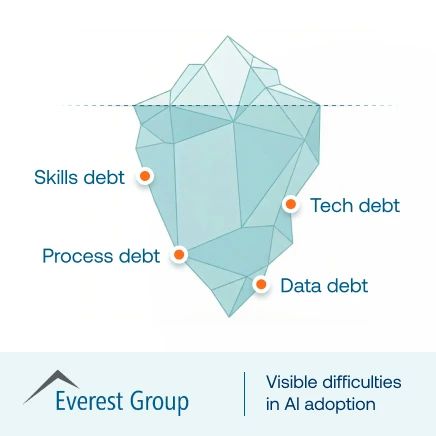



The modern workplace operates in a state of constant flux. Between layered processes, frequent software updates, and shifting industry demands, enterprises have little tolerance for downtime or disruption.
As a result, L&D leaders relying on outdated training methods struggle to keep pace with continuous change. Classroom sessions, static LMS courses, and one-time onboarding programs fall short because they are disconnected from real work. They lack the personalization, context, and hands-on reinforcement required for sustained skill development and confident task execution.
Organizations are responding by embracing just-in-time learning as a more effective approach. Instead of treating training as a separate event or expanding content libraries, just-in-time learning focuses on enabling employees directly within their workflows. This allows users to get the right guidance, at the right moment, while completing real tasks, helping them adapt faster to new tools, processes, and expectations.
In this article, we’ll explore what just-in-time (JIT) learning is, why it’s become essential for modern workplace training, and its common use cases across enterprise teams. We’ll also examine how Whatfix enables moment-of-need support through in-app guidance, simulation-based training, and data-driven insights to drive productivity and maximize digital transformation ROI.
What Is Just-in-Time Learning?
Just-in-time (JIT) learning is a workplace training approach that delivers instruction or guidance at the learner’s exact moment of need. It provides proactive, immediate support as users encounter new tasks, unfamiliar workflows, or friction within an application.
Just-in-time support, by contrast, is less focused on teaching and more focused on enabling execution. Rather than pulling employees out of their work to learn, JIT support delivers contextual in-app guidance that helps users complete tasks correctly and efficiently while maintaining workflow continuity. This reduces reliance on managers, IT support teams, or external documentation.
Key characteristics of just-in-time learning include:
- Bite-sized learning opportunities
- In-the-moment knowledge acquisition
- Personalization based on individual knowledge gaps and role context
- Performance-oriented, task-specific content
- Direct integration into live applications and systems
- Continuous and informal delivery
- Insights driven by real user behavior and usage patterns
Modern enterprises need both moment-of-need training and support to enable employees in the flow of work while minimizing friction and disruption. Together, these approaches extend hands-on learning beyond pre-work or post-work training and into live, real-world execution, shifting training from a before-work activity to a during-work experience.
Why Traditional Training Models Fail in Modern Enterprise Environments
Enterprise success depends on employee proficiency and productivity. Effective technology enablement can be the difference between a workforce that adapts and performs and one that struggles to keep pace with change.
However, modern operating environments make traditional training difficult to sustain. Software sprawl, frequent UI changes, role-based workflow variation, and constant time pressure all work against centralized, event-based training models. LMS-first strategies and one-time enablement programs often fail because they assume employees can disengage from real work to learn and then retain that knowledge long enough to apply it later.
Without continuous, hands-on enablement embedded into daily workflows, L&D initiatives break down. The result is lost productivity, higher error rates, increased compliance risk, and the rise of shadow processes as employees create workarounds to get their jobs done.
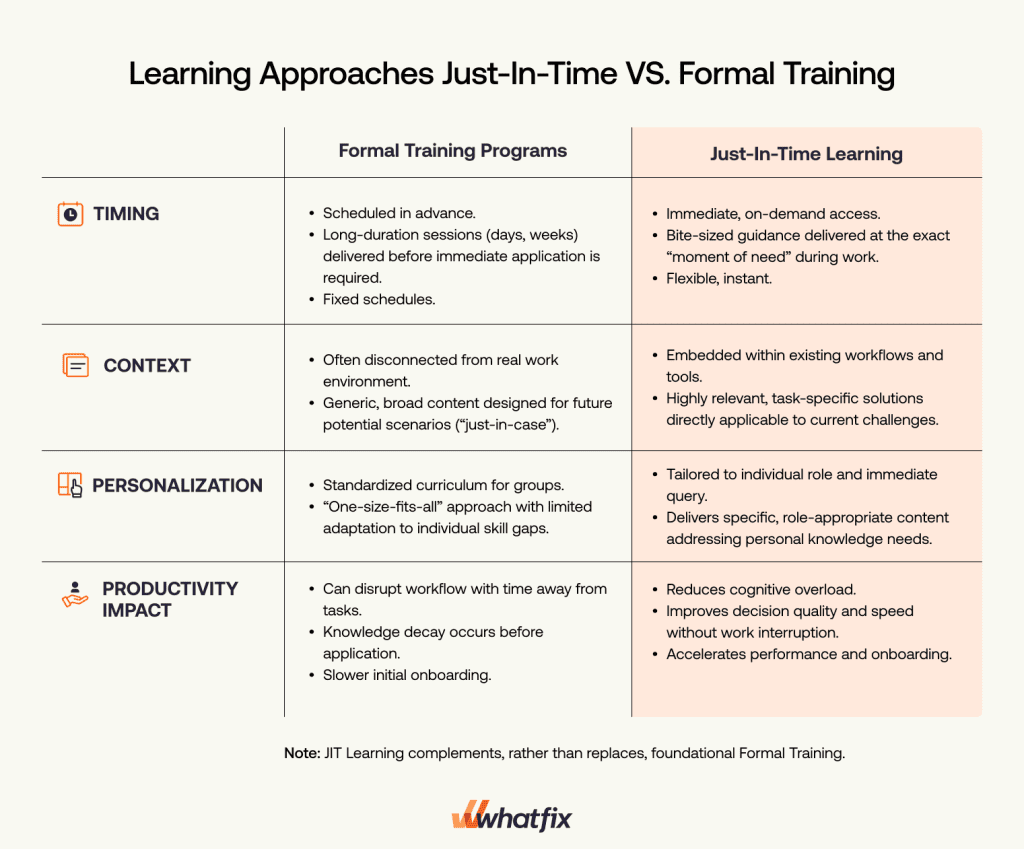
Just-in-Time Learning vs. Formal Training Programs
Traditional training programs have historically relied on rigid, instructor-led formats such as workshops and seminars. Even with the rise of eLearning, many programs still require employees to click through static presentations or attend long, low-engagement webinars.
While formal training remains valuable for foundational knowledge, certification requirements, and key onboarding milestones, it lacks the interactivity and continuity needed to support ongoing performance. These models are typically detached from live systems and real workflows, making it difficult for employees to apply what they’ve learned when it matters most.
Just-in-time learning complements formal training by supporting employees as they move from structured learning into real work. It provides contextual guidance during broader employee training initiatives and extends into live production environments. By delivering support at the moment of need, JIT learning reduces friction during new tasks, infrequent workflows, unexpected scenarios, and periods of change.
| Dimension | Formal Training Programs | Just-in-Time Learning |
| Primary purpose | Build foundational knowledge and baseline competency | Enable task execution and performance at the moment of need |
| Timing | Before work begins or at fixed milestones | During work, embedded in live workflows |
| Learning context | Detached from real systems and applications | Delivered inside the applications employees actually use |
| Content format | Courses, workshops, webinars, static modules | Bite-sized, contextual, task-specific guidance |
| Personalization | Role-based at best, often one-size-fits-all | Personalized by role, behavior, and workflow context |
| Hands-on practice | Limited, often theoretical or simulated outside production | Embedded guidance and optional simulation before live execution |
| Adaptability to change | Slow to update and redeploy | Updates dynamically as workflows, UI, or processes change |
| Measurement focus | Completion rates and assessment scores | Task success, adoption, productivity, and friction reduction |
| Impact on productivity | Requires time away from work | Reduces disruption and accelerates workflow completion |
Core Enterprise Use Cases for Just-in-Time Learning
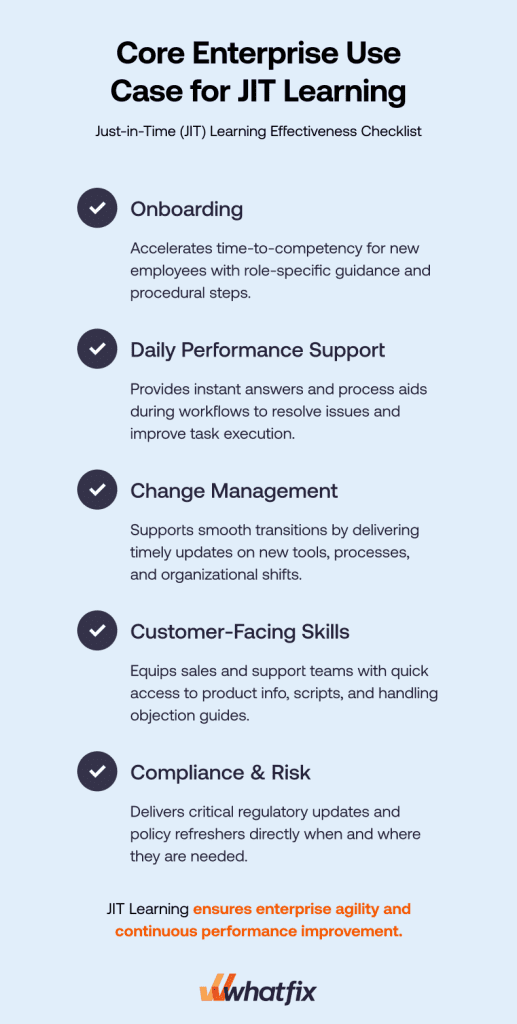
As enterprises evolve, employees are continuously required to learn new systems, workflows, and ways of working. Just-in-time learning can be applied across nearly any digital task or training initiative to provide deeper, more contextual support where it matters most.
Employee Onboarding & New Hire Training
Traditional onboarding establishes foundational knowledge, but just-in-time learning accelerates productivity by enabling new hires to get directly inside core systems such as CRM, ERP, and HCM platforms. By supporting role-specific, guided new hire onboarding workflows from day one, JIT reduces reliance on classroom training, shadowing, and manager intervention while helping new employees become productive faster without overwhelming them upfront.
Daily Performance Support
Even experienced employees encounter complex or infrequently used workflows. Just-in-time learning delivers step-by-step, contextual guidance that enables employees to learn in the flow of work within their applications, reducing errors across functions such as finance, HR, IT, and operations while minimizing time spent searching for help outside the flow of work.
Change Management
Software rollouts, feature updates, and process changes often create resistance when employees receive only high-level communications or one-time training. Just-in-time support guides users through changes directly within the application, driving change adoption as work happens, reducing the need for retraining programs, and limiting productivity dips during periods of transformation.
Customer-Facing Skills
As new employees train for customer interactions, real-time guidance can be integrated into CRM tools for immersive, hands-on training opportunities. Tools like Whatfix offer AI roleplay and simulations that get employees ready for live interactions, ultimately reducing ramp time and improving consistency across customer experiences
Compliance and Risk Management
Most enterprises have teams working within constraints of laws and regulations, whether they’re related to things like customer data or policy governance. Here, JIT learning can provide guided support for executing regulated workflows, ensuring that they complete tasks correctly on their first attempt. Over time, this reduces the risk of operational errors, audits, and legal or regulatory penalties.
5 Challenges of Managing Just-in-Time Learning
Just-in-time training has many benefits, but building a JIT learning initiative on top of existing L&D endeavors is tough. Here are some of the main challenges of implementing and maintaining a JIT program:
- Contextual, role-based targeting: Delivering the right guidance to the right user at the right moment is difficult in large enterprises with diverse roles, permissions, and workflows. Without accurate role and behavior-based targeting, JIT content risks becoming generic, or irrelevant which undermines trust and adoption rather than improving performance.
- Overlays can cause UX issues: Some JIT solutions rely on overlays or limited integrations that interfere with application usability. When guidance obstructs workflows, loads inconsistently, or behaves differently across systems, it creates new friction instead of removing it. In these cases, employees may disengage from the support entirely or develop workarounds.
- Maintaining outdated guidance and support: Enterprise applications evolve constantly, with frequent UI updates, workflow changes, and policy revisions. Maintaining just-in-time guidance at this pace can be challenging, especially when updates require heavy IT involvement. Outdated or incorrect guidance quickly erodes user confidence and can introduce operational or compliance risk.
- Lack of workflow governance: Without established governance, enforcing compliance and proper execution is virtually impossible. It’s best to establish workflow governance early on and incorporate JIT tools to provide continuous support.
- Ownership between L&D, department leaders, and IT: Just-in-time learning often sits at the intersection of L&D, department leaders, and IT. When ownership is unclear, initiatives can stall due to competing priorities, access constraints, or political friction. Without shared visibility and accountability, it becomes difficult to scale JIT learning or continuously improve it using real usage data.
Why Just-in-Time Learning Requires a Centralized Enablement Platform
Just-in-time learning breaks down when it is managed through fragmented tools, standalone overlays, or ad hoc solutions. These approaches may work for isolated use cases, but they fail to scale in complex enterprise environments with multiple applications, roles, and constant change.
A centralized digital adoption platform is required to manage just-in-time learning effectively because it enables organizations to:
- Govern in-app guidance at scale by standardizing workflows and ensuring employees receive consistent, approved guidance across systems.
- Target support to the context of the role, behavior, and workflow stage, rather than delivering generic or disruptive guidance.
- Maintain accuracy as systems evolve by updating guidance quickly as applications, UI, and processes change, without heavy IT dependency.
- Reduce user friction by delivering support natively within applications instead of relying on disconnected tools or documentation.
- Measure impact and optimize continuously by analyzing user behavior, identifying friction points, and closing the feedback loop with data-driven improvements.
How Whatfix Operationalizes Just-in-Time Learning and Support
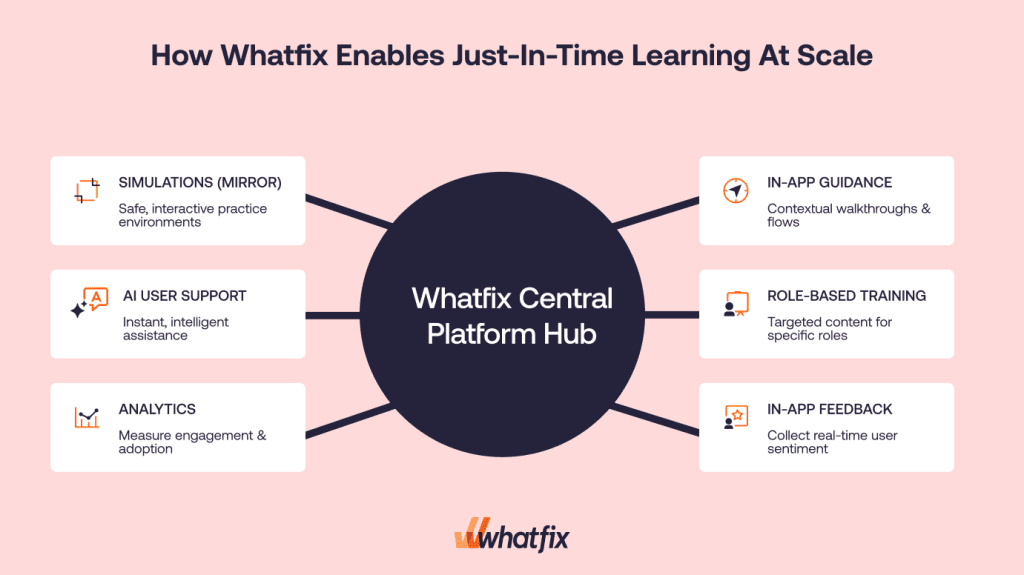
Whatfix’s digital adoption platform combines in-app guidance, simulation-based training, AI-powered assistance, and behavioral analytics to operationalize just-in-time learning at enterprise scale. Together, these capabilities enable employees with contextual support before, during, and after task execution, bridging practice, productivity, and real-time performance support across the digital workplace.
Below are the core capabilities that enable Whatfix to deliver governed, people-first just-in-time learning and support.
In-App Guidance
Whatfix overlays directly on everyday enterprise platforms to deliver contextual in-app guidance as employees work. Through step-by-step walkthroughs, tooltips, smart nudges, and task lists, Whatfix supports users at precise moments of friction, helping them complete workflows correctly while learning in the flow of work.
AI User Support
Whatfix combines AI and behavioral analytics to surface the most relevant self-help content at the moment of need. Employees can access contextual answers, guided help, and knowledge resources without leaving the application, reducing dependency on IT tickets, managers, or external documentation.
Role-Based Training Experiences
Whatfix personalizes guidance according to a user’s specific role, region, proficiency level, and behavior to deliver relevant support at scale. By ensuring that employees receive guidance that matches up exactly with their background and needs, Whatfix enables employees with immediate support and lasting learning.
Simulation-Based Training in Risk-Free Sandbox Environments
Whatfix Mirror empowers leaders to create interactive application replicas that can be used for risk-free training, experimentation, and simulation training. Mirror enables hands-on learning within complex systems, allowing users to learn and experiment safely before executing tasks in live environments.
AI-Powered Roleplay
Whatfix also supports AI-powered roleplay scenarios that prepare employees for real-world customer interactions and high-stakes decision-making. By practicing workflows and soft skills in simulated environments, customer-facing teams are better prepared before entering live situations.
Behavioral Analytics to Identify Friction and Optimize Workflows
Whatfix Analytics continuously tracks how users interact with applications to identify drop-offs, errors, and adoption gaps. These insights allow enablement teams to pinpoint friction areas, optimize workflows, and deploy targeted in-app guidance where it will have the greatest impact.
Continuous Enablement Across Onboarding, Adoption, and Change
Whatfix’s in-app guidance persists beyond initial employee onboarding or go-live events. This ensures employees receive ongoing just-in-time support as applications evolve, features change, and processes are updated, enabling sustained adoption rather than one-time training success.
Closed-Loop Feedback Through In-App Surveys and User Insights
On top of behavioral analytics, user feedback is essential for leaders seeking to understand what employees need in terms of support and training. JIT tools like Whatfix in-app pop-ups can capture user sentiment within workflows. This enables continuous validation and refinement of enablement strategies.
Making Just-in-Time Learning Work for Enterprises, with Whatfix
Without just-in-time learning and support, enterprises risk investing heavily in training programs that fail to translate into on-the-job performance. With Whatfix, organizations operationalize just-in-time learning through a centralized, data-driven enablement platform that supports employees before, during, and after work. The result is higher productivity, faster adoption, and measurable digital transformation outcomes driven by a people-first approach.
Request a demo to see how Whatfix enables just-in-time learning, in-app guidance, and simulation-based training at enterprise scale.