










ACFS Port Logistics is Australia’s largest privately owned container logistics company, operating across all major ports and servicing over 850,000 TEUs annually. The company offers a full spectrum of services—transportation, intermodal rail, warehousing, and customs—and is a vital link between port terminals and inland destinations across retail, FMCG, and industrial sectors.
To future-proof operations and improve customer experience, ACFS made the bold move to migrate to a new transportation management system (TMS) with new capabilities and advanced features. A shift of this magnitude required more than technology; it required new ways of working. ACFS needed to ensure teams were engaged early, workflows were validated before go-live, and users felt confident using the new platform from day one.
“Whatfix has enabled an organization that is just embarking on their digital journey to understand the technology, remove the fear, and guide our teams through systems in a way that feels familiar,” said Rix, Head of Digital Transformation at ACFS.
Most ACFS employees had minimal experience with enterprise software tools and their workflows, and the company lacked the internal bandwidth for high-touch training, user acceptance testing (UAT), and performance support.
UAT was critical, but time-consuming. Manual test documentation, duplicate issues in triage efforts, onboarding ux, and scattered support resources slowed progress, delayed feedback loops, and increased costs. With multiple time zones, shift-based work, and limited training resources, rolling out consistent and repeatable UAT across Australia was a massive challenge.
ACFS had onboarded a centralized SME UAT team, but later moved to a decentralized model, putting additional strain on the training team. Major bottlenecks included:
ACFS needed a better way to train SME change agents, simplify testing, and streamline feedback—all while tracking UAT effectiveness and adoption in real time.
“New technology is exciting, but it rarely comes with a user manual. Even if I had the budget for five trainers, a digital adoption platform would still be necessary to deliver consistent messaging, clear workflows, and accessible resources, making adoption smoother and less stressful,” said Rix.
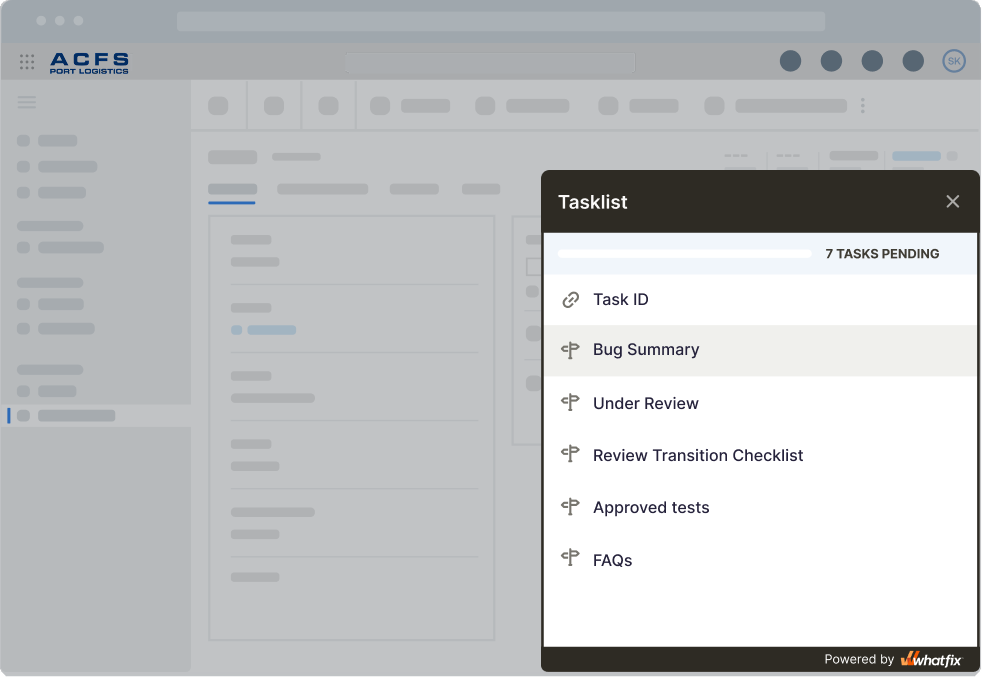
ACFS reimagined its UAT process by deploying Whatfix to onboard SME change agents into each UAT iteration and embedded all testing, learning, and feedback within the new TMS interface.
Here’s how it worked:
“The Whatfix team worked closely with us to build in functionality ensuring the system was fit for our new purpose,” Susan Nguyen Huynh, Systems Analyst.
Integrating with Jira, each logged ticket was automatically routed to the right board, captured all mandatory fields (like steps to reproduce the issue and screenshots), linked to the relevant workflow epic, and automatically sent status updates to the reporter.
“We show users a video, walk them through it step-by-step, and have them try it themselves. What we’re finding now is that people aren’t even noticing Whatfix—it’s just part of their experience,” said Rix.
With Whatfix Product Analytics, ACFS was able to identify additional areas of user friction, such as tasks where users spent too much time or became disengaged.
“Using Whatfix Analytics, we can support users from day one—even if they have no prior knowledge—guiding them to confidently navigate the system and complete their tasks. The insights we gain also allow us to spot trends and make informed decisions to continuously improve our TMS experience,” said Huynh.
Whatfix helped ACFS streamline UAT, reduce training time, and increase user engagement in just a few months. The impact was felt across the transformation efforts, from validating and testing its new user workflows before launch to supporting users in the flow of work with embedded guidance.
“Even with a budget for 40 trainers to accommodate 30+ sites with 24-hour shifts, utilizing Whatfix has enabled the use of AI for content creation, standardizing our in-app messaging, and helping users learn at their own pace,” said Klare Nepia, Systems Trainer at ACFS.
The partnership with Whatfix enabled ACFS Port Logistics to:
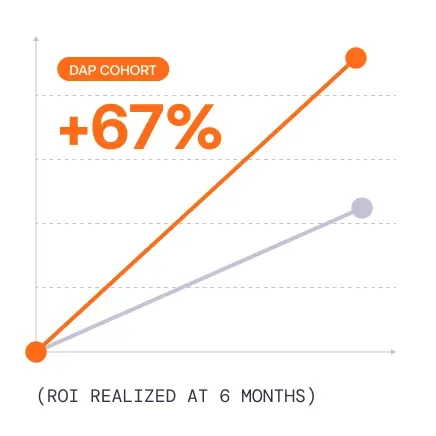
ACFS’s new approach to UAT paid off in measurable ways, like time savings and post-transformation user confidence. This included 4,263 hours saved across the transformation rollout, including:
“Whatfix empowers all of our staff to learn at their own pace, building confidence and capability. We now have a calm, highly engaged team – something that doesn’t come easily,” said Rix.
Looking ahead, ACFS plans to integrate Whatfix Product Analytics with Power BI to segment users, measure behaviors, and drive data-led adoption. They’re also exploring Whatfix AI to bring more automation and contextual personalization to the in-app experience.
“The Whatfix team has been extraordinarily collaborative,” said Nguyen Huynh. “They’ve helped us use DAP differently—and allowed us to create an in-app experience unique to ACFS.”