












Research on simulation-based training found that scenario-based learning significantly improved teamwork and communication compared with traditional approaches, with roleplay participants performing roughly in the 66th percentile for teamwork and 70th percentile for communication against control groups.
While this research comes from the healthcare sector, it supports the broader value of roleplay-based training: structured simulations help teams practice communication, collaboration, and decision-making before they face high-pressure, real-world situations.
This user readiness matters because poor customer experiences carry direct revenue risk. Qualtrics estimates that organizations globally are putting nearly $3 trillion in sales at risk in 2026 due to bad customer experiences, with 34% of consumers reducing spending and 13% stopping spending entirely after a negative interaction.
Well-designed roleplaying scenarios help agents build the confidence, judgment, and workflow accuracy required to respond clearly, follow the right process, and resolve issues under pressure.
This guide includes 44 roleplaying scenarios for customer support teams across different industries such as banking, healthcare, insurance, retail, and more, all with script starters, agent responses, evaluation criteria, and ways to use AI roleplay to make practice more consistent and scalable.
What Are Roleplaying Scenarios for Customer Support?
Roleplaying scenarios for customer support are structured training exercises that simulate real customer interactions, such as billing disputes, technical issues, refund requests, escalation calls, or frustrated customers. They help agents practice how to respond, follow the right process, and escalate issues before handling similar situations with live customers.
44 Roleplaying Scenarios for Customer Support Teams
The following roleplay scenarios help place frontline and service team members into situations that put agents soft skills, procedural knowledge, product awareness, and more to the test.
Each scenario should be adapted to your team’s contextual needs, whether that is support channel, product complexity, customer segment, or agent experience level.
We’ve also broken up our contact center and customer service roleplay scenarios into the following categories:
- General support scenarios (industry-agnostic)
- Banking scenarios
- Healthcare scenarios
- Insurance scenarios
- Retail and e-commerce scenarios
- SaaS provider scenarios
- Telecom and utilities scenarios
General scenarios (industry-agnostic)
Every support team must prepare their agents for frustrated callers, unclear problems, and policy pushback from customers. These core, general customer service scenarios help agents practice the core skills behind great service: active listening, empathy, ownership, clear communication, and confident resolution.
Scenario 1. Angry Customer After a Repeated Unresolved Issue
A customer has contacted support multiple times about the same issue and feels the team has failed to take ownership. The agent’s goal is to acknowledge the frustration, review the customer’s history, and move the issue toward a clear next step.
Customer says: “I’ve already contacted support three times about this, and I still don’t have a solution. Why should I keep explaining the same issue again?”
Agent goal: Rebuild trust by acknowledging the repeated effort, taking ownership of the issue, and setting a clear path forward.
| What agents should do | Agents should avoid |
| Acknowledge the customer’s frustration without sounding defensive. | Asking the customer to repeat the full issue from the beginning. |
| Review previous case notes before asking new questions. | Blaming another team, previous agent, or the customer. |
| Summarize what has already been tried. | Giving vague reassurance like “we’ll look into it.” |
| Explain the next action and who owns it. | Making promises without confirming feasibility. |
| Escalate with full context if the issue needs specialist review. | Ending the interaction without a clear next step. |
Evaluate Criteria: Empathy, ownership, issue summary, next-step clarity, escalation judgment, and follow-through.
Scenario 2. Technical Troubleshooting Under Time Pressure
A customer is blocked by a technical issue while trying to complete an urgent task. The agent’s goal is to diagnose the issue quickly, guide the customer through the right steps, and keep the interaction calm and focused.
Customer says: “I need this fixed right now. I’m in the middle of something important and this issue is blocking me.”
Agent goal: Diagnose the issue efficiently while keeping the customer focused, informed, and confident in the troubleshooting process.
| What agents should do | Agents should avoid |
| Acknowledge the urgency and explain the troubleshooting approach. | Rushing into random fixes without understanding the issue. |
| Ask targeted questions about the task, error message, device, browser, or workflow step. | Overloading the customer with too many questions at once. |
| Guide the customer through one step at a time. | Using technical language the customer may not understand. |
| Document what has been tested and what changed. | Repeating steps without explaining why they matter. |
| Escalate when the issue needs technical investigation or admin support. | Keeping the customer waiting without status updates. |
Evaluate Criteria: Troubleshooting accuracy, question quality, pacing, instruction clarity, documentation, and escalation judgment.
Scenario 3. Account Access or Login Issue
A customer cannot log in, reset their password, or access the right account permissions. The agent’s goal is to help the customer regain access while following identity verification and security protocols.
Customer says: “I’m locked out of my account and need access immediately. Can you just reset it for me?”
Agent goal: Restore account access safely without bypassing required verification steps or exposing sensitive account information.
| What agents should do | Agents should avoid |
| Acknowledge the customer’s urgency. | Resetting access before verifying the customer’s identity. |
| Complete the required identity verification steps. | Sharing account information with an unverified user. |
| Determine whether the issue is related to password reset, multi-factor authentication, permissions, or account status. | Overpromising immediate access. |
| Walk the customer through the approved recovery process. | Blaming the customer for being locked out. |
| Escalate the issue if verification fails or admin approval is required. | Giving vague next steps like “try again later.” |
Evaluate Criteria: Security compliance, verification accuracy, troubleshooting clarity, patience, escalation judgment, and avoidance of unsafe shortcuts.
Scenario 4. Customer Immediately Asks for a Manager
A customer refuses to continue with the frontline agent and asks to speak with a manager. The agent’s goal is to acknowledge the request, stay composed, and understand the issue before escalating.
Customer says: “I don’t want to talk to you. Get me your manager.”
Agent goal: Keep the interaction professional, gather enough context, and determine whether manager escalation is required.
| What agents should do | Agents should avoid |
| Acknowledge the customer’s request calmly. | Taking the request personally. |
| Ask for brief context so the issue can be routed correctly. | Refusing escalation outright. |
| Try to understand the customer’s desired outcome. | Arguing about whether a manager is needed. |
| Explain what can be done immediately and what requires manager review. | Transferring without documenting the issue. |
| Escalate with clear notes if manager involvement is appropriate. | Making the customer repeat the issue unnecessarily. |
Evaluate Criteria: Composure, professionalism, issue clarification, ownership, escalation judgment, and handoff quality.
Scenario 5. Service Outage or Known Incident
A customer is affected by downtime, degraded performance, or a known issue that is already being investigated. The agent’s goal is to communicate clearly, share what is known, and set expectations without overpromising.
Customer says: “Your service is down and it’s affecting my work. When is this going to be fixed?”
Agent goal: Provide accurate incident information, offer any approved workaround, and set realistic expectations for updates.
| What agents should do | Agents should avoid |
| Acknowledge the disruption and business impact. | Guessing a resolution time without confirmation. |
| Share the latest confirmed incident update. | Minimizing the issue or using vague language. |
| Explain any available workaround. | Blaming internal teams or external vendors. |
| Tell the customer where and when to expect updates. | Giving conflicting information across channels. |
| Document the customer’s impact if escalation or follow-up is needed. | Ending the conversation without a follow-up path. |
Evaluate Criteria: Transparency, accuracy, expectation-setting, workaround guidance, follow-up clarity, and incident communication.
Scenario 6. Customer Refuses Troubleshooting Steps
A customer is frustrated and does not want to repeat basic troubleshooting steps they believe they have already completed. The agent’s goal is to acknowledge the customer’s effort, explain why verification matters, and adapt the troubleshooting flow where possible.
Customer says: “I already tried everything. Don’t make me repeat the same steps again.”
Agent goal: Avoid unnecessary repetition while still verifying the steps needed to diagnose and resolve the issue correctly.
| What agents should do | Agents should avoid |
| Acknowledge what the customer has already tried. | Starting from the beginning without reviewing prior actions. |
| Ask which steps were completed and what happened after each one. | Sounding scripted or dismissive. |
| Explain why a specific verification step is necessary. | Saying “we have to do this” without context. |
| Skip or adapt steps when enough evidence exists. | Ignoring troubleshooting protocol completely. |
| Document verified steps to prevent future repetition. | Escalating too early without enough diagnostic information. |
Evaluate Criteria: Patience, adaptability, explanation quality, troubleshooting discipline, tone, and documentation.
Scenario 7. Multiple Issues in One Interaction
A customer brings up several unrelated problems in the same conversation, making the interaction difficult to manage. The agent’s goal is to organize the issues, confirm priorities, and handle each one in a clear order.
Customer says: “I have three different problems, and I need all of them fixed today.”
Agent goal: Structure the conversation so each issue is captured, prioritized, and handled without losing context.
| What agents should do | Agents should avoid |
| Summarize each issue back to the customer. | Jumping between issues without a clear order. |
| Confirm which issue is most urgent. | Ignoring lower-priority issues without documenting them. |
| Handle one issue at a time. | Promising all issues will be resolved in the same interaction. |
| Create separate tickets or follow-ups when needed. | Mixing unrelated problems into one unclear case note. |
| Set expectations for what can be resolved now and what needs follow-up. | Ending the interaction without confirming next steps for each issue. |
Evaluate Criteria: Prioritization, summarization, conversation control, follow-up planning, documentation, and expectation-setting.
Scenario 8. Abusive or Inappropriate Customer Behavior
A customer becomes verbally abusive, uses inappropriate language, or crosses a professional boundary during the interaction. The agent’s goal is to stay calm, set a clear boundary, and follow the company’s escalation or interaction-closure policy.
Customer says: “This is ridiculous. You people are completely useless.”
Agent goal: Maintain professionalism, set respectful communication boundaries, and continue support only if the interaction can proceed safely.
| What agents should do | Agents should avoid |
| Stay calm and professional. | Matching the customer’s tone or arguing back. |
| Acknowledge the issue without accepting abusive behavior. | Ignoring abusive language if policy requires a warning. |
| Set a clear boundary using approved language. | Threatening the customer or sounding punitive. |
| Redirect the conversation back to the issue. | Continuing indefinitely if the customer remains abusive. |
| Escalate or end the interaction according to company policy. | Handling unsafe behavior without documenting it. |
Evaluate Criteria: Composure, boundary-setting, professionalism, policy adherence, safe escalation, and documentation.
Scenario 9. Language Barrier or Accessibility Need
A customer needs extra support because of a language barrier, disability, assistive technology requirement, or difficulty understanding the instructions. The agent’s goal is to make the interaction easier to follow and confirm the customer can complete the next step.
Customer says: “I’m having trouble understanding these instructions. Can you explain it another way?”
Agent goal: Make the support experience clear, accessible, and manageable without making the customer feel rushed or dismissed.
| What agents should do | Agents should avoid |
| Slow down and use plain language. | Repeating the same explanation louder or faster. |
| Break instructions into smaller steps. | Using jargon, acronyms, or unclear product terms. |
| Check understanding after each step. | Assuming the customer understands because they did not interrupt. |
| Offer approved accessibility or language support options when available. | Treating accessibility needs as an inconvenience. |
| Summarize the next step clearly before moving on. | Ending the interaction without confirming completion or understanding. |
Evaluate Criteria: Clarity, patience, inclusive communication, accessibility support, confirmation of understanding, and customer reassurance.
Scenario 10. Escalation Handoff to Tier 2 or Technical Support
The issue cannot be resolved by the frontline agent and needs to be transferred to Tier 2, technical support, engineering, billing, or another specialist team. The agent’s goal is to explain the handoff clearly, document the case context, and set expectations so the customer does not feel passed around.
Customer says: “Can you transfer me to someone who can actually fix this?”
Agent goal: Escalate the issue with complete context while maintaining customer confidence and reducing the need for repeated explanations.
| What agents should do | Agents should avoid |
| Explain why escalation is needed. | Making the customer feel dismissed or passed off. |
| Document the issue, actions taken, and desired outcome. | Transferring without case notes. |
| Share what the next team will review or do. | Saying “someone will get back to you” without detail. |
| Set expectations for timeline, channel, or follow-up process. | Overpromising resolution from the next team. |
| Reassure the customer that context will be passed along. | Forcing the customer to restart the conversation with the next team. |
Evaluate Criteria: Handoff quality, documentation, expectation-setting, customer reassurance, escalation accuracy, and ownership.
Banking scenarios
Support conversations in banking and financial services contact centers are high-stakes because customers are dealing with money, identity, credit, and financial security. Agents must be able to de-escalate quickly, verify identities, follow fraud and privacy protocols, and explain policies without increasing customer anxiety.
Scenario 11. A Customer Sees a Suspicious Transaction
A customer notices a charge or withdrawal they do not recognize and is worried their account or card has been compromised. The agent’s goal is to verify the customer’s identity, gather transaction details, and follow the bank’s fraud-reporting process.
Customer says: “There’s a charge on my account that I don’t recognize. Has someone stolen my card information?”
Agent goal: Help the customer report the suspicious transaction while following identity verification, fraud, and account security protocols.
| What agents should do | Agents should avoid |
| Acknowledge the customer’s concern and urgency. | Confirming sensitive account details before verification. |
| Complete required identity verification steps. | Telling the customer it is definitely fraud before investigation. |
| Ask for the transaction date, amount, merchant name, and account or card type. | Making promises about refunds, credits, or investigation outcomes. |
| Follow the approved process for reporting suspicious activity. | Skipping fraud-reporting steps to move faster. |
| Explain what happens next, including card lock, dispute review, provisional credit, or follow-up timelines if applicable. | Giving vague next steps like “someone will look into it.” |
Evaluate Criteria: Verification accuracy, fraud protocol compliance, urgency, clarity, expectation-setting, and avoidance of unsafe account disclosures.
Scenario 12. A Customer Is Locked Out of Online Banking
A customer cannot access online banking because of a password issue, multi-factor authentication failure, device change, or account lock. The agent’s goal is to restore access safely while protecting the customer’s account.
Customer says: “I can’t log in to my online banking, and I need to transfer money today. Can you unlock it right now?”
Agent goal: Help the customer regain access without bypassing identity verification, authentication, or account security controls.
| What agents should do | Agents should avoid |
| Acknowledge the urgency and explain that security verification is required. | Unlocking access before verifying identity. |
| Confirm whether the issue is password-related, MFA-related, device-related, or account-status related. | Asking the customer to share passwords, PINs, or full security answers aloud. |
| Walk the customer through the approved recovery flow. | Suggesting workarounds that bypass bank security controls. |
| Explain any waiting period, admin review, or additional authentication step. | Overpromising immediate access if security review is required. |
| Escalate if the lockout is linked to suspected fraud or failed verification. | Blaming the customer for failed login attempts. |
Evaluate Criteria: Security compliance, verification accuracy, troubleshooting clarity, patience, and safe escalation.
Scenario 13. A Customer Is Upset About an Overdraft Fee
A customer is frustrated after being charged an overdraft fee and believes the fee is unfair. The agent’s goal is to acknowledge the concern, explain the policy clearly, and review any available resolution options.
Customer says: “Why did you charge me an overdraft fee? I deposited money the same day.”
Agent goal: Explain the overdraft fee clearly, review the account timeline, and offer approved options without making unauthorized fee reversals.
| What agents should do | Agents should avoid |
| Acknowledge the customer’s frustration. | Saying “that’s just the policy” without explanation. |
| Review the transaction and deposit timing carefully. | Reversing a fee without confirming eligibility. |
| Explain how overdraft rules, posting order, cutoff times, or available balance apply. | Using confusing banking jargon. |
| Check whether the customer qualifies for a fee review, waiver, or account option. | Blaming the customer for the overdraft. |
| Offer prevention guidance if appropriate, such as alerts or account settings. | Overpromising that future fees will not occur. |
Evaluate Criteria: Empathy, policy explanation, account review accuracy, resolution options, and responsible communication.
Scenario 14. A Customer Wants to Dispute a Charge on Their Card or Account
A customer calls about a specific charge on their debit card, credit card, or bank account and wants to dispute it. The agent’s goal is to confirm the details, identify the correct dispute path, and set expectations for review timelines.
Customer says: “There’s a charge on my card that I didn’t make. I want it removed from my account.”
Agent goal: Start the correct dispute process while gathering required details and explaining what the customer can expect next.
| What agents should do | Agents should avoid |
| Verify the customer’s identity before discussing account activity. | Discussing transaction details before verification. |
| Confirm the transaction amount, date, merchant, and card or account involved. | Assuming the dispute will be approved. |
| Ask whether the card is still in the customer’s possession and whether they recognize the merchant. | Telling the customer the charge will be removed immediately unless policy allows it. |
| Explain the dispute process, documentation needs, and review timeline. | Skipping required disclosures or compliance steps. |
| Follow the correct path for fraud, merchant dispute, duplicate charge, or billing error. | Treating every charge dispute as the same type of case. |
Evaluate Criteria: Compliance, documentation quality, transaction-detail accuracy, expectation-setting, and dispute-path selection.
Scenario 15. A Customer Is Confused About Loan or Credit Card Terms
A customer does not understand a loan, credit card, interest rate, repayment term, fee, or statement detail. The agent’s goal is to explain the information clearly using approved language without giving unauthorized financial advice.
Customer says: “I don’t understand why my payment changed. Can you explain what I’m actually being charged for?”
Agent goal: Clarify the customer’s account or product terms accurately while staying within approved communication and disclosure guidelines.
| What agents should do | Agents should avoid |
| Ask which term, fee, rate, payment, or statement detail is unclear. | Giving personal financial advice outside the agent’s role. |
| Use plain language to explain the relevant term or calculation. | Using technical terms without explanation. |
| Reference approved disclosures, statements, or policy language. | Speculating about future rates, approvals, or outcomes. |
| Confirm the customer understands before moving on. | Rushing through complex financial details. |
| Escalate to a licensed or specialist team if the question requires it. | Interpreting legal or financial terms beyond approved guidance. |
Evaluate Criteria: Clarity, accuracy, responsible communication, disclosure adherence, customer understanding, and escalation judgment.
Scenario 16. A Customer Is Denied a Mortgage Loan
A customer is upset after receiving a mortgage denial and wants the agent to explain or reverse the decision. The agent’s goal is to respond with empathy, explain the next steps within approved guidelines, and route the customer to the right team or documentation.
Customer says: “I was denied my mortgage, and I don’t understand why. I need someone to fix this.”
Agent goal: Help the customer understand the approved next steps after a mortgage denial without making unauthorized promises or giving lending advice.
| What agents should do | Agents should avoid |
| Acknowledge the disappointment and seriousness of the situation. | Saying or implying that the decision can be reversed on the call. |
| Confirm what information the agent is permitted to discuss. | Sharing restricted credit, underwriting, or decisioning details without authorization. |
| Direct the customer to the official denial notice, reason codes, or appropriate lending team if applicable. | Giving personal advice on how to qualify for a loan. |
| Explain the appeal, reconsideration, documentation, or next-step process if one exists. | Speculating about underwriting decisions. |
| Document the interaction and route the customer to the right specialist when needed. | Sounding dismissive or treating the denial as a routine inconvenience. |
Evaluate Criteria: Empathy, compliance, responsible communication, expectation-setting, escalation accuracy, and documentation quality.
Healthcare scenarios
Healthcare support requires extra sensitivity because customers may be dealing with pain, fear, confusing bills, test results, prescriptions, or access to care. Agents must communicate with patience while following strict privacy, consent, and HIPAA-related requirements.
Scenario 17. A Patient Is Confused About a Medical Bill
A patient does not understand a medical bill, insurance adjustment, copay, deductible, or out-of-pocket charge. The agent’s goal is to explain the bill clearly, show patience, and help the patient understand the next step without giving incorrect financial or coverage information.
Customer says: “I don’t understand why I’m being charged this much. I thought my insurance covered this.”
Agent goal: Explain the billing details in plain language while confirming what can be reviewed, corrected, or escalated.
| What agents should do | Agents should avoid |
| Acknowledge that medical bills can be confusing and stressful. | Sounding dismissive or implying the patient should already understand the bill. |
| Verify the patient’s identity before discussing billing details. | Sharing billing or health information before verification. |
| Walk through the charge, insurance adjustment, copay, deductible, or balance due in simple terms. | Using billing jargon without explanation. |
| Explain whether the next step is payer review, billing correction, payment plan, or specialist follow-up. | Promising that insurance will cover or remove a charge. |
| Escalate to billing specialists when the issue requires deeper review. | Giving vague next steps like “call your insurance” without context. |
Evaluate Criteria: Billing explanation, patience, identity verification, sensitivity, clarity, and escalation judgment.
Scenario 18. A Patient Cannot Access Their Online Patient Portal
A patient cannot log in to the patient portal, reset a password, complete MFA, view information, or use an accessibility feature. The agent’s goal is to troubleshoot access while protecting patient privacy and making the steps easy to follow.
Customer says: “I can’t get into my patient portal, and I need to see my appointment details.”
Agent goal: Restore portal access through the approved support process without exposing protected health information or bypassing security controls.
| What agents should do | Agents should avoid |
| Acknowledge the urgency, especially if the patient needs appointment, prescription, or care information. | Discussing protected health information before verification. |
| Complete required identity verification steps. | Resetting access without confirming the patient’s identity. |
| Determine whether the issue is password, MFA, browser, device, permissions, or account-status related. | Assuming the patient is at fault or technically inexperienced. |
| Walk the patient through the approved recovery process step by step. | Rushing through instructions or using technical jargon. |
| Offer accessibility or alternate support options when available. | Leaving the patient without a clear next step if portal access cannot be restored immediately. |
Evaluate Criteria: Privacy compliance, troubleshooting clarity, accessibility support, patience, verification accuracy, and safe escalation.
Scenario 19. A Patient Wants Test Results the Agent Cannot Share
A patient calls asking for test results, lab results, imaging results, or clinical information that the support agent is not authorized to share. The agent’s goal is to stay empathetic while following privacy, clinical communication, and escalation rules.
Customer says: “I can see that my test results are ready. Can you just tell me what they say?”
Agent goal: Protect patient privacy and clinical safety by routing the patient to the approved channel or care team for test result communication.
| What agents should do | Agents should avoid |
| Acknowledge that waiting for test results can be stressful. | Reading or interpreting test results if the agent is not authorized to do so. |
| Verify the patient’s identity before discussing account or portal information. | Sharing protected health information without verification. |
| Explain what information the agent can and cannot provide. | Giving clinical advice or interpreting medical terms. |
| Direct the patient to the appropriate provider, portal message, care team, or approved results process. | Saying “everything looks fine” or “you should be worried” based on visible information. |
| Document the inquiry and escalate if the patient reports urgent symptoms or the process requires follow-up. | Leaving the patient without a clear next step. |
Evaluate Criteria: HIPAA-safe communication, privacy boundaries, empathy, next-step clarity, escalation judgment, and avoidance of unauthorized clinical guidance.
Scenario 20. A Caregiver Calls on Behalf of a Patient
A caregiver, family member, or guardian calls to discuss a patient’s appointment, bill, medication, portal access, or care information. The agent’s goal is to verify consent or authorization before sharing information and to help within the allowed privacy boundaries.
Customer says: “I’m calling for my father. He asked me to check his appointment and test results.”
Agent goal: Confirm whether the caller is authorized to receive information and provide support without violating privacy or consent requirements.
| What agents should do | Agents should avoid |
| Acknowledge the caregiver’s intent to help. | Sharing patient information before confirming authorization. |
| Verify the caller’s identity and relationship to the patient according to policy. | Assuming a family member is automatically authorized. |
| Check consent, proxy access, power of attorney, guardian status, or approved caregiver permissions if applicable. | Discussing test results, diagnoses, prescriptions, or billing details outside approved access rules. |
| Explain what can be shared and what requires patient consent or a different process. | Sounding accusatory when privacy rules limit the conversation. |
| Provide approved next steps for gaining access or routing the request. | Ending the call without explaining how the caregiver can proceed appropriately. |
Evaluate Criteria: Verification accuracy, consent handling, privacy compliance, empathy, boundary-setting, and next-step clarity.
Insurance scenarios
Insurance support teams are often contacted after something has gone seriously wrong, such as a car accident, natural disaster, damaged property, or unexpected coverage issue. Agents must balance empathy with accuracy, helping customers navigate stressful moments while staying within policy, claims, documentation, and compliance requirements.
Scenario 21. A Policyholder Is Confused About Their Coverage
A policyholder does not understand what their insurance policy covers, what is excluded, or why a deductible, limit, or condition applies. The agent’s goal is to explain the policy in simple language without giving inaccurate coverage interpretations.
Customer says: “I thought my policy covered this. Why am I being told I may have to pay out of pocket?”
Agent goal: Explain coverage terms clearly, confirm what can be reviewed, and route the customer to the right claims or policy team when needed.
| What agents should do | Agents should avoid |
| Acknowledge that insurance terms can be confusing. | Using policy jargon without explanation. |
| Verify the customer and policy details before discussing coverage. | Confirming coverage before the policy and claim details are reviewed. |
| Explain relevant terms such as deductible, limit, exclusion, waiting period, or covered event in plain language. | Giving legal or claims advice outside approved guidance. |
| Clarify what the policy documents say and what still needs review. | Promising the claim will be paid or denied before review. |
| Escalate to a licensed agent, claims adjuster, or specialist if the question requires interpretation. | Leaving the customer without a clear next step. |
Evaluate Criteria: Policy explanation, clarity, accuracy, verification, expectation-setting, and escalation judgment.
Scenario 22. A Customer Is Upset Their Claim Was Denied
A customer is frustrated after receiving a claim denial and wants the agent to reverse the decision immediately. The agent’s goal is to respond with empathy, explain the approved next steps, and avoid making promises outside the claims process.
Customer says: “I filed a claim because I needed help, and now you’re telling me it was denied. This is unacceptable.”
Agent goal: Acknowledge the customer’s frustration, explain the denial review path, and guide them toward appeal, reconsideration, or documentation steps if available.
| What agents should do | Agents should avoid |
| Acknowledge the stress and disappointment of a denied claim. | Sounding dismissive or treating the denial as routine. |
| Verify the customer’s identity and claim details. | Sharing claim information before verification. |
| Explain what can be discussed based on the claim status and policy rules. | Saying the denial is wrong or promising reversal. |
| Clarify appeal, reconsideration, additional documentation, or review options if available. | Giving legal advice or personal opinions about the claim. |
| Document the conversation and route the customer to the right claims team when needed. | Ending the interaction without clear next steps. |
Evaluate Criteria: Empathy, compliance, claim-process accuracy, expectation-setting, escalation judgment, and documentation quality.
Scenario 23. A Customer Needs Help Filing a Claim After an Accident
A customer contacts support shortly after an accident and may be stressed, injured, or unsure what information is needed. The agent’s goal is to guide the customer calmly through the first notice of loss or claim intake process.
Customer says: “I was just in an accident and I don’t know what I’m supposed to do next.”
Agent goal: Help the customer begin the claim process calmly and accurately while prioritizing safety, required documentation, and next steps.
| What agents should do | Agents should avoid |
| Start by checking whether the customer is safe or needs emergency assistance. | Jumping straight into forms before acknowledging the situation. |
| Explain the claim intake process one step at a time. | Overwhelming the customer with too many questions at once. |
| Collect required details such as date, location, parties involved, damage, photos, police report, or incident summary where applicable. | Asking for unnecessary or speculative details. |
| Explain what happens after the claim is filed. | Promising a payout, repair approval, or timeline that has not been confirmed. |
| Document the claim accurately and provide the claim number or follow-up instructions. | Leaving the customer unsure about what happens next. |
Evaluate Criteria: Calm guidance, empathy, claim intake accuracy, documentation quality, safety awareness, and expectation-setting.
Scenario 24. A Policyholder Wants to Lower Their Premium
A policyholder says their premium is too high and wants help reducing the cost. The agent’s goal is to explore approved options, explain trade-offs, and set expectations without making unsupported savings promises.
Customer says: “My premium is too expensive. What can you do to lower it?”
Agent goal: Help the customer understand available premium-reduction options while explaining how changes may affect coverage, deductibles, or eligibility.
| What agents should do | Agents should avoid |
| Acknowledge the customer’s cost concern. | Promising a lower premium before reviewing options. |
| Review approved options such as discounts, deductible changes, bundling, policy adjustments, or updated information where applicable. | Recommending changes without explaining coverage trade-offs. |
| Explain how each option may affect coverage, out-of-pocket costs, or future claims. | Pressuring the customer into reducing coverage. |
| Confirm whether the customer needs a licensed agent or specialist review. | Giving advice outside the agent’s authorization. |
| Document requested changes and next steps clearly. | Leaving the customer with unclear expectations about savings or eligibility. |
Evaluate Criteria: Consultative support, expectation-setting, policy accuracy, responsible communication, and documentation.
Scenario 25. A Customer Missed a Payment and Fears Losing Coverage
A customer missed an insurance payment and is worried their policy may lapse or already be canceled. The agent’s goal is to reassure the customer, explain policy rules, and review payment or reinstatement options where available.
Customer says: “I missed my payment. Am I going to lose my coverage?”
Agent goal: Help the customer understand their payment status, coverage implications, and available next steps without misrepresenting policy rules.
| What agents should do | Agents should avoid |
| Acknowledge the customer’s concern and urgency. | Saying coverage is active or inactive before checking policy status. |
| Verify the customer and policy details. | Discussing payment or policy details before verification. |
| Review payment status, grace period, lapse status, cancellation notice, or reinstatement options where applicable. | Promising coverage continuation if policy rules do not allow it. |
| Explain payment options, deadlines, and next steps clearly. | Using unclear language about grace periods or reinstatement. |
| Escalate if the situation requires underwriting, billing, or licensed agent review. | Creating false reassurance or unnecessary panic. |
Evaluate Criteria: Reassurance, policy-rule accuracy, payment-status review, clarity, escalation judgment, and compliance.
Scenario 26. Customer Requests a Policy Exception
A customer asks the agent to make an exception to a policy rule, claim requirement, deadline, documentation request, fee, or coverage condition. The agent’s goal is to show empathy while following approved exception or escalation procedures.
Customer says: “I know the deadline passed, but I need you to make an exception for me.”
Agent goal: Explain what can and cannot be changed, document the customer’s situation, and route the request through the approved exception process if one exists.
| What agents should do | Agents should avoid |
| Acknowledge the customer’s situation and why they are asking for flexibility. | Saying yes before confirming whether an exception is allowed. |
| Review the relevant policy rule, deadline, or documentation requirement. | Bypassing policy or compliance requirements. |
| Explain any approved exception, appeal, or review process. | Telling the customer “there’s nothing we can do” without checking the correct path. |
| Document the context and supporting details accurately. | Making unauthorized promises about the outcome. |
| Escalate to the appropriate claims, policy, billing, or licensed team if required. | Treating the request casually when it has compliance implications. |
Evaluate Criteria: Empathy, policy accuracy, boundary-setting, exception-path handling, documentation quality, and escalation judgment.
Retail and e-commerce scenarios
Retail and e-commerce support teams deal with customers who expect fast answers on orders, returns, refunds, damaged products, discounts, and delivery issues. Agents must resolve problems efficiently while protecting margins, following return policies, and keeping a service issue from turning into a lost customer relationship.
Scenario 27. A Customer Wants to Return an Item Outside the Return Window
A customer wants to return an item after the return period has ended and expects the agent to make an exception. The agent’s goal is to explain the return policy clearly, show empathy, and offer approved alternatives where possible.
Customer says: “I know the return window ended last week, but I still want to return this. I barely used it.”
Agent goal: Explain the return policy without sounding dismissive and check whether any approved alternatives are available.
| What agents should do | Agents should avoid |
| Acknowledge the customer’s request and disappointment. | Saying “you missed the window” without explanation or empathy. |
| Verify the order date, return eligibility, item condition, and policy terms. | Approving a return without confirming eligibility. |
| Explain the return window and any exceptions in simple language. | Blaming the customer for not returning the item sooner. |
| Offer approved alternatives, such as exchange, store credit, warranty review, or escalation if applicable. | Making promises outside the return policy. |
| Document the request and outcome clearly. | Giving vague next steps like “try contacting us again later.” |
Evaluate Criteria: Policy communication, empathy, order review accuracy, alternative options, boundary-setting, and documentation.
Scenario 28. A Customer Received the Wrong Product
A customer receives an item they did not order, such as the wrong size, color, model, quantity, or product. The agent’s goal is to apologize, verify the order details, and guide the customer through the correction process.
Customer says: “I ordered a black jacket in medium, but I received a blue one in large. I need the right item sent.”
Agent goal: Take ownership of the order error and help the customer receive the correct product with minimal effort.
| What agents should do | Agents should avoid |
| Apologize for the incorrect item and acknowledge the inconvenience. | Making the customer feel responsible for proving the mistake. |
| Verify the order number, item received, and item originally purchased. | Sending a replacement before confirming inventory or policy. |
| Explain the correction process, including replacement, return label, pickup, or refund if applicable. | Giving unclear instructions for returning the wrong product. |
| Confirm the next step and expected timeline. | Overpromising delivery dates that are not confirmed. |
| Document the issue for fulfillment or warehouse review if needed. | Ending the interaction without confirming the customer’s preferred resolution. |
Evaluate Criteria: Apology quality, order verification, ownership, resolution clarity, timeline accuracy, and documentation.
Scenario 29. A Package Says Delivered, but the Customer Never Received It
A customer says the carrier marked the package as delivered, but they cannot find it. The agent’s goal is to guide the customer through the investigation steps, check available order and shipping information, and set expectations for resolution.
Customer says: “The tracking says delivered, but I never received my package. Where is my order?”
Agent goal: Investigate the missing delivery while setting clear expectations for carrier review, replacement, refund, or next steps.
| What agents should do | Agents should avoid |
| Acknowledge the customer’s concern and urgency. | Assuming the customer misplaced the package. |
| Confirm the shipping address, delivery date, carrier, and tracking details. | Promising an immediate refund or replacement before checking policy. |
| Ask the customer to check approved locations, such as mailbox, front desk, parcel locker, or delivery photo if available. | Sending the customer in circles between retailer and carrier. |
| Explain the investigation process and expected timeline. | Giving vague answers like “wait a few more days” without context. |
| Document the case and follow the approved path for carrier claim, replacement, or refund. | Failing to set a clear follow-up or resolution path. |
Evaluate Criteria: Investigation accuracy, empathy, expectation-setting, policy adherence, carrier-process clarity, and follow-up quality.
Scenario 30. A Customer Is Angry About a Discount Code That Failed
A customer tried to use a discount code during checkout, but it did not apply or expired before purchase. The agent’s goal is to troubleshoot the issue, explain eligibility rules, and offer approved resolution options.
Customer says: “Your discount code didn’t work, and now I’ve been charged full price. I want the discount applied.”
Agent goal: Determine why the code failed and resolve the issue fairly within promotion rules and approved support policy.
| What agents should do | Agents should avoid |
| Acknowledge the frustration and ask for the code or promotion details. | Assuming the customer used the code incorrectly. |
| Check expiration date, product eligibility, account eligibility, minimum cart value, and exclusions. | Applying discounts outside approved promotion rules. |
| Explain why the code did or did not apply in clear terms. | Using vague phrases like “the system rejected it.” |
| Offer approved options, such as price adjustment, store credit, alternate code, or escalation if applicable. | Promising a discount before confirming eligibility. |
| Document the issue if the code failed due to a technical or checkout problem. | Ignoring patterns that may indicate a promotion setup issue. |
Evaluate Criteria: Troubleshooting, fairness, promotion-policy accuracy, clarity, resolution options, and documentation.
Scenario 31. A Customer Received a Damaged Product
A customer receives an item that is broken, defective on arrival, leaking, torn, cracked, or otherwise damaged. The agent’s goal is to acknowledge the issue, collect required evidence, and move quickly toward replacement, refund, or claim review.
Customer says: “My order arrived damaged. I waited a week for this, and now I can’t even use it.”
Agent goal: Resolve the damaged-product issue quickly while following evidence, replacement, refund, or shipping-claim requirements.
| What agents should do | Agents should avoid |
| Apologize for the damaged delivery and acknowledge the inconvenience. | Making the customer feel blamed for the damage. |
| Verify the order, item, delivery date, and damage details. | Asking for unnecessary information that slows resolution. |
| Request required photos or evidence if policy requires it. | Promising replacement or refund before confirming eligibility. |
| Explain the next step, such as replacement, refund, return, disposal instructions, or carrier claim. | Leaving the customer unclear on whether they need to return the damaged item. |
| Escalate urgent or high-value cases according to policy. | Delaying resolution without explaining why. |
Evaluate Criteria: Empathy, speed, evidence collection, policy accuracy, replacement-process clarity, and ownership.
Scenario 32. Refund Request Outside Policy
A customer asks for a refund even though the order, item, condition, time window, or reason does not meet the company’s standard refund policy. The agent’s goal is to explain the policy clearly and offer any approved alternatives without escalating unnecessarily.
Customer says: “I want my money back. I don’t care what your refund policy says.”
Agent goal: Set a clear boundary around refund eligibility while preserving the customer relationship through approved options.
| What agents should do | Agents should avoid |
| Acknowledge the customer’s frustration. | Starting with a blunt refusal. |
| Review the order, purchase date, item condition, return history, and refund eligibility. | Issuing refunds outside policy to end the conversation quickly. |
| Explain the specific reason the refund is outside policy. | Using policy language that sounds cold or confusing. |
| Offer approved alternatives, such as exchange, store credit, warranty review, repair, replacement, or escalation if applicable. | Saying there are no options without checking. |
| Document the decision and any alternative offered. | Giving inconsistent answers across channels. |
Evaluate Criteria: Empathy, refund-policy accuracy, boundary-setting, alternative options, consistency, and documentation.
Scenario 33. Product Defect or Service Failure
A customer reports that a product stopped working, did not perform as described, or failed after purchase. The agent’s goal is to determine whether the issue is a defect, misuse, shipping damage, warranty case, or service failure, then route the customer to the right resolution path.
Customer says: “I bought this product two weeks ago, and it already stopped working. I want this fixed.”
Agent goal: Gather the right details, identify the correct resolution path, and set expectations for repair, replacement, warranty review, refund, or escalation.
| What agents should do | Agents should avoid |
| Acknowledge the customer’s disappointment. | Assuming the customer damaged or misused the product. |
| Confirm order details, product model, purchase date, issue description, and usage context. | Treating every product issue as a standard return. |
| Check warranty, defect, service, or troubleshooting policy. | Promising replacement or refund before confirming eligibility. |
| Guide the customer through approved troubleshooting or evidence steps if needed. | Making the customer repeat information already captured. |
| Route the case to warranty, technical, repair, or specialist support when required. | Ending the interaction without explaining the next step or timeline. |
Evaluate Criteria: Issue intake, product knowledge, troubleshooting clarity, warranty or policy accuracy, expectation-setting, and escalation judgment.
SaaS provider scenarios
SaaS and IT technology support teams help users who may be blocked from doing their jobs because of bugs, login issues, confusing workflows, integrations, outages, or product changes. Agents must diagnose problems clearly, translate technical details into plain language, and set realistic expectations when fixes require escalation.
Scenario 34. A Customer Is Angry About the Platform Being Down
A customer cannot access the SaaS platform or a critical feature, and the downtime is disrupting their work. The agent’s goal is to acknowledge the urgency, determine whether the issue is isolated or part of a broader incident, and guide the customer to the right next step.
Customer says: “Your platform is down again, and my team can’t get any work done. What is going on?”
Agent goal: Triage the issue quickly, share confirmed information, and prioritize the case appropriately without guessing or overpromising.
| What agents should do | Agents should avoid |
| Acknowledge the disruption and business impact. | Minimizing the issue or treating it like a routine question. |
| Check whether there is a known incident, degraded service, or account-specific issue. | Stating a root cause before it is confirmed. |
| Ask targeted questions about login status, affected users, error messages, location, browser, or feature area. | Asking the customer to perform unnecessary steps during a known outage. |
| Share any approved status update, workaround, or escalation path. | Giving an unconfirmed resolution timeline. |
| Document business impact and route urgent cases based on severity rules. | Leaving the customer without a status page, case number, or follow-up path. |
Evaluate Criteria: Urgency, troubleshooting accuracy, incident communication, prioritization, expectation-setting, and documentation quality.
Scenario 35. A Customer Reports a Bug That Cannot Be Fixed Immediately
A customer reports a product bug that blocks or disrupts their workflow, but the support agent cannot resolve it during the interaction. The agent’s goal is to gather complete details, document impact, explain next steps, and route the case appropriately.
Customer says: “This bug is breaking our workflow. I need you to fix it right now.”
Agent goal: Capture enough technical and business context for escalation while setting realistic expectations about investigation and resolution.
| What agents should do | Agents should avoid |
| Acknowledge the customer’s frustration and workflow impact. | Saying “there’s nothing I can do” because the issue needs engineering review. |
| Collect reproduction steps, screenshots, error messages, affected users, environment, browser, integration, and frequency. | Asking for vague details that engineering cannot act on. |
| Check whether the bug is known, newly reported, or linked to a recent release. | Promising a fix date before it is confirmed. |
| Offer any approved workaround while the issue is investigated. | Hiding uncertainty or implying the bug is already solved. |
| Escalate with severity, impact, and complete notes. | Closing the case without a clear follow-up plan. |
Evaluate Criteria: Transparency, technical intake quality, impact capture, workaround guidance, escalation accuracy, and expectation-setting.
Scenario 36. An Angry Customer After a Data Breach
A customer is concerned that their data, users, or account may have been exposed after a suspected or confirmed security incident. The agent’s goal is to respond with urgency, follow the approved incident communication process, and avoid sharing unverified or unauthorized information.
Customer says: “I heard there was a data breach. Was our account affected, and what are you doing about it?”
Agent goal: Provide approved security-incident guidance, protect sensitive information, and route the customer to the correct security or account team.
| What agents should do | Agents should avoid |
| Acknowledge the seriousness of the concern. | Speculating about what happened or who was affected. |
| Verify the customer’s identity and account permissions before discussing account-specific details. | Sharing security, customer, or incident details before verification. |
| Use only approved incident messaging and escalation paths. | Giving personal interpretations of breach scope, cause, or liability. |
| Explain where the customer can find official updates or who will follow up. | Making unauthorized promises about remediation, compensation, or timelines. |
| Escalate to security, legal, privacy, or account teams when required. | Treating the issue like a standard support ticket without proper routing. |
Evaluate Criteria: Urgency, security protocol adherence, privacy boundaries, approved communication, escalation judgment, and customer reassurance.
Scenario 37. Confused Customer During Onboarding
A new customer is trying to set up the SaaS product but does not understand the next step, workflow, configuration, or required input. The agent’s goal is to simplify the process, guide the customer through the immediate next action, and reduce onboarding friction.
Customer says: “I’m new to this platform and I don’t understand what I’m supposed to do next.”
Agent goal: Help the customer complete the next onboarding step clearly and confidently without overwhelming them with too much information.
| What agents should do | Agents should avoid |
| Confirm where the customer is in the onboarding or setup flow. | Assuming the customer understands product terms or setup logic. |
| Break the workflow into one step at a time. | Explaining the entire product before solving the immediate issue. |
| Use plain language to explain required fields, permissions, integrations, or configuration choices. | Using internal product jargon. |
| Share relevant help resources or guided steps if available. | Sending a long documentation link without explaining what to do next. |
| Confirm the customer completed the step and knows what comes next. | Ending the interaction before confirming progress. |
Evaluate Criteria: Clarity, product knowledge, patience, workflow guidance, confirmation of understanding, and onboarding support quality.
Scenario 38. Customer Requests a Feature Not Available
A customer asks for a feature, integration, report, configuration option, or workflow capability the SaaS product does not currently support. The agent’s goal is to set clear expectations, identify any workaround, and capture the customer’s use case for product feedback.
Customer says: “Why doesn’t your platform support this feature? We need it for our team.”
Agent goal: Respond honestly without overpromising, offer approved alternatives, and document the business need behind the request.
| What agents should do | Agents should avoid |
| Acknowledge the customer’s need and ask about the use case. | Saying “that’s not possible” without exploring the goal behind the request. |
| Confirm whether the feature, integration, or configuration is currently available. | Suggesting unofficial workarounds that may create risk. |
| Offer approved alternatives, existing settings, APIs, integrations, reports, or process workarounds if available. | Promising the feature will be added to the roadmap. |
| Capture the customer’s workflow, business impact, and desired outcome for product feedback. | Logging vague feedback with no context. |
| Set expectations on how feature requests are reviewed or followed up. | Implying the request will be prioritized without confirmation. |
Evaluate Criteria: Expectation-setting, product knowledge, workaround quality, feedback capture, honesty, and customer reassurance.
Scenario 39. High-Value Customer Threatening to Churn
A strategic customer says they may cancel, downgrade, or move to a competitor because of product issues, poor support, missing functionality, or unresolved escalations. The agent’s goal is to capture the business impact, de-escalate the conversation, and route the case with the urgency it deserves.
Customer says: “If this does not get fixed, we’re moving to another provider.”
Agent goal: Preserve the relationship by acknowledging the risk, documenting the impact, and involving the right support, success, or account team.
| What agents should do | Agents should avoid |
| Acknowledge the seriousness of the concern. | Treating the threat to churn like a routine complaint. |
| Ask what issue is driving the risk and how it affects the customer’s business. | Becoming defensive about the product or support history. |
| Review existing tickets, prior escalations, account context, and open commitments. | Making promises to retain the customer without approval. |
| Route the case to the right support, customer success, account, or leadership team. | Letting the issue stay in a standard queue if it requires priority handling. |
| Document business impact, urgency, requested outcome, and next step. | Ending the interaction without ownership or follow-up. |
Evaluate Criteria: Urgency, empathy, account awareness, business impact capture, escalation quality, and ownership.
Telecom and utilities scenarios
Telecommunications and utilities support conversations can become tense quickly because customers rely on these services for work, safety, communication, and daily life. Agents must handle outage complaints, billing disputes, technician delays, and cancellation risks with clear explanations, calm escalation, and precise expectation-setting.
Scenario 40. Internet or Service Outage
A customer has lost internet, phone, electricity, gas, water, or another essential service and wants to know when service will be restored. The agent’s goal is to acknowledge the disruption, check outage information, and set realistic expectations.
Customer says: “My service is down, and I need it back immediately. When will this be fixed?”
Agent goal: Communicate outage status clearly, explain available next steps, and avoid giving unconfirmed restoration timelines.
| What agents should do | Agents should avoid |
| Acknowledge the disruption and its impact on the customer’s day. | Minimizing the issue or treating it like a minor inconvenience. |
| Check whether there is a known outage, localized issue, or account-specific problem. | Guessing the cause or restoration time. |
| Share the latest confirmed update and any available estimated restoration window. | Giving a firm timeline if one has not been confirmed. |
| Explain any troubleshooting steps or workaround only if relevant. | Asking the customer to troubleshoot during a confirmed area outage. |
| Provide the status page, notification option, case number, or follow-up path. | Ending the conversation without explaining how the customer will receive updates. |
Evaluate Criteria: Outage communication, accuracy, empathy, expectation-setting, troubleshooting judgment, and follow-up clarity.
Scenario 41. A Customer Is Angry About a Higher-Than-Expected Bill
A customer receives a telecom or utility bill that is higher than expected and believes they were overcharged. The agent’s goal is to review the bill, explain the charges clearly, and de-escalate the conversation.
Customer says: “My bill is much higher than usual. I need you to explain why I’m being charged this much.”
Agent goal: Help the customer understand the bill and identify whether the increase is due to usage, fees, taxes, plan changes, equipment charges, late payments, or billing errors.
| What agents should do | Agents should avoid |
| Acknowledge the customer’s concern about the unexpected charge. | Saying the bill is correct before reviewing it. |
| Verify the customer and account details before discussing billing information. | Sharing billing details before verification. |
| Break down the bill line by line in simple language. | Using billing codes, tax terms, or plan language without explanation. |
| Check for usage spikes, proration, promotions ending, late fees, equipment charges, or errors. | Blaming the customer for higher usage or missed details. |
| Offer approved options such as billing correction, payment plan, plan review, or escalation. | Promising a credit or adjustment before confirming eligibility. |
Evaluate Criteria: Billing explanation, de-escalation, account review accuracy, clarity, resolution options, and expectation-setting.
Scenario 42. A Technician Missed a Scheduled Appointment
A customer waited for a technician who did not arrive during the scheduled service window. The agent’s goal is to apologize, investigate the missed appointment, reschedule service, and offer any approved service recovery options.
Customer says: “I took time off work, and your technician never showed up. This is unacceptable.”
Agent goal: Take ownership of the missed appointment, explain the next available option, and reduce the customer’s effort to reschedule.
| What agents should do | Agents should avoid |
| Apologize for the missed appointment and acknowledge the inconvenience. | Blaming the technician, dispatch team, or customer. |
| Review appointment notes, technician status, access issues, and service-window details. | Rescheduling without checking why the appointment was missed. |
| Explain what happened if confirmed information is available. | Guessing why the technician did not arrive. |
| Offer the earliest available reschedule or escalation path. | Making the customer restart the entire scheduling process. |
| Share any approved credit, priority scheduling, or service recovery option if applicable. | Promising special treatment outside approved policy. |
Evaluate Criteria: Apology quality, ownership, scheduling accuracy, service recovery, expectation-setting, and documentation.
Scenario 43. A Customer Wants to Cancel After Repeated Service Issues
A customer wants to cancel service because they have experienced repeated outages, poor signal, technician delays, unresolved billing issues, or unsatisfactory support. The agent’s goal is to understand the customer’s reason, acknowledge the history, and route the case through the correct retention or cancellation process.
Customer says: “I’ve had enough. I want to cancel because this service keeps failing.”
Agent goal: Understand the root cause of the cancellation risk, offer approved resolution or retention options, and process cancellation correctly if the customer chooses to proceed.
| What agents should do | Agents should avoid |
| Acknowledge the repeated frustration and ask what led to the cancellation decision. | Pressuring the customer to stay before understanding the issue. |
| Review prior outages, tickets, technician visits, billing disputes, or service credits. | Ignoring the customer’s support history. |
| Offer approved retention, service review, plan adjustment, technician escalation, or credit options if available. | Making unauthorized promises to prevent cancellation. |
| Explain cancellation terms, equipment return, final bill, or contract implications clearly. | Hiding fees, contract terms, or next steps. |
| Document the reason for cancellation or retention outcome. | Treating churn risk as a routine transaction with no context capture. |
Evaluate Criteria: Empathy, retention judgment, account history review, policy clarity, escalation accuracy, and documentation.
Scenario 44. A Customer Does Not Understand Usage-Based Charges
A customer is confused by usage-based telecom or utility charges, such as data overages, roaming, energy consumption, peak-time usage, water usage, or meter-based billing. The agent’s goal is to explain usage clearly and help the customer understand how to monitor or manage future charges.
Customer says: “Why am I being charged extra? I don’t understand where this usage came from.”
Agent goal: Explain the usage-based charge in plain language and provide approved guidance for monitoring or reducing future usage.
| What agents should do | Agents should avoid |
| Acknowledge that usage-based charges can be confusing. | Assuming the customer knowingly exceeded limits. |
| Verify the account, billing cycle, usage period, and charge type. | Discussing account or billing details before verification. |
| Explain how the charge was calculated using simple terms. | Using technical meter, data, or tariff language without explanation. |
| Point to usage alerts, account dashboards, meter readings, plan options, or conservation tools if available. | Giving vague advice like “just use less.” |
| Offer approved plan review, billing review, or escalation if the customer disputes the usage. | Promising that charges will be removed without checking eligibility. |
Evaluate Criteria: Usage explanation, billing transparency, clarity, account review accuracy, prevention guidance, and escalation judgment.
What Makes an Effective Roleplay Scenario?
Traditional training often leans on passive instruction, slide-based learning, and memorized responses. Roleplay is more effective because agents have to make decisions, respond to customer inputs, and practice the workflows they will use in real support situations. The 70-20-10 learning model reinforces this idea: most workplace learning comes from hands-on training, while formal instruction plays a smaller supporting role.
High-impact customer support roleplay scenarios should include:
- System simulation that mirrors real workflows: The scenario should reflect the systems agents use during live support, such as CRM, ticketing, billing, knowledge base, claims, portal, or order management tools.
- Adaptive AI that responds to agent inputs: AI roleplay can simulate different customer moods, objections, follow-up questions, and escalation paths based on how the agent responds.
- Clear escalation paths: The scenario should define when the agent can resolve the issue independently and when it needs escalation to a manager, specialist, fraud team, billing team, care team, or technical team.
- Defined success criteria: Each scenario should be scored against clear readiness criteria, such as empathy, issue diagnosis, policy accuracy, workflow completion, documentation quality, escalation judgment, and next-step clarity.
Best Practices for Creating Roleplay Training Programs for Support Teams
Customer support roleplay works best when each scenario is treated as a structured practice exercise. Support enablement managers and L&D teams should connect every scenario to a real support risk, a clear agent objective, and a measurable readiness outcome.
Follow this process to turn each scenario into a repeatable training exercise:
- Choose scenarios based on real support risks. Use ticket trends, QA findings, escalation patterns, customer complaints, product updates, and policy changes to decide what agents should practice.
- Define what the agent needs to demonstrate. The objective could be de-escalating an angry customer, explaining a billing decision, resolving a technical issue, completing account verification, or handing off a case to Tier 2 support.
- Add the workflow step. Connect the conversation to the task the agent must complete, such as updating a CRM record, creating a ticket, checking a knowledge base article, verifying account details, or documenting an escalation.
- Run the scenario in the right channel. Practice through the same channel agents use in live support, such as phone, chat, email, social, or in-app support.
- Score, coach, and repeat. Evaluate the agent’s response, coach the specific gap, and repeat the scenario until the agent can complete both the conversation and the workflow accurately.
Use this rubric to evaluate whether agents can handle the customer conversation, follow the right process, and complete the required support workflow.
| Scoring Area | What to Assess |
| Empathy and tone | Did the agent acknowledge the customer’s emotion and respond professionally? |
| Issue diagnosis | Did the agent understand the real problem before offering a solution? |
| Policy accuracy | Did the agent follow approved policies, rules, and exception paths? |
| Resolution ownership | Did the agent clearly explain the next step and take responsibility for follow-through? |
| Workflow accuracy | Did the agent complete the correct CRM, ticketing, billing, knowledge base, or product workflow? |
| Escalation judgment | Did the agent know when to resolve the issue and when to escalate it? |
| Documentation quality | Did the agent capture enough context for reporting, follow-up, or handoff? |
Over time, roleplay scores should connect back to support performance metrics such as time-to-proficiency, first-contact resolution, escalation rate, average handle time, QA score, CSAT, repeat contact rate, and case documentation quality.
This helps managers see which agents are ready, which scenarios need more practice, and which workflows need better training or support.
4 Methods for Delivering Roleplay Scenarios
Manual roleplay and static scripts still have a place in customer support training, but they become harder to scale when teams need consistent practice across agents, locations, support channels, and product changes.
| Training Method | What It Helps With | Where It Falls Short |
| Manual roleplay | Live coaching, manager feedback, and discussion-based practice | Depends on trainer availability and can vary by team |
| Static call center scripts | Standardizing approved responses and support language | Gives limited practice for unpredictable customer emotions, edge cases, or policy exceptions |
| AI roleplay | Practicing different customer moods, objections, escalation requests, and issue types repeatedly | Works best when scenarios are reviewed and aligned with real support policies |
| Simulated workflows and in-app guidance | Practicing the CRM, ticketing, billing, knowledge base, or product steps agents complete during support | Works best when paired with realistic customer scenarios |
The strongest support training combines conversation readiness with workflow readiness. AI roleplay helps agents practice what to say and how to respond, while simulated workflows help them practice what to do inside the systems they use during live support.
How Whatfix Helps Support Teams Turn Roleplay Scenarios Into Agent Readiness
Roleplay scenarios help agents prepare for the customer situations they will face on the job. Whatfix helps support teams take that practice further by turning roleplay into a measurable agent readiness program.
With Whatfix, teams can train agents on both sides of the support interaction. Agents can practice the application workflows they need to complete and the customer conversations they need to handle, before they move into live support environments.
Train Agents on the System and the Conversation Together
Support agents rarely handle customer conversations in isolation. They need to listen, diagnose the issue, navigate internal systems, follow policies, document the case, and resolve the request at the same time.
Whatfix helps teams recreate this real support environment through a combination of application simulation and AI-powered roleplay. Agents can practice workflows such as verifying an account, checking order status, processing a refund, updating a case, handling a billing dispute, or escalating an issue while also responding to a realistic customer conversation.
This helps agents build workflow accuracy, conversation confidence, and decision-making skills before they support real customers.

Practice Support Workflows in Replicated Application Environments
Whatfix Mirror helps teams create replicated versions of CRM, ticketing, billing, product, claims, order management, or knowledge base systems where agents can practice workflows without using live systems or customer data.
Agents can build hands-on familiarity with the screens, fields, process steps, and exception paths they will use during real customer interactions. This is especially useful for high-volume or high-risk workflows such as account verification, refund approvals, claims intake, case documentation, appointment scheduling, and escalation handoffs.
By giving agents a safe place to practice, support teams can reduce live-environment risk and improve readiness before agents enter production.

Scale Customer Conversation Practice With AI Roleplay
AI roleplay helps agents rehearse realistic customer conversations, objections, escalation requests, frustrated customers, compliance-sensitive moments, and complex issue types through repeatable practice.
Support enablement teams can create roleplay scenarios for different products, customer segments, regions, policies, and support channels. Agents can then practice how to respond with the right tone, empathy, accuracy, and resolution approach.
This gives teams a scalable way to prepare agents for high-pressure customer interactions without relying only on live shadowing, manager-led practice, or peer coaching.
Assess Agents Before Live Customer Interactions
Practice becomes more valuable when support leaders can measure whether agents are ready.
With Whatfix assessments and analytics, teams can validate whether agents can complete required workflows, follow the right process, respond appropriately to customer scenarios, and meet readiness criteria before they support live customers.
Teams can track assessment attempts, pass rates, completion rates, workflow-level performance, and learner progress. These insights help managers identify which agents are ready, which agents need more coaching, and which workflows or scenarios need additional training coverage.
This helps support teams move from training completion to readiness proof.

Guide Agents Through Live Support Workflows
After agents move into production, Whatfix DAP provides step-by-step in-app guidance inside the tools agents use every day.
Teams can guide agents through workflows where accuracy and consistency matter, including identity verification, refund approvals, case categorization, troubleshooting steps, escalation handoffs, compliance scripts, and post-call documentation.
This helps agents follow the right process in the flow of work, especially during onboarding, product launches, policy updates, process changes, or high-volume support periods.

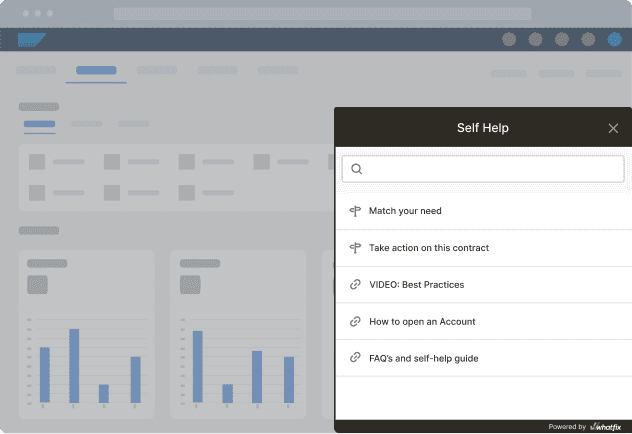
Give Agents Contextual Answers With Self Help
Whatfix Self Help brings SOPs, policies, knowledge base articles, process guides, troubleshooting resources, and support documentation into the agent’s workflow.
Agents can find answers while working inside the application, reducing dependency on managers, peers, side-by-side support, or separate documentation tabs.
This helps support teams reduce internal “how-to” questions and gives agents faster access to the information they need during customer interactions.
Reinforce Product, Policy, and Process Changes
Contact center teams deal with constant change, including product releases, pricing updates, policy changes, new escalation rules, compliance updates, and revised support workflows.
Whatfix helps teams communicate and reinforce these changes directly inside the tools agents use. Teams can update guidance, Self Help content, and training simulations as processes change, helping agents adapt faster and keeping enablement content aligned with current workflows.
This reduces the risk of outdated process knowledge showing up in live customer conversations.
Identify Agent Readiness and Workflow Gaps With Analytics
Whatfix Product Analytics, guidance analytics, and assessment analytics help leaders understand where agents struggle, which workflows create friction, and where additional coaching or in-app support is needed.
Support teams can identify workflow drop-offs, repeated help searches, incomplete assessments, low-performing scenarios, and cohort-level readiness gaps. These insights help teams improve roleplay scenarios, update training content, prioritize coaching, and focus enablement efforts on the workflows that have the greatest impact on support performance.
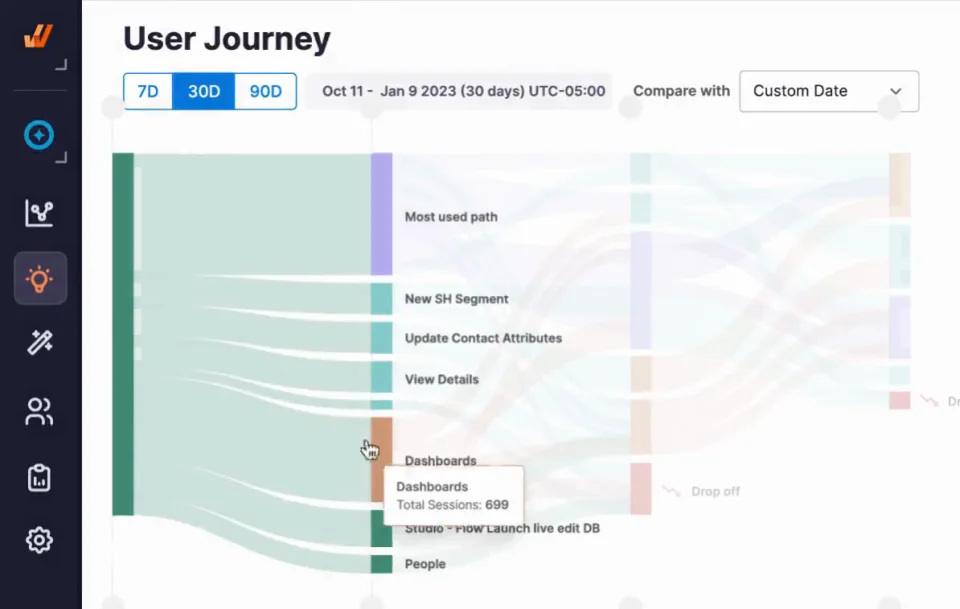
By connecting simulated practice, AI roleplay, assessments, in-flow support, Self Help, and analytics, Whatfix helps support teams improve the metrics that matter most in contact centers, including time-to-proficiency, first contact resolution, average handle time, escalation rate, QA consistency, CSAT, and agent confidence.
Request a demo to see how Whatfix helps support teams turn roleplay scenarios into measurable agent readiness.