












Sales coaching is a cornerstone of high-performing enterprise sales organizations. Reps and account executives rely on active coaching to master messaging, refine negotiation tactics, and internalize complex product knowledge, and adopt internal sales policies and processes. Studies show that 65% of the highest performing sales organizations spend 20% more time coaching sales reps than those with lower performance, with this extra investment influencing win rates and quota attainment.
Emerging AI technology has redefined every aspect of how sellers work, and the pace of transformation has outgrown traditional training models. L&D leaders and sales enablement teams now face a critical challenge: how to provide personalized, continuous coaching and sales training at an enterprise scale, in a time of constant change. T
AI coaching and roleplay models empower sales leaders with the ability to deliver adaptive, contextual training at scale, from creating personalized AI models for different exercises and scenarios to assessing seller readiness for real-world activities.
Instead of one-size-fits-all training sessions, AI sales coaching platforms create dynamic, interactive environments where reps can practise real-world scenarios (like objection handling, discovery calls, and product demos) with instant feedback and performance scoring. According to research from Gartner and Forrester, organizations using AI sales coaching tools see up to a 20–25% improvement in rep proficiency and a 15% faster ramp time for new hires.
The result is a new era of personalized, hands-on sales learning and development where every seller is empowered with a contextual, virtual coach that learns from their performance, adapts to their skill gaps, builds confidence, and helps them become master sellers.
In this article, we’ll further define AI sales coaching, explain how it’s transforming sales enablement and training, share common enterprise use cases for AI roleplay and coaching, and break down the best AI coaching platforms for sales teams – including why Whatfix Mirror is the best all-in-one AI coaching and performance support platform for enterprise sales organizations.
What Is AI Sales Coaching?
AI sales coaching utilizes generative AI to train, assess, and continuously develop sellers through contextual guidance and data-driven simulated roleplay. Instead of relying on manual coaching or static LMS or classroom learning methods, AI sales coaching platforms personalize experiences to each seller’s role and proficiency, generate tailored feedback based on user input, create adaptive learning paths for each seller, and assess seller readiness for real-world situations.
These systems combine speech recognition, natural language processing, and predictive analytics to evaluate how sales reps handle customer conversations, product pitches, and objections. They can transcribe and score calls, flag improvement areas, and even simulate realistic buyer interactions, allowing sellers to practice in a controlled, feedback-rich environment before engaging with real prospects.
AI sales coaching also involves analyzing conversations between sales reps and customers to provide real-time coaching. It often also includes immersive AI roleplaying opportunities so agents can practice soft skills and product knowledge recall before interacting with real customers.
For sales managers, AI coaching tools eliminate guesswork. They surface insights into rep behavior, skill gaps, and customer sentiment at scale, data that would otherwise take hours of manual review. With this level of intelligence, sales leaders can provide more strategic coaching by targeting specific seller weaknesses, as well as more accurately measure how sales coaching and training impact key sales outcomes (like pipeline performance and closed won deals).
How AI Coaching Empowers Sales Teams
When AI-powered coaching is embedded within your sales performance support ecosystem, the advantages extend far beyond traditional training. Studies show that sales teams that implement AI coaching program see win rates improve by 32%.
The following capabilities illustrate how AI sales coaching equips enterprise sales teams to develop their talent better with intelligent, personalized coaching for every seller:
- Accelerated seller onboarding: New sellers face increasingly complex tech stacks, must learn products, and adopt internal processes. AI coaching creates immersive hands-on onboarding experiences via simulated roleplay, guided walkthroughs, and adaptive feedback, accelerating time-to-proficiency for new sellers by over 50%.
- Consistent training at scale: Traditional coaching is highly dependent on the instructor or subject matter expert’s ability to effectively coach. AI ensures every rep receives high-quality, contextual coaching and ongoing reinforcement training. Automated feedback loops and real-time performance tracking enable continuous improvement without relying on one-on-one sessions.
- Contextual experiences for each seller: AI coaching tools analyze rep performance data, recorded calls, and CRM activity to personalize each learning path. A field rep handling enterprise renewals receives different coaching than an inside rep managing SMB leads.
- Higher seller confidence: AI simulation training and coaching build seller confidence and prepare them with the right skills before they handle live customer conversations. Practicing objection handling and negotiation in a safe environment builds lasting confidence that carries into quota-bearing calls.
- Higher win rate, shorter deal cycles: AI-coached reps master discovery, negotiation, and follow-up faster, leading to more conversions and reduced time between pipeline stages.
- Cleaner pipeline and CRM hygiene: Many AI sales coaching tools automate note-taking and other CRM tasks, making data entry more consistent for easier compliance monitoring and continuous QA.
Why AI Sales Coaching Needs CRM Context and Revenue Outcomes
AI sales coaching is most effective when it helps sellers prepare for specific conversations and execute the corresponding sales process.
In a 2026 trial of 114 employees, human coaches improved every primary outcome measured, while the AI coach did not outperform the no-coaching control group on a single primary measure. This contrasted with an earlier trial where AI performed comparably to human coaches while guiding users through a structured goal-attainment process.
Sales organizations should apply AI to bounded activities such as discovery practice, objection handling, negotiation rehearsal, call preparation, and the CRM workflows required to move opportunities forward.
Research supports three key principles for more effective AI coaching
- AI performs best within bounded tasks. Apply AI to defined sales scenarios, repeatable methodologies, CRM workflows, and specific behaviors that can be practiced and evaluated consistently.
Engagement metrics are not evidence of improvement. Completed sessions, practice frequency, and satisfaction scores measure activity. Sales leaders need evidence that sellers improve proficiency, CRM execution, pipeline progression, and revenue outcomes. - Human support still matters. Sales managers remain essential for deal strategy, buyer dynamics, complex negotiations, judgment calls, and individualized development.
How Whatfix Mirror addresses AI sales coaching challenges
| Challenge with modern AI coaching | The Whatfix Mirror approach |
|---|---|
| Sales coaching is too open-ended | Mirror grounds coaching in defined RevOps and sales roles, customer-facing scenarios, applications, and CRM workflows. |
| Roleplay is disconnected from actual CRM tasks | Sellers practice the conversation and complete the related CRM process in one simulated environment. |
| Training measures participation | Assessments validate whether learners can independently complete critical workflows. |
| Leaders cannot see where performance breaks | Analytics reveal errors, abandoned CRM workflows, completion rates, pass rates, and proficiency gaps. |
| AI is applied equally to every employee | Performance data helps leaders identify who is ready, who needs more practice, and who requires human coaching. |
| Training ends before production | Whatfix DAP and Product Analytics extend support into the flow of real work and measure actual user behavior and workflow friction. |
Use Cases for AI Sales Coaching
AI sales coaching empowers enterprise sales teams, across AEs, SDRs, CSMs, and sales managers, to build high-performing habits that help them move deals across every stage of the sales cycle. Below are the most common and impactful use cases.
1. Sales Conversations and Negotiation Mastery
AI sales coaching tools simulate real-world selling scenarios so reps can refine how they communicate, negotiate, and close. These immersive roleplay experiences strengthen verbal delivery and objection handling while providing personalized, adaptive feedback and CRM training. Here are AI coaching use cases for building better sales tactics and skills:
- Practicing objection handling for pricing, contract terms, and competitive differentiation.
- Coaching SDRs on discovery call questioning and qualification flow to book more meetings.
- Training AEs to tailor demos, handle multi-stakeholder objections, and guide deals from proposal to closed-won.
- Roleplaying renewal conversations and upsell pitches for CSMs managing existing accounts.
- Real-time, in-call coaching that surfaces prompts for the next best response or relevant case study to reference.
- AI-driven speech analysis to improve clarity, pacing, empathy, and confidence across all customer interactions.
2. Personalized Skill and Performance Development
AI sales coaching software personalizes every seller’s learning journey through continuous data analysis and behavioral insights, adapting coaching to each rep’s strengths, weaknesses, and role-specific requirements. Here are specific use cases:
- AI identifies skill gaps in call recordings, emails, and CRM activity, then recommends tailored practice modules.
- Adaptive learning paths for SDRs focusing on outreach cadence and messaging; for AEs, negotiation and closing techniques.
- Continuous scoring on metrics like talk-to-listen ratio, objection resolution rate, and next-step alignment.
- Intelligent feedback loops that adjust difficulty and topic relevance based on performance progression.
- Personalized coaching dashboards for managers to track readiness, performance trends, and improvement velocity.
3. Product, Process, and Compliance Enablement
Enterprise sales organizations often are tasked with selling complex products and services and face pressure from evolving compliance and regulatory rules. To add additional complexity, enterprise sales systems (like CRM and CPQs) are mission-critical to operations. Here are AI coaching use cases to help build seller knowledge of internal products and processes:
- Dynamic coaching walkthroughs and simulation training for new product launches, pricing updates, and feature walkthroughs.
- AI-powered knowledge reinforcement on complex SKUs, service plans, or renewal packages.
- Guided process training within CRMs and CPQ tools (e.g., Salesforce, HubSpot, Oracle) to ensure accurate data entry and approvals.
- Compliance training and scenario coaching for industries like insurance, healthcare, or finance that reinforce KYC, disclosure, and documentation protocols.
- Roleplay simulations that test adherence to sales process frameworks such as MEDDIC, BANT, or SPIN Selling.
4. Emotional Intelligence and Customer Interaction Quality
AI coaching goes beyond hard skills by improving empathy, tone, and conversational confidence. Emotional intelligence has become a critical differentiator for enterprise sales teams engaging buyers across digital and hybrid channels. Here are specific use cases:
- Sentiment analysis that evaluates customer reactions during calls and flags when empathy levels drop.
- AI roleplay scenarios where reps practise de-escalating frustrated customers or managing complex objections with empathy.
- Tone and body-language training (for video calls) that helps sellers convey credibility and trust.
- Coaching CSMs to handle post-implementation issues with empathy and solution-oriented communication.
- Guidance on adapting communication styles to different buyer personas—executive decision-makers, technical evaluators, or procurement leads.
5. Continuous Readiness and Coaching Optimization
AI transforms coaching into a continuous, measurable process rather than an occasional training event. It ensures every rep (from seller onboarding through advanced enterprise playbooks) stays ready, informed, and aligned with business goals. Use cases for AI coaching platforms for providing continuous feedback and support include:
- Automated proficiency scoring to evaluate each rep’s readiness for live customer engagement.
- Insights dashboards that aggregate performance data across regions, teams, and product lines.
- AI-generated recommendations for refresher courses or new scenario training based on CRM data and call outcomes.
- Predictive analytics that forecast performance trends and identify at-risk sellers early.
- Real-time alerts to managers when reps deviate from playbooks or compliance workflows during live calls.
- Improves overall proficiency to drive CRM adoption and value realization across the sales team.
6 Best AI Sales Coaching Platforms
As the need for AI support in sales rep training becomes increasingly apparent, new AI coaching software is constantly emerging, and existing solutions are incorporating AI features into their arsenals.
This is an emerging software category, but large players are already rising. Here are some of the leading AI Sales Coaching platforms on the market today:
1. Whatfix Mirror
- Review Rating: 4.6/5 (DAP)
- Get a Demo
Whatfix Mirror is an AI-powered simulation, coaching, and roleplay platform designed to modernize how enterprise sales organizations train and support their sales and revenue teams. It enables enablement leaders to replicate CRM, CPQ, and sales engagement environments without developer support, creating risk-free training sandboxes where sellers can practice real-world workflows and conversations before going live with prospects.
Mirror transforms traditional sales training into immersive, adaptive simulations that mirror day-to-day sales scenarios. With its AI coaching and roleplay capabilities, sales enablement leaders can create contextual experiences that adapt to each AE, SDR, or CSM’s needs, helping to build confidence and close their skill gaps. Sales teams can build extensive libraries of coaching sessions, roleplay exercises, and scenario-based lessons for things like:
- Prospecting and outreach: Practice cold calls, discovery conversations, and qualification sequences tailored to ICPs and verticals.
- Demo delivery and storytelling: Simulate live product demos with adaptive AI buyers that respond dynamically to rep input.
- Negotiation and objection handling: Train AEs to manage pricing pushback, procurement delays, or multi-stakeholder objections.
- Cross-sell, renewal, and upsell conversations: Coach CSMs on renewal positioning, retention techniques, and expansion opportunities.
- Internal process and compliance: Walk sales teams through CRM workflows, proposal templates, and deal desk approvals in a guided, interactive environment.
Mirror’s adaptive AI analyzes seller performance (such as evaluating communication, objection handling, process accuracy, and product knowledge fluency) and recommends targeted exercises to strengthen specific skills. It continuously measures proficiency and assesses readiness, helping sales managers track rep development and forecast team performance with better confidence.
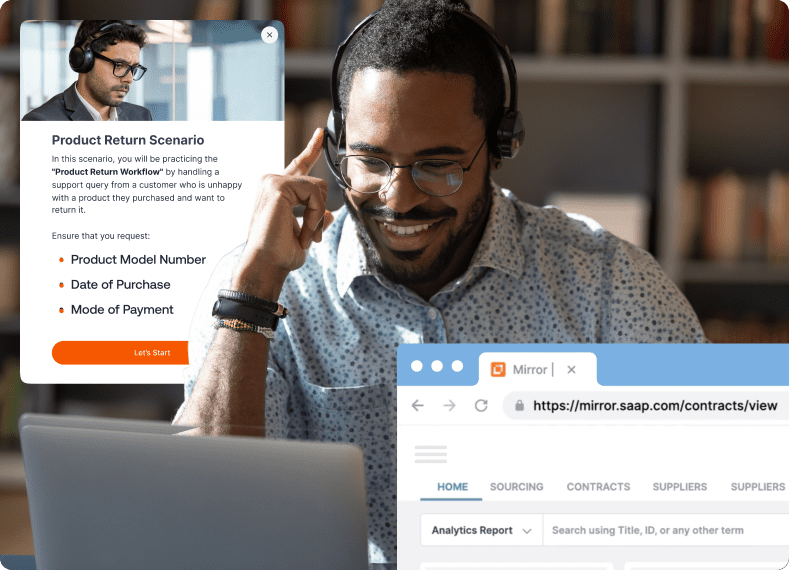
Whatfix Mirror extends beyond simulation by integrating seamlessly with the Whatfix Digital Adoption Platform (DAP). This enables sellers in the flow of work with contextual, in-app guidance and performance support directly overlaid on their live CRM or enterprise sales tools. Reps can reference step-by-step guidance for complex tasks (like logging lead activities, updating opportunity stages, or generating quotes) and access Self Help, an AI-powered knowledge hub that connects to your internal repositories, playbooks, and policies.
Key features of Whatfix Mirror for sales coaching and development include:
- Clone CRM and sales applications environments to create hands-on, simulation-based training experiences without engineering support.
- Provide contextual AI roleplay scenarios and coaches for every seller that adapts to input and personalizes based on seller needs across discovery, negotiation, demo delivery, and renewal conversations.
- Analyze rep performance, assess readiness, and recommend personalized next-step training.
- Use no-code authoring tools to build in-app guidance and walkthroughs within live CRM and sales tools for just-in-time guidance.
- Provide always-on performance support through Whatfix Self Help, which integrates knowledge repositories like sales playbooks, SOPs, and product documentation directly into the seller’s workflow. Sellers can utilize its AI conversational search to find relevant help documentation, summarize content, and prompt guided experiences.
This combination of simulated training, adaptive coaching, and in-the-flow guidance enables organizations to create a closed loop between training, practice, and real-world execution. Enterprise sales leaders can now scale personalized development, accelerate onboarding, and ensure that every seller—regardless of role, geography, or experience—operates at peak proficiency.
2. Zenarate
- Review Rating: 4.9/5
Zenarate is a popular AI simulation training software for training teams and contact center agents. It uses natural language processing and GenAI to deliver immersive training experiences that help sales reps learn new skills and improve sales approaches before engaging with real customers.
This powerful solution allows learners to engage in branching audio or text conversations with lifelike AI coaches. They receive coaching on opportunities for upselling, escalating issues, or conveying empathy. Zenarate monitors performance during every training instance and provides thorough assessments and insights.
Zenarate offers include realistic AI coaches, extensive language support, and gamification features that engage sales reps for better learning outcomes.
Key features of Zenarate include:
- Immersive AI simulation training
- Real-time feedback and personalized learning content
- Live agent assessments
- Analytics and reporting tools
3. SecondNature.ai
- Review Rating: 4.6/5
SecondNature is an AI coaching platform built for customer-facing teams. This solution makes it easy to provide and review role-playing training experiences to onboard new reps and train sales teams on new products. It’s also useful for coaching sales reps as they master different sales activities, from pitches to product demos to slide presentations.
With this solution, managers can automatically generate AI role-playing experiences based on just about any type of content – from recorded calls to sales playbooks to sales decks. Managers can also describe ideal training scenarios in simple text, and SecondNature’s AI assistant will take it from there.
Within training experiences, SecondNature offers lifelike, moving AI sales training avatars, AI roleplay templates that make roleplay activities feel real and engaging to learners. It also gamifies training with certifications and provides real-time feedback to keep employees motivated.
Key features of SecondNature include:
- AI screen action analysis
- Lifelike AI sales training avatars
- Sales certifications
- AI assistant for easy roleplay creation
4. Hyperbound
- Review Rating: 4.9/5
Hyperbound is an AI sales coaching platform that uses a generative LLM model to sift through sales call data and create AI roleplaying experiences based on winning behaviors and approaches. With Hyperbound, leaders can create AI customers with specific roles to match ones that reps are likely to interact with in real life.
Sales reps interact with AI customers in unique, role-based scenarios from simple sales conversations to customer objections. Hyperbound records calls and monitors each interaction to identify skill gaps and provide recommendations for practice areas to close them. Hyperbound’s post-interaction assessments include everything from total talk time to filler words used, so reps get a better understanding of how they are perceived by customers.
All in all, Hyperbound is an exciting AI coaching tool built to upskill sales reps, improve pipeline conversion, and boost change management efforts.
Key features of Hyperbound include:
- AI Roleplays
- AI Real Call Scoring
- AI meeting Assistant
- Analytics and Reporting
5. Gong
- Review Rating: 4.7/5
Gong is an AI operating system made for sales representatives and customer experience agents. It includes AI agents, forecasting tools, and sales engagement tools that improve sales operations from every angle.
Gong’s AI coaching tool, Gong Enable Essentials, uses conversation data to pinpoint and optimize positive behaviors and improve organization-wide sales performance. Gong’s Revenue Intelligence Platform analyzes customer interactions and delivers insights for a multi-faceted understanding of the state of sales across an organization.
Gong Engage uses data from billions of real customer interactions to produce insights and guidance to boost sales engagement for any business. AI recommendations surface during customer interactions to keep sales reps on top of their to-do lists and maintain positive customer relationships. It also allows reps to write follow-up emails quickly with generative AI composition tools.
Gong offers AI-powered account contact recommendations and provides sales team members in different roles, from reps to managers, with the most relevant insights to drive quality engagement and make more sales. Used by 50% of FORTUNE 10 companies, Gong is a strong choice for handling end-to-end sales operations.
Key features of Gong include:
- AI call reviewer
- AI-powered contact recommendations
- Initiative tracking
- Coaching inbox and metrics
6. Eubrics AI
- Review Rating: 4.8/5
Eubrics AI is an end-to-end AI sales coaching platform that combines AI roleplays, automated call analysis, and personalized coaching plans to improve rep performance and drive consistent revenue growth. It is built to support large, distributed revenue organizations with the control, security, and scalability needed for global deployment – including support for 20+ languages.
The platform enables managers to create custom AI buyer persona bots tailored to specific sales scenarios, ensuring realistic and relevant roleplay practice for every rep. After every roleplay or call, a personalized coaching plan is generated from identified skill gaps, with reps tracking progress on individual dashboards while managers monitor team readiness and performance trends.
Eubrics also provides deep call analysis across dimensions like BANT, objection handling, value articulation, and communication quality – giving sales managers objective, data-backed insights without hours of manual call review. An always-available AI Mentor supports reps with both general sales queries and call-specific coaching on demand. Key features of Eubrics AI include:
- AI roleplay with custom buyer personas
- Automated call QA and scoring
- Personalized post-call coaching plans
- Sales readiness indicator
- Always-on AI mentor for reps
Why Whatfix Is the Best AI Sales Coaching Platform for Enterprise Organizations
Enterprise sales organizations need a complete sales performance enablement platform that scales personalized, hands-on coaching across complex teams, systems, and geographies. Whatfix Mirror delivers exactly that.
With Mirror, sales enablement and training leaders can replicate real CRM and enterprise sales systems to create immersive, hands-on training experiences that mirror how reps actually sell, in a risk-free environment.
AI coaching and roleplay scenarios transform sales training from static experiences (like videos, LMS courses, or classroom training) and adapts to each rep’s responses in real time, creating dynamic experiences that build mastery through repetition and feedback. Whether it’s an SDR improving cold call execution, an AE refining negotiation strategy, or a CSM preparing for a renewal conversation, Mirror provides contextual, adaptive coaching that accelerates learning and improves performance outcomes.
Mirror is also powered by its broader Whatfix Digital Adoption Platform (DAP), which bridges training and live performance. Once sellers transition from the sandbox to real systems, Whatfix DAP continues supporting them with step-by-step in-app guidance, Smart Tips, and Self Help resources embedded directly within their CRM or any tool in theirs sales stack. This ensures sellers are continuously coached and supported as they work, reducing errors, driving faster deal cycles, and improving pipeline accuracy.
For sales leaders, enablement teams, and L&D professionals, Whatfix provides an end-to-end ecosystem for skill development, knowledge reinforcement, and performance visibility. It’s a single platform that connects AI roleplay, simulation training, in-app enablement, and behavioral analytics—delivering measurable gains in quota attainment, win rates, and seller productivity.
Ready to see how Whatfix Mirror can transform your sales coaching, training, and performance support programs? Request a demo now!