










As technology evolves, businesses must evolve in response, not merely if, but how they transform.
Digital transformation is an ongoing evolution of the business, experimenting with new technologies, rethinking processes, and embedding adaptability into the enterprise’s fabric. As MIT Sloan Management Review puts it, “Digital transformation is better thought of as continual adaptation to a constantly changing environment.”
This has never been more true than in the current moment, where enterprises must embrace new technologies and showcase resiliency through the disruption. This ongoing evolution empowers enterprises to enhance the end‑user experience, whether delivering on‑demand training, shifting workloads to the cloud, or embedding AI-powered workflows that make work smarter, faster, and more user-friendly.
Here is what the data says on the continued importance of digital transformation on modern enterprises:
- Digital economy growth is accelerating, expected to grow at 10–12% annually, outpacing global GDP, and further expanding the value created by digital channels.
- The digital economy’s core value is set to hit $16.5T by 2028, driven by continued investment in tech infrastructure and cloud services.
- Deloitte’s 2025 Chief Transformation Officer Study shows funding for transformation is now 2.5X higher than in 2022, with almost half of CTOs fully dedicated to transformation initiatives, spotlighting execution and measurement as key success drivers.
How Digital Transformation Drives Business Outcomes
When executed strategically, digital transformation delivers measurable gains across revenue, efficiency, and market positioning. It shifts technology from being a cost center to a core driver of enterprise competitiveness, enabling organizations to adapt faster, operate smarter, and capture new opportunities.
The impacts of transformation projects compound to unlock new business models and revenue streams, from immediate benefits to long-term value realization, including key outcomes like:
- Amplified revenue and growth: Generates sustained value through new revenue streams and expanded market reach.
- Improved user productivity: Streamlines operations and workflows with automation, AI, and data-driven insights.
- Enhanced customer experience: Delivers seamless, personalized, and responsive digital interactions.
- Maximized technology value realization: Strong adoption practices can translate investments into substantial financial returns.
- Improved business agility and resilience: Enables faster response to shifting markets and evolving customer expectations.
However, a Bain & Company study revealed that “only 8% of global companies have been able to achieve their targeted business outcomes from their investments in digital technology”, which begs the question, why? We’ll discuss why digital transformation projects fail later in this article, but let’s first define the key focus areas of digital transformation projects.
Key Areas of Digital Transformation
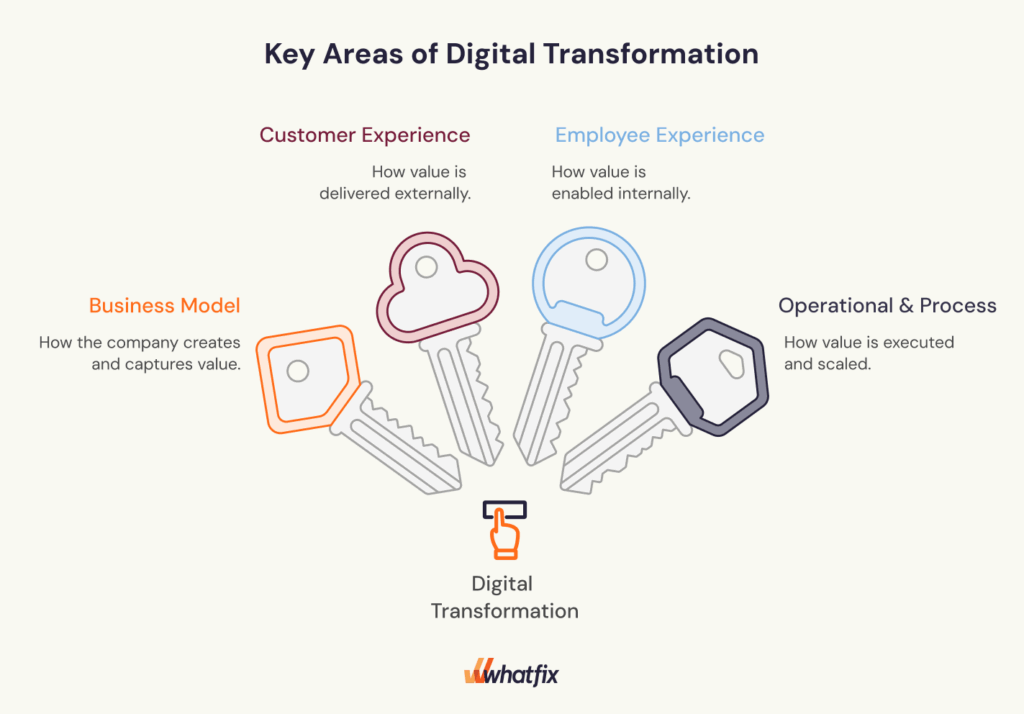
Digital transformation spans multiple domains, each addressing a different dimension of how an enterprise creates, delivers, and sustains value. While every organization’s journey is unique, most initiatives fall into one or more of these four broad areas:
- Business Model: How the company creates and captures value.
- Customer Experience: How value is delivered externally.
- Employee Experience: How value is enabled internally.
- Operational & Process: How value is executed and scaled.
These four domain areas cover the full value chain of enterprise digital transformation. High-impact digital strategies often combine multiple domains, ensuring that innovation in one area is reinforced by progress in others.
| Domain Area | Definition | Outcomes | Examples | Why It Matters |
| Business Model Transformation | Redesigning how the organization creates, delivers, and captures value by leveraging digital capabilities. | New revenue streams, diversified offerings, stronger competitive positioning. | Shifting from product sales to subscription models; launching a digital marketplace; monetizing data assets. | Reinventing the business model enables organizations to stay relevant, capture new markets, and maintain long-term growth. |
| Customer Experience Transformation | Using technology to enhance how customers discover, engage with, purchase from, and receive value from the organization. | Higher customer satisfaction, increased loyalty, improved retention and lifetime value. | Implementing AI-driven personalization; offering omnichannel self-service; launching mobile-first customer portals. | Customer experience is often the most important competitive differentiator and directly impacts revenue performance. |
| Employee Experience Transformation | Applying digital tools and workplace design to improve how employees collaborate, learn, and perform. | Increased productivity, higher engagement, reduced turnover, stronger talent retention. | Deploying a digital adoption platform; creating a unified collaboration hub; offering personalized learning paths. | A strong employee experience improves performance, accelerates adoption of new tools, and reduces change resistance. |
| Operational & Process Transformation | Reengineering core processes and systems to improve efficiency, agility, and resilience. | Faster cycle times, reduced operational costs, greater scalability, improved risk management. | Implementing intelligent automation in supply chain; migrating ERP systems to the cloud; embedding real-time analytics into operations. | Operational transformation enables the enterprise to deliver value faster and more cost-effectively while managing risk. |
Digital Transformation by Business Function
Digital transformation impacts every corner of the enterprise, but differ in terms of objectives, scope, and technologies by function. While some functions lead transformation strategy (like IT Operations), others experience transformation in how they deliver value (ie. Sales, HR, Customer Service).
Across all functions, transformation requires collaboration between leadership, technology owners, and operational teams to align initiatives with business priorities, customer needs, and measurable outcomes. The following table highlights how digital transformation plays out in key business functions, who typically drives it, common examples, and the measurable impact on performance.
| Functional Area | Transformation Owner | Examples | Key Outcomes | Why It Matters |
| Customer Service Transformation | Head of Customer Experience, VP of Support, Contact Center Director | AI chatbots, omnichannel support platforms, predictive service analytics | Faster response times, improved CSAT/NPS, reduced support costs | Customer service is often the most visible part of a brand, making its transformation critical for customer loyalty and retention. |
| Finance Transformation | CFO, Head of Finance Transformation | Cloud-based ERP, real-time financial reporting dashboards, robotic process automation (RPA) for AP/AR | Greater financial transparency, faster closes, reduced operational costs | Finance transformation enables real-time insights that drive strategic decision-making and safeguard profitability. |
| HR Transformation | CHRO, HR Transformation Lead | Unified HCM systems, AI-driven ATS systems, digital onboarding portals, HR analytics dashboards | Better talent retention, reduced time-to-hire, improved employee engagement | HR transformation ensures the organization attracts, develops, and retains the talent needed to execute its strategy. |
| L&D Transformation | CLO, Head of Learning & Development | Learning management systems (LMS), simulated sandbox training, personalized learning paths, learning in the flow of work with digital adoption platforms | Faster skill development, higher training completion rates, improved job performance | L&D transformation builds workforce capability and resilience, enabling employees to adapt to new tools and processes. |
| Procurement Transformation | CPO, Head of Procurement Transformation | e-Procurement platforms, supplier risk analytics, contract lifecycle management | Shorter procurement cycles, cost savings, reduced supplier risk | Procurement transformation strengthens supply chain resilience and optimizes spend across the organization. |
| Sales Transformation | CRO, VP of Sales Enablement | CRM transformation, AI-based sales forecasting, digital sales engagement tools | Higher conversion rates, improved pipeline accuracy, faster deal cycles | Sales transformation improves revenue predictability and equips teams with tools to close deals faster. |
| IT Transformation | CIO, Chief Digital Officer | Cloud migration, cybersecurity modernization, enterprise architecture overhaul | Stronger system resilience, lower IT costs, faster tech deployment cycles | IT transformation is the foundation that enables and sustains digital change across every other function. |
| Supply Chain Transformation | COO, Head of Operations Transformation | IoT-enabled asset tracking, automated inventory management, predictive maintenance | Improved delivery times, reduced downtime, lower logistics costs | Operations transformation drives efficiency, agility, and scalability across the enterprise’s core activities. |
| Marketing Transformation | CMO, Head of Marketing Technology | Marketing automation platforms, customer data platforms (CDPs), AI-driven content personalization | Higher campaign ROI, better lead quality, increased engagement | Marketing transformation allows for data-driven personalization and precision targeting to drive growth. |
| Product R&D Transformation | Chief Product Officer, Head of Innovation | Digital twin simulations, agile product lifecycle management, AI-driven design | Faster product launches, reduced development costs, higher product-market fit | Product transformation accelerates innovation cycles |
Digital Transformation by Industry
While certain industries have been early adopters of digital technologies, no sector is immune from disruption. Advances in automation, data analytics, artificial intelligence, and customer experience platforms are rewriting the rules of competition. For enterprises in vertical industries, digital transformation presents both opportunity and risk: the chance to unlock growth, efficiency, and innovation, with the threat of falling behind if modernization is put off.
Every industry’s transformation journey is shaped by its unique operating environment, regulatory requirements, customer expectations, and competitive pressures. In many cases, sub-industries face distinct challenges and opportunities that require tailored strategies.
| Industry | Transformation Drivers | Opportunities | Risks of Inaction |
| Banking | Customer demand for digital-first banking, rising competition from fintech, regulatory compliance requirements. | Real-time payments, AI-driven fraud detection, hyper-personalized financial products. | Loss of market share to digital-native challengers, higher compliance costs, customer attrition. |
| Credit Unions | Need to offer modern digital experiences while preserving member-first culture. | Cloud-based banking systems, member engagement platforms, mobile-first service. | Member dissatisfaction, inability to attract younger demographics. |
| Financial Services | Increasing demand for transparency, faster transactions, and integrated financial ecosystems. | Blockchain for settlement, advanced analytics for investment, robo-advisory platforms. | Operational inefficiencies, slower time-to-market for new services. |
| Aerospace & Defense | Need for advanced simulation, supply chain resilience, and cybersecurity. | Digital twin simulations, additive manufacturing, AI-driven maintenance scheduling. | Program delays, cost overruns, security vulnerabilities. |
| Agriculture | Food security demands, climate impact, and supply chain efficiency. | Precision agriculture, drone crop monitoring, AI yield optimization. | Lower yields, higher costs, inability to meet sustainability targets. |
| Automotive | Electrification, connected vehicle technology, and changing mobility models. | Predictive maintenance, connected car platforms, mobility-as-a-service offerings. | Falling behind in EV adoption, loss of brand relevance to tech-first competitors. |
| AEC | Rising project complexity, sustainability mandates, and skilled labor shortages. | Building Information Modeling (BIM), digital twins, connected job sites. | Project delays, cost overruns, reduced competitiveness in bids. |
| Consumer Packaged Goods (CPG) | Demand for faster product innovation, sustainable packaging, and omnichannel retail partnerships. | AI demand forecasting, smart packaging, direct-to-consumer e-commerce. | Stockouts, excess inventory, declining brand loyalty. |
| Construction | Cost management pressures and safety requirements. | AI-powered scheduling, AR/VR for site visualization, IoT safety monitoring. | Increased workplace incidents, profit margin erosion. |
| Engineering | Need for design efficiency and collaborative innovation. | Cloud-based CAD, simulation modeling, generative design. | Slower product development cycles, reduced innovation capacity. |
| Higher Education | Competition from online providers, changing student demographics. | Micro-credentialing, AI student support bots, virtual labs. | Lower enrollment rates, loss of tuition revenue. |
| K-12 Education | Digital literacy goals and equity in access. | Personalized learning apps, parent engagement portals, remote learning capabilities. | Widening achievement gaps, reduced student engagement. |
| Healthcare | Patient expectations for access, rising costs, regulatory shifts. | Telehealth, EHR systems, AI diagnostics, integrated patient portals. | Patient dissatisfaction, operational inefficiencies, regulatory penalties. |
| Hospitality | Demand for seamless guest experiences and operational efficiency. | Mobile check-in, AI-powered personalization, dynamic pricing engines. | Loss of guest loyalty, occupancy rate decline. |
| Insurance | Pressure to modernize claims, underwriting, and customer engagement. | AI-driven claims processing systems, telematics, predictive risk modeling. | Higher claims costs, policyholder churn. |
| Legal and Law Firms | Client demand for transparency, efficiency, and predictable costs. | Document automation, e-discovery tools, client collaboration platforms. | Reduced billable hours, loss of clients to tech-enabled firms. |
| Life Sciences | Need for faster drug development and regulatory compliance. | Clinical trial digitization, AI drug discovery, connected medical devices. | Longer time-to-market, higher R&D costs, compliance risks. |
| Pharma | Competitive R&D timelines, rising regulatory oversight. | Digital lab automation, real-world evidence platforms, regulatory management systems, quality management systems, AI formulation. | Loss of competitive advantage, regulatory delays. |
| Logistics & Transportation | E-commerce growth, supply chain volatility, cost pressures. | Route optimization, IoT asset tracking, autonomous delivery. | Missed delivery SLAs, increased logistics costs. |
| Manufacturing | Demand for efficiency, customization, and resilience. | Industry 4.0 technologies, predictive maintenance, smart factories. | Production downtime, waste, reduced competitiveness. |
| Media | Shifts to streaming, on-demand, and personalized content. | AI-driven content recommendations, subscription optimization, immersive media. | Subscriber churn, advertising revenue loss. |
| Nonprofits | Donor engagement and operational efficiency needs. | Digital fundraising platforms, donor CRM, impact measurement dashboards. | Declining donations, reduced program impact. |
| Oil & Gas | Price volatility, environmental regulation, operational risk. | Predictive maintenance, IoT monitoring, digital twin modeling. | Unplanned downtime, compliance fines, reputational damage. |
| Public Sector | Rising citizen expectations, budget constraints, and compliance mandates. | E-government portals, process automation, open data platforms. | Public dissatisfaction, inefficiency, compliance breaches. |
| Professional Services | Client demand for faster, more data-driven insights. | Workflow automation, AI research tools, client collaboration hubs. | Loss of high-value clients to more tech-enabled competitors. |
| Professional Staffing Services | Need for speed and precision in matching candidates to roles. | AI-driven talent matching, automated onboarding, recruitment analytics. | Slower placements, reduced fill rates. |
| Property Management | Demand for tenant experience and operational efficiency. | Smart building systems, digital lease management, maintenance apps. | Tenant turnover, operational cost increases. |
| Retail | Shift to e-commerce and omnichannel expectations. | Unified commerce platforms, AI merchandising, automated fulfillment. | Loss of market share to digital-first competitors. |
| Retail Fashion | Fast-changing trends, supply chain agility needs. | AI trend forecasting, 3D product modeling, virtual try-on. | Overstocking, markdown losses, reduced brand relevance. |
| Real Estate | Need for virtual engagement and operational agility. | Virtual property tours, AI valuation models, transaction automation. | Slower sales cycles, reduced buyer interest. |
| Telecommunications | 5G rollout, demand for seamless connectivity. | Network virtualization, AI network optimization, customer self-service portals. | Network congestion, customer churn. |
Key Technologies Driving Digital Transformation
Digital transformation is powered by a set of foundational technologies that enable enterprises to operate smarter, faster, and more securely. While the specific tech stack varies by industry and business model, these core categories are driving measurable gains in efficiency, innovation, and competitive differentiation.
Some technologies, like AI and advanced analytics, are constantly evolving and expanding their potential impact. Others, such as enterprise cloud systems and IoT, provide the infrastructure and connectivity needed to sustain large-scale transformation. Together, these technologies form the backbone of modern digital enterprises.
Let’s explore each key technology disruptor below:
| Technology | Definition | Enterprise Outcomes | Examples |
| Artificial Intelligence (AI) | Machine learning and AI algorithms that enable automation, prediction, and intelligent decision-making. | Process and task automation, personalized customer experiences, predictive maintenance, fraud detection. | AI chatbots, recommendation engines, predictive analytics models, adaptive guidance, AI-powered task completion. |
| Enterprise Cloud Systems | Integrated, cloud-based business platforms for managing core functions (i.e., CRM, ERP, HCM, EHR, PLM). | Improved scalability, reduced IT costs, unified data visibility, faster deployments. | Salesforce CRM, SAP S/4HANA, Workday HCM, Epic EHR, Siemens PLM. |
| Data Management & Analytics | Tools and practices for collecting, integrating, enriching, storing, and analyzing enterprise data. | Better decision-making, trend forecasting, compliance reporting, competitive insights. | Snowflake data warehouse, Tableau BI, Google BigQuery, predictive analytics platforms. |
| Robotic Process Automation (RPA) | Software bots that automate structured, repetitive business processes. | Reduced manual effort, fewer errors, faster processing times, improved compliance. | UiPath, Blue Prism, Automation Anywhere. |
| Simulations & Immersive Technologies | Virtual models and environments for design, training, and operational testing. | Reduced prototyping costs, safer training environments, improved process optimization. | Digital twins, AR/VR, simulation training and planning tools. |
| Internet of Things (IoT) & Connected Devices | Networked sensors and devices that collect and transmit real-time operational data. | Real-time monitoring, predictive maintenance, supply chain optimization, safety improvements. | Industrial IoT sensors, connected medical devices, fleet telematics. |
| Cybersecurity & Zero Trust | Security frameworks and tools designed to protect systems, data, and identities in a distributed environment. | Reduced risk of breaches, improved compliance, stronger resilience to cyberattacks. | Zero Trust Network Access (ZTNA) tools, multi-factor authentication, SIEM platforms. |
| Low-Code / No-Code Development | Platforms enabling non-technical users to create apps and automate workflows. | Faster time-to-market for solutions, reduced development backlog, greater agility. | Microsoft Power Apps, OutSystems, Appian. |
Why Digital Transformation Projects Fail
Digital transformation projects face high hurdles: research shows that 70%+ of these initiatives fail to achieve their intended outcomes, and other reports claim it’s closer to 95% when accounting for realizing full value from digital investments.
Failure rarely stems from a single factor. Instead, it’s typically the cumulative effect of people, planning, technology, and measurement challenges. Addressing each of these areas holistically is critical to sustaining momentum and realizing long-term ROI.
| Category | Failure Pattern | What Research Says | Key Risks |
| People | Underestimating the human aspects, like change resistance, skill gaps, and productivity loss. | Projects with excellent change management are 6× more likely to meet objectives than those with poor change management (Prosci). | Slow user adoption, reversion to legacy processes, increased support burden. |
| Planning | Launching without clear objectives, realistic timelines, or stakeholder alignment. | 54% of executives cite unclear objectives and poor alignment as the primary cause of underperformance in a 2024 Deloitte report. | Scope drift, unmet requirements, low user engagement. |
| Technology | Deploying solutions that don’t scale, integrate, or align with strategic needs. | 44% of leaders report integration challenges and data quality issues as top obstacles (Gartner). | Data silos, technical debt, low ROI from new systems. |
| Measurement | Tracking activity instead of outcomes, making success impossible to prove or improve. | Forrester reports only 27% of enterprises actively track core business outcome metrics to measure the success of digital transformation projects.. | Misleading progress reports, inability to justify investment, missed optimization opportunities. |
Let’s explore each key challenge domain areas facing digital leaders and product owners, starting with the people-related aspects.
People
People are the cornerstone of transformation success. Even the most advanced technologies will fail to deliver results if employees resist adoption, lack confidence, or are not given the right tools and training to succeed.
Research from Prosci shows that projects with excellent change management are 6× more likely to meet objectives than those with poor change management. Conversely, projects that underestimate the human side of change often face slow adoption, reversion to legacy processes, and lower productivity during transition periods.
Here are key people-related friction points caused by digital transformation projects:
- Lack of user confidence or hands-on experiences: New systems mean new interfaces, workflows, and rules. Without sufficient exposure through end-user training and sandbox environments for pre-launch testing and training, users feel uncertain and avoid using the system. In volatile industries or seasonal workforces, this risk is magnified.
- Increased burden on support teams: When change is poorly supported at the user level, IT, application owners, and help desk teams are flooded with issues (ranging from password resets to critical workflow breakdowns), leaving little time for strategic initiatives.
- Reduced user productivity during transition: Employees spend more time in onboarding sessions and less time completing their core work. SMEs are diverted from high-value activities to provide peer support.
- Resistance to change & reliance on legacy systems: Without understanding the “why” behind change, employees often revert to familiar tools and processes, undermining adoption and creating process inconsistencies.
- User errors from workflow friction: Ambiguity in workflows results in mistakes, dirty data, and compliance risks. These errors accumulate into technical debt that diminishes the value of the new system.
Planning
A lack of strategic clarity and structured execution is a primary driver of failure. Deloitte’s 2024 research shows that 54% of executives believe unclear objectives and poor alignment are the main reasons transformation efforts underdeliver. Poor planning manifests in unrealistic timelines, insufficient stakeholder engagement, and a lack of iterative feedback loops, all of which make the change harder for teams to absorb and sustain.
Here are key communication and planning-related friction points caused by digital transformation projects:
- Failure to communicate the “why”: If leadership cannot clearly connect transformation to business outcomes and personal benefits, change feels arbitrary, fueling employee resistance.
- Overly aggressive timelines: Rushed go-lives reduce time for adequate testing, refinement, and user training, leading to more post-launch issues.
- Insufficient stakeholder involvement during planning: Failure to involve the right stakeholders early means missing critical business requirements and encountering resistance during rollout.
- Ignoring user feedback in pre-launch testing: By skipping or discounting pilot program feedback, organizations allow preventable adoption barriers to persist into launch.
Technology
Technology decisions can either accelerate transformation or introduce costly user friction. Gartner notes that 44% of transformation leaders cite integration challenges and data quality issues as top obstacles. Poorly chosen or implemented solutions, especially those that don’t scale, integrate, or align with business needs, can stall transformation momentum and erode user trust.
- Integration gaps between systems: Disconnected tools require manual workarounds, introducing inefficiency and data silos.
- Poor data migration & dirty legacy data: Migrating outdated or incorrect data carries errors forward, undermining analytics, decision-making, and compliance.
- Shiny object syndrome: Investing in hyped technologies without strategic fit results in low adoption and wasted budget.
- Over-customization of tools: Heavily customized solutions are fragile, costly to maintain, and difficult to update when business needs change.
- Lack of scalability in infrastructure: When systems cannot grow with user demand or data volume, costly upgrades or replacements become unavoidable.
Measurement
Without clear, relevant metrics, organizations cannot determine whether their transformation is succeeding or where to pivot. Forrester research finds that only 27% of enterprises use business outcome metrics to measure transformation success, with most relying on activity or usage metrics that fail to capture ROI.
- No defined transformation success metrics: Without agreed KPIs, progress and ROI are subjective and inconsistent across teams.
- Failure to track software usage: Lack of monitoring masks underutilization and prevents timely intervention. It also forces product owners to go blind in making workflow design decisions, and can’t identify which users and departments are under-adopting.
- Lack of baseline performance data: Without a pre-transformation benchmark, improvements cannot be proven.
- Not connecting metrics to business outcomes: Focusing on vanity metrics (i.e., login counts) rather than outcomes like cost savings, cycle time reduction, or revenue impact creates a false sense of success.
How to Accelerate Digital Transformation
Digital transformation often falls prey to the simple idea that its most important aspect is deployment and rollout. However, value realizations happen when organizations can achieve measurable business outcomes quickly, and can sustain those results over time. Yet, too many initiatives stall because organizations underestimate the complexity of user adoption, underestimate integration challenges, or fail to track real business impact.
Acceleration requires a deliberate strategy that addresses both the technical and human sides of transformation. This means aligning IT roadmaps with business priorities, enabling end users through personalized in-the-flow-of-work training, embedded end-user support and in-app guidance, tracking adoption and usage in real time, and building feedback loops for continuous optimization.
This is where Whatfix provides a competitive advantage for digital leaders and product owners. By combining its three products, Whatfix Digital Adoption Platform (DAP), Whatfix Mirror for sandbox training, and Whatfix Product Analytics, organizations can:
- Reduce the time it takes for employees to adopt and become proficient in new applications, accelerating value, achieving outcomes, and unlocking user productivity.
- Centralize user acceptance testing (UAT) and rollout readiness with sandbox application environments and hands-on user training.
- Enable contextual, self-service support that reduces help desk burden and provides just-in-time help when and where users need it.
- Track and optimize adoption with data-driven insights that identify areas of user friction, offer suggestions for streamlining workflows, and reduce cycle times.
- Continuously refine processes for higher ROI.
Below are the core strategies enterprise leaders and product owners can use to accelerate transformation and ensure value realization, each with a direct role for Whatfix in eliminating friction.
| Strategy | Impact for Transformation | Whatfix’s Role |
| Role-Based Learning | Accelerates proficiency and reduces training overhead | Contextual, role-specific in-app guidance and embedded workflow support. |
| Sandbox Training | Builds confidence and minimizes post-launch issues | Mirror environment for safe user testing and training in a risk-free simulated environment. |
| Contextual Engagement | Boosts usage and cuts content creation costs | Interactive walkthroughs, tooltips, field validation, pop-ups, and task lists that provide just-in-time help and contextual guidance. |
| Self-Service Support | Reduces help desk burden and support costs | In-app searchable via Self Help that integrates within your organization’s knowledge repositories and SOPs. |
| Data-Driven Optimization | Improves workflows and ROI | Track, benchmark, and analyze user engagement, workflows, and tasks to spot friction points, design optimized workflows, and take a continuous approach to operational excellence. |
| Feedback Loops | Enables agile, user-informed evolution | In-app surveys and analytics-driven iteration. |
1. Enable Role-Based, In-the-Flow Learning
Most transformation projects falter because training is treated as a one-time event rather than a continuous, role-specific enablement process. Employees need learning embedded in the applications they use every day — not static PDFs or lengthy LMS courses disconnected from the work context.
With Whatfix, organizations embed personalized, role-based training inside the workflow. Smart Tips, task lists, and pop-ups appear at the exact moment of need, guiding users through processes in real time. This drastically reduces the learning curve and ensures employees can apply training immediately.
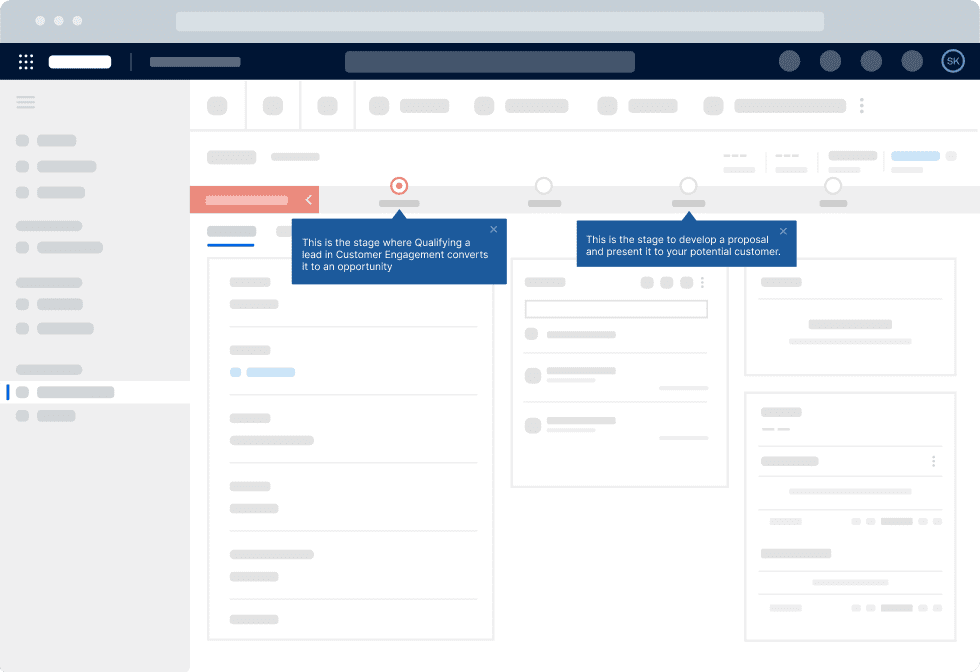
It not only accelerates proficiency but also allows L&D and IT teams to continuously update training content without disrupting work — a critical factor in keeping pace with evolving applications.
- With Whatfix, Experian embedded contextual Salesforce guidance, resulting in a 72% productivity boost, 55% fewer support queries, and a 46% reduction in training content creation costs.
- Shield HealthCare applied the same principle for their Core2 system, enabling self-paced, in-app learning that reduced post-training knowledge loss, cut reliance on SMEs, and sped up adoption timelines.
- REG cut time-to-proficiency for its ERP and CRM systems by 50%, streamlining its new hire onboarding and accelerating their ramp up time.
2. Validate Workflows and Provide Hands-On Training within a Risk-Free Sandbox
User acceptance testing (UAT) is too often treated as a checkbox exercise, but in reality, it’s the last and best opportunity to ensure workflows work as intended before the business is impacted. Incomplete or rushed UAT means bugs, poor user experience, and higher support demand post-launch.
Whatfix Mirror enables a safer, more effective approach by creating a replica of the live environment where employees can practice real workflows without risk. This gives testers and end users confidence, uncovers usability gaps, and allows teams to capture immediate feedback in context.
The impact is twofold:
- Before launch — organizations validate the workflows against real user behavior, ensuring the go-live version is free from bottlenecks or confusing UI flows.
- After launch — new hires and existing staff can use Mirror to practice infrequent or complex processes (i.e., compliance workflows, high-stakes transactions) without risking data integrity.
This level of readiness means value can start flowing from day one rather than weeks or months into deployment.
3. Drive Adoption with Contextual In-App Engagement
Even the most advanced systems fail without high adoption. Traditional onboarding emails or training videos quickly go stale, and generic support content doesn’t address the unique needs of different user personas.
Whatfix solves this by embedding engagement directly into the application with contextual, process-specific walkthroughs, Smart Tips, and pop-up messages. This means every user gets exactly the guidance they need at the exact step they need it — no searching, no delays.

For enterprise leaders, this translates to shorter time-to-value and higher ROI on tech investments because adoption becomes a natural part of daily operations.
- Microsoft drove adoption of Copilot within its sales organization by 600% with in-app guidance and embedded help, powered by Whatfix.
- Marketboomer, a hospitality procurement software provider, implemented Whatfix to guide customers through onboarding and ongoing adoption inside their PurchasePlus platform. The results were dramatic: over 3,000 fewer support tickets, 280 hours of training content eliminated, and $71,000 saved annually in onboarding costs, with a 98% self-help query success rate.
4. Deliver Self-Service Support Embedded Within Key Workflows
Help desks often see ticket volumes spike during and after transformation rollouts, pulling resources away from high-priority projects. Employees lose productivity while waiting for answers, and IT teams burn time solving repeat issues.
With Whatfix Self Help, support is embedded right inside the application interface. Employees can search for and access contextual answers, knowledge base articles, process documentation, and guided flows without leaving their workflow.

This model frees IT and support teams to focus on strategic initiatives while empowering end users to resolve their own issues in seconds.
- Sentry Insurance implemented Whatfix across eight critical applications, giving employees instant, in-app access to the information they needed. This eliminated onboarding friction, significantly reduced support volumes, and supported a culture of agile learning — saving the company nearly $1M in training and support costs.
- Old Mutual achieved its digital transformation outcomes by enabling its financial advisors with embedded workflow support, self-service, and in-app guidance, reducing IT support calls by 33%.
5. Track, Measure, Optimize, and Iterate Workflows with Product Analytics
Without visibility into how users are actually engaging with applications, leaders can’t identify adoption gaps, bottlenecks, or underutilized features. Guesswork leads to wasted training resources, inefficient processes, and missed ROI targets.
Whatfix Product Analytics provides end-to-end insight into adoption, including feature usage, flow completion rates, and drop-off points. Leaders can segment by user role, location, or department to understand where adoption is strong and where it’s stalling.
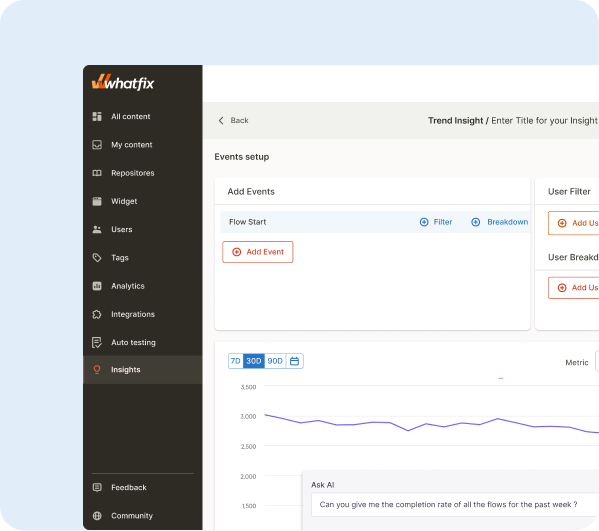
The analytics also allow teams to deploy and A/B test updated guidance instantly, ensuring processes remain optimized as business needs and technology evolve.
- For example, Grifols, a global healthcare company, used Whatfix analytics to pinpoint friction in Salesforce workflows. By deploying targeted guided flows, they reduced support calls, saved over 400 training hours, and achieved a 3× return on their Salesforce investment.
- Vizient used Whatfix to streamline its contracting workflows, eliminating 93% of end-user errors and accleerating contract execution by 19 days.
6. Provide Continuous Feedback & Communication Loops
Transformation is iterative. Success depends on regularly capturing feedback, measuring sentiment, and communicating changes effectively to users. Without structured feedback loops, problems go undetected until they become costly.
Whatfix enables in-app surveys, NPS prompts, and feedback forms that capture user input without disrupting workflows. This allows leaders to make data-driven adjustments and communicate process or feature changes in real time.

By combining this feedback with usage analytics, organizations can ensure training and support evolve alongside user needs, driving sustained adoption and continuous value realization.
Digital Transformation Clicks With Whatfix
Digital transformation is the foundation for how modern enterprises compete, operate, and deliver value. The organizations that win aren’t just investing in technology; they’re building the operational muscle to adapt faster, execute smarter, and continuously optimize every digital touchpoint.
Whatfix empowers leaders with the technology to make that happen. From accelerating user adoption with in-app, role-specific guidance, to tracking and optimizing application usage with real-time analytics, to enabling risk-free practice environments that build confidence before go-live, Whatfix empowers enterprises to close the gap between investment and impact.
With Whatfix, transformation is not a one-time rollout — it’s an ongoing cycle of enablement, measurement, and improvement. You can launch with speed, adapt with agility, and scale with confidence, knowing your people, processes, and platforms are fully aligned to deliver on business outcomes.
If you’re ready to shorten time-to-value, maximize ROI, and achieve digital excellence, it’s time to put Whatfix at the center of your transformation strategy. Let’s build the future of work, together.